


























Views
Downloads




Addition with Regrouping Quiz — Essential Grade 3 Math
Paste this activity's link or code into your existing LMS (Google Classroom, Canvas, Teams, Schoology, Moodle, etc.).
Students can open and work on the activity right away, with no student login required.
You'll still be able to track student progress and results from your teacher account.
This comprehensive Grade 3 addition and geometry quiz provides a complete assessment of multi-digit computation and spatial reasoning. Students solve multi-digit addition problems with regrouping, identify 2D and 3D shapes, and apply their skills to real-world word problems. It is designed to measure fluency and conceptual understanding in a single printable packet.
At a Glance
- Grade: Grade 3 · Subject: Math
- Standard:
CCSS.MATH.CONTENT.3.NBT.A.2— Fluently add and subtract within 1000 using strategies based on place value- Skill Focus: Addition with Regrouping & Geometry
- Format: 4 pages · 27 problems · Answer key included · PDF
- Best For: Formative assessment or end-of-unit mixed review
- Time: 30–45 minutes
What's Inside
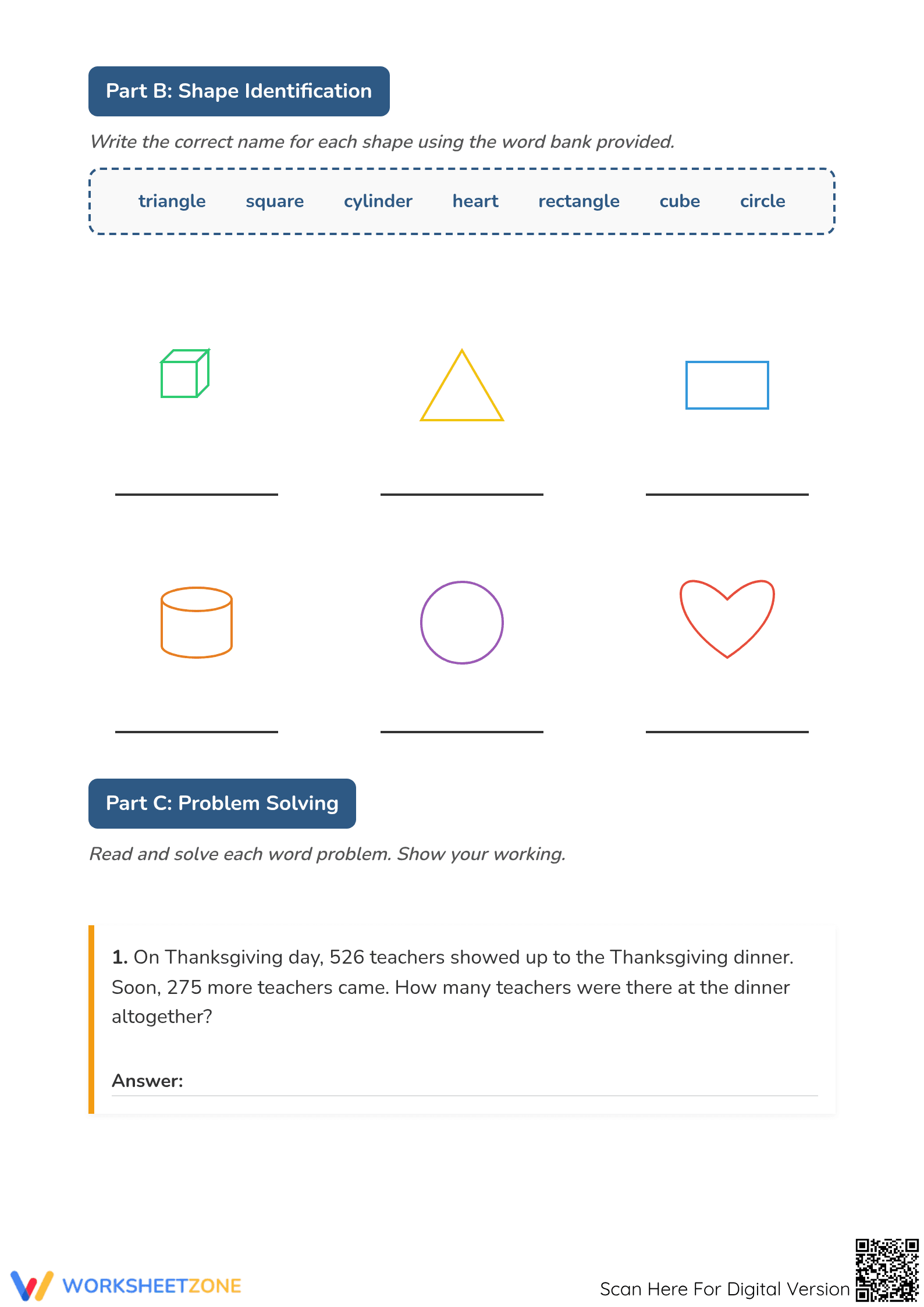
The four-page packet contains four distinct sections: a computation drill with vertical addition, a shape identification word bank featuring plane and solid figures, three complex word problems requiring multi-step thinking, and a mixed review section with missing-addend puzzles. A full answer key is provided to ensure quick and accurate grading.
Zero-Prep Workflow
- Print: Generate copies of the 4-page PDF in less than 30 seconds for your entire class.
- Distribute: Hand out the quiz as a quiet individual assessment or a collaborative review session.
- Review: Use the included answer key to grade each student’s work in under 60 seconds per packet.
This workflow ensures that teachers spend zero time on preparation, making it an ideal choice for emergency sub plans or last-minute formative checks. Total teacher setup time is less than two minutes.
Standards Alignment
CCSS.MATH.CONTENT.3.NBT.A.2 requires students to fluently add and subtract within 1000 using strategies and algorithms based on place value, properties of operations, and the relationship between addition and subtraction. This worksheet also touches on CCSS.MATH.CONTENT.2.G.A.1 through the identification of cubes, cylinders, and triangles. Both standard codes can be copied directly into lesson plans, IEP goals, or district curriculum mapping tools.
How to Use It
Administer the quiz after completing a unit on regrouping to identify students who need targeted intervention in place value or carrying. Alternatively, place the pages in a math center rotation folder for independent practice, allowing students to check their own work using a provided answer station. Expected completion time for most third-grade students is 40 minutes.
Who It's For
This resource is ideal for Grade 3 students mastering addition fluency, but it also serves as an excellent challenge for Grade 2 learners or a scaffolded review for Grade 4. It naturally pairs with base-ten blocks or geometric manipulatives for students requiring hands-on support in the classroom.
The development of computational fluency in multi-digit addition, specifically CCSS.MATH.CONTENT.3.NBT.A.2, is a cornerstone of the elementary mathematics curriculum, serving as the bridge to multiplication and higher-order algebraic thinking. According to the RAND AIRS 2024 report, students who demonstrate proficiency in regrouping and place-value strategies by the end of third grade are significantly more likely to achieve success in middle school mathematics. This worksheet facilitates this mastery by combining vertical computation with context-rich word problems, ensuring that students can apply mathematical procedures in diverse scenarios. Furthermore, the inclusion of geometry and shape recognition reinforces spatial reasoning, a skill that Fisher & Frey (2014) highlight as critical for overall cognitive development. By providing a structured and standards-aligned assessment tool, this resource allows educators to collect high-quality data on student progress without the burden of extensive preparation or complex grading rubrics.


