


























Views
Downloads




Essential Grade 1 Addition Worksheet | Sums to 20
Paste this activity's link or code into your existing LMS (Google Classroom, Canvas, Teams, Schoology, Moodle, etc.).
Students can open and work on the activity right away, with no student login required.
You'll still be able to track student progress and results from your teacher account.
This comprehensive addition worksheet provides Grade 1 students with focused practice to build fluency with sums up to 20. Through a sequence of vertical problems, horizontal equations, and simple word problems, learners will strengthen their foundational arithmetic skills. The packet is designed for independent practice, homework, or small-group reinforcement.
At a Glance
- Grade: 1 · Subject: Math
- Standard:
CCSS.MATH.CONTENT.1.OA.C.6— Add and subtract within 20 with fluency.- Skill Focus: Addition fluency, story problems
- Format: 5 pages, 42 problems, answer key, PDF
- Best For: Independent practice, fluency drills, homework
- Time: 20–30 minutes
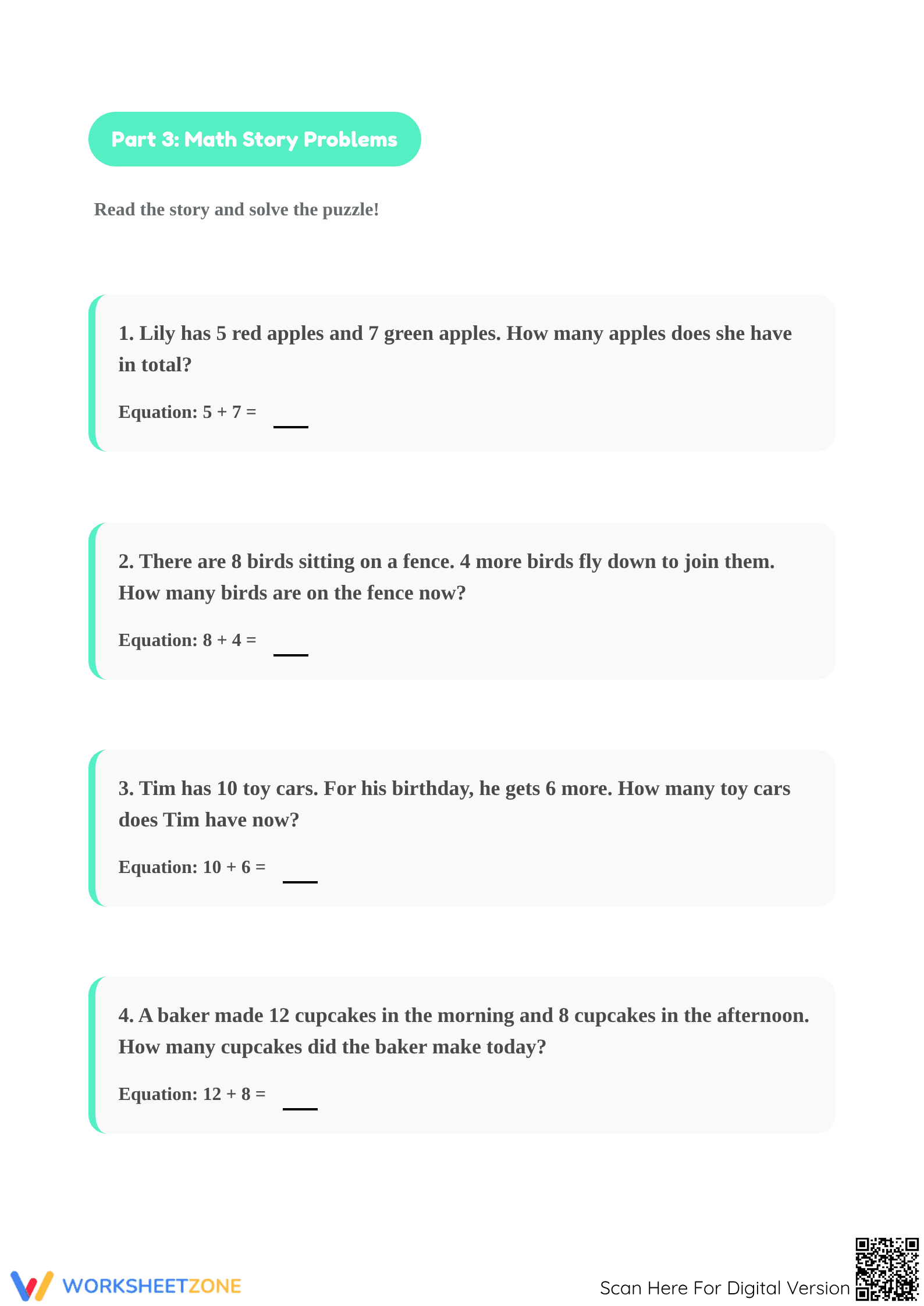
This five-page PDF download includes four distinct sections that build in complexity. It begins with 20 vertical addition problems (sums to 12), followed by 12 horizontal equations (sums to 20). The third section introduces 4 basic story problems, and the final part challenges students with 6 missing addend puzzles. A complete five-page answer key is provided for easy grading.
- Guided Practice: The worksheet opens with 20 vertical addition problems with sums to 12. This familiar format lets students warm up and build confidence.
- Supported Practice: The next sections increase the challenge. "Horizontal Addition" changes the orientation, while "Math Story Problems" asks students to apply addition in simple contexts.
- Independent Practice: The final "Missing Numbers" part introduces early algebraic thinking by asking students to find an unknown addend, serving as a solid independent challenge.
This worksheet is aligned to Common Core standard CCSS.MATH.CONTENT.1.OA.C.6, which requires students to "add and subtract within 20, demonstrating fluency." The exercises directly support this goal. It also supports 1.OA.A.1 (word problems) and 1.OA.D.8 (missing addends). The standard codes can be copied directly into lesson plans or curriculum maps.
Use this resource as independent practice after a lesson on addition strategies. For a quick assessment, observe students as they work through the story problems to see which strategies they employ. This informs your next instructional steps. It can also be assigned as homework, with an expected completion time of 20 to 30 minutes for the full packet.
This is designed for first-grade students developing addition fluency. It's also suitable for advanced kindergarteners or second-graders needing review. For students needing support, provide a number line or manipulatives. The worksheet pairs well with a classroom anchor chart displaying addition strategies like "counting on."
This worksheet provides practice aligned with CCSS.MATH.CONTENT.1.OA.C.6, focusing on addition fluency within 20. Developing procedural fluency is critical in early elementary mathematics, as it frees up working memory to tackle more complex tasks like multi-step word problems. Research consistently shows that a lack of fluency in basic facts is a significant impediment to higher-level math achievement. The National Assessment of Educational Progress (NAEP) has highlighted the importance of computational skill as a building block for mathematical proficiency. This resource offers the targeted, repeated practice that, according to the RAND AIRS (2024) report on foundational skills, is necessary for students to move from deliberate, strategy-based calculation to automatic retrieval. By offering varied formats—vertical, horizontal, and contextual—it helps solidify students' understanding of addition and prepares them for future mathematical concepts.


