


























Views
Downloads

Essential 3-Digit to 2-Digit Addition Aligned Worksheet
Paste this activity's link or code into your existing LMS (Google Classroom, Canvas, Teams, Schoology, Moodle, etc.).
Students can open and work on the activity right away, with no student login required.
You'll still be able to track student progress and results from your teacher account.
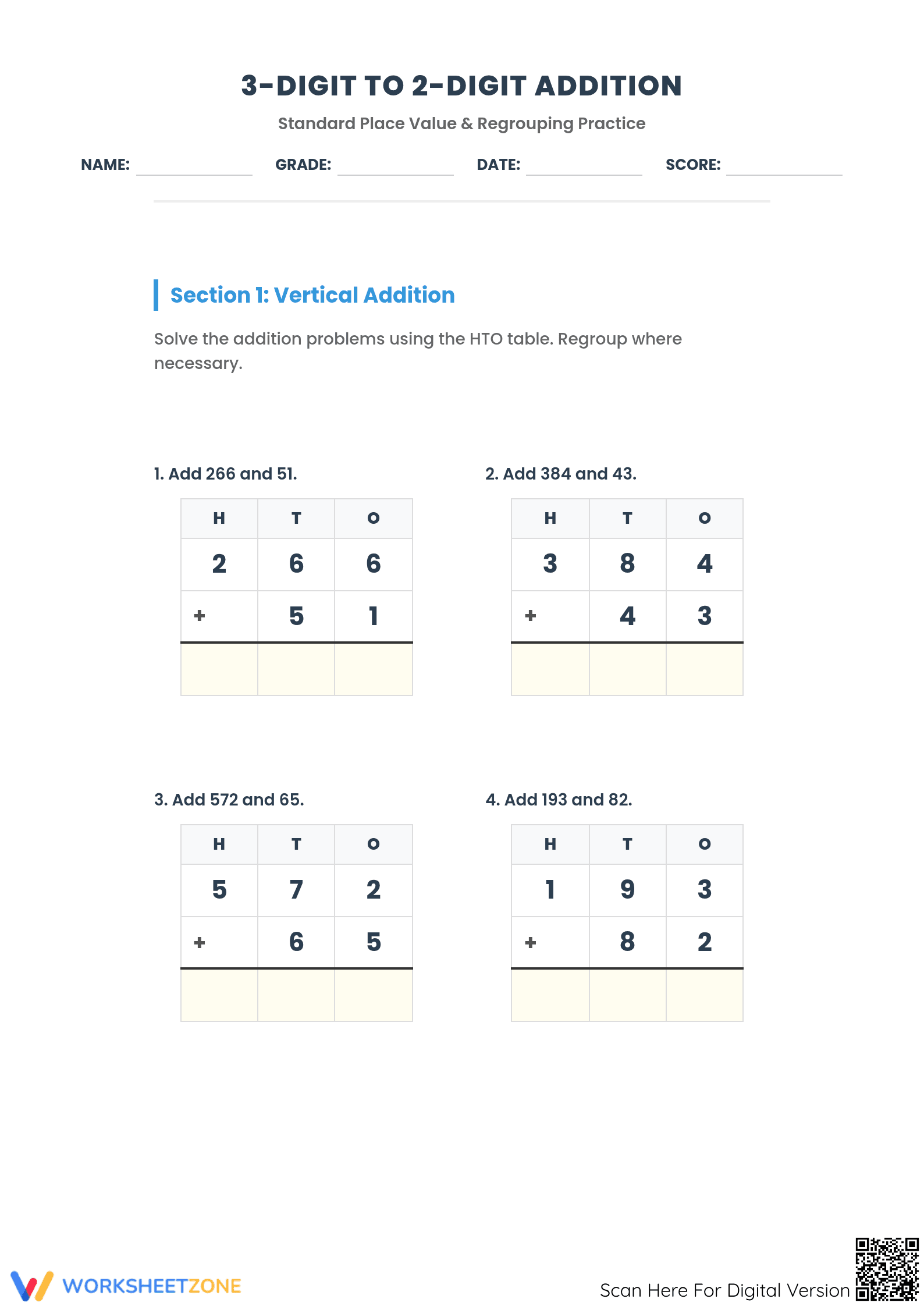
This 3-digit to 2-digit addition worksheet helps students master calculations through regrouping practice. Using visual place value grids, learners develop a concrete understanding of how to compose tens and hundreds during vertical addition. This resource ensures students gain computational fluency while maintaining a strong grasp of mathematical concepts.
At a Glance
- Grade: 2–4 · Subject: Math
- Standard:
CCSS.MATH.CONTENT.2.NBT.B.7— Add within 1000 using place value strategies and regrouping across tens and hundreds- Skill Focus: 3-digit to 2-digit addition with regrouping
- Format: 4 pages · 17 problems · Answer key included · PDF
- Best For: Independent practice and standards-based assessment
- Time: 25–35 minutes
What's Inside
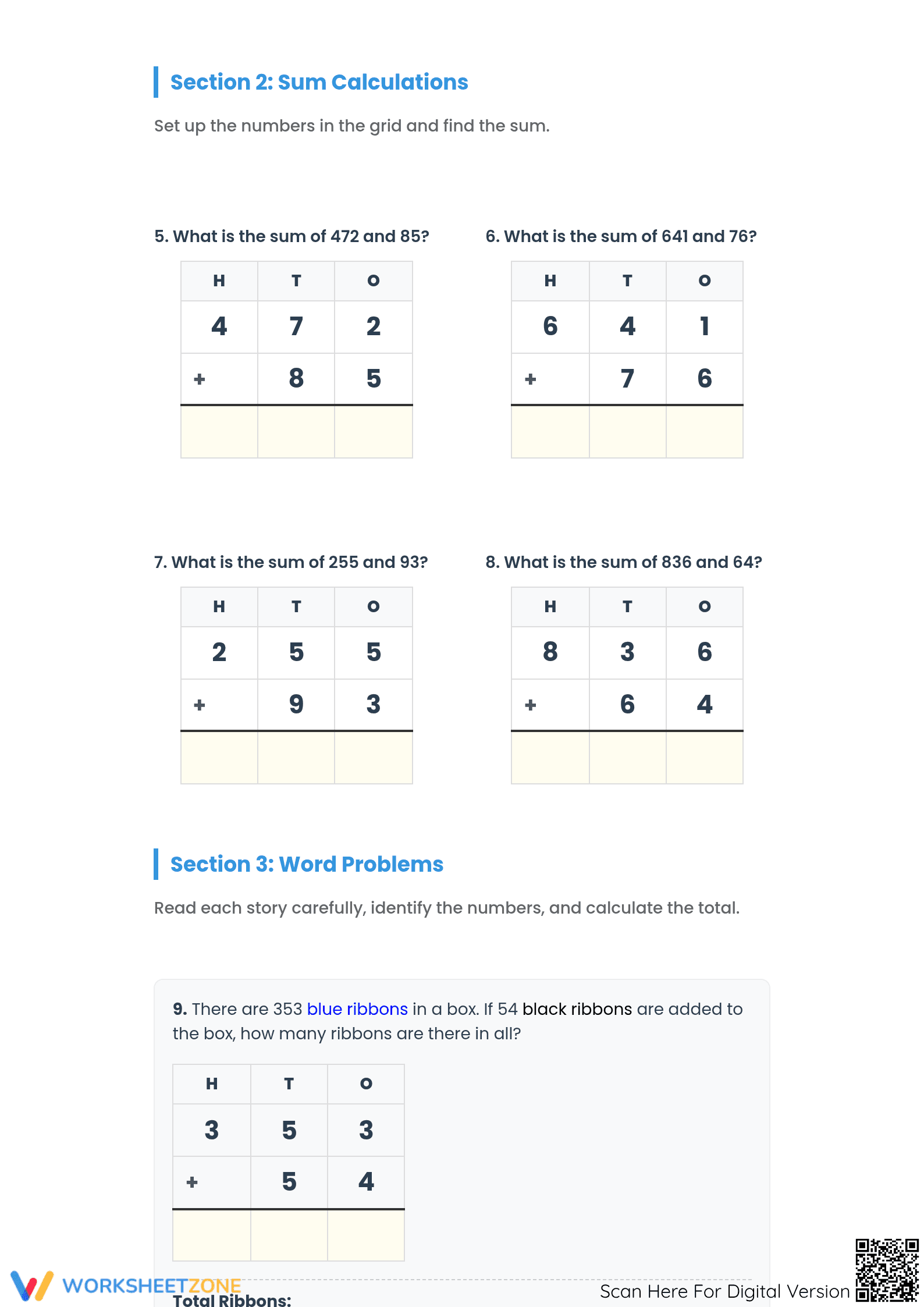
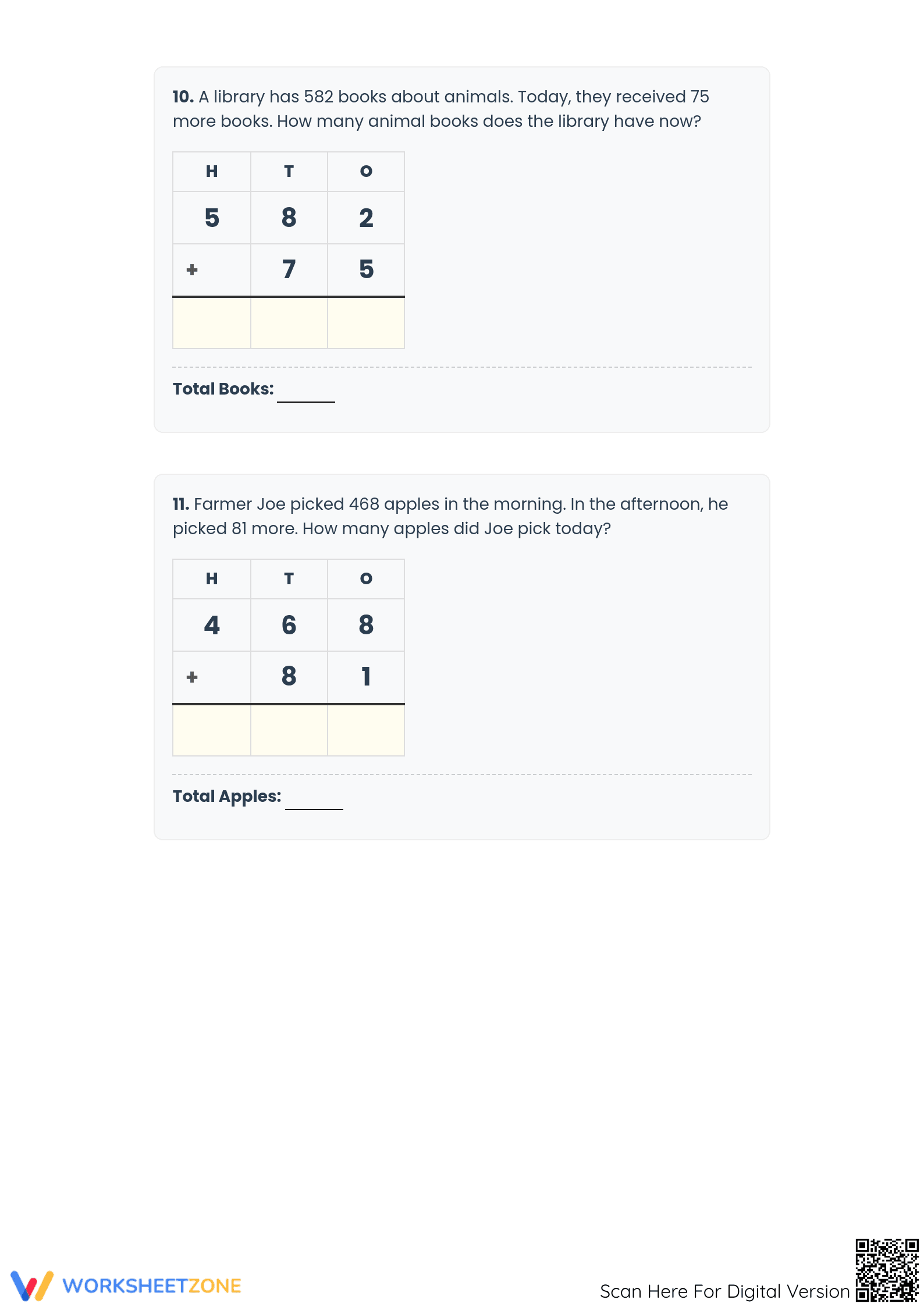
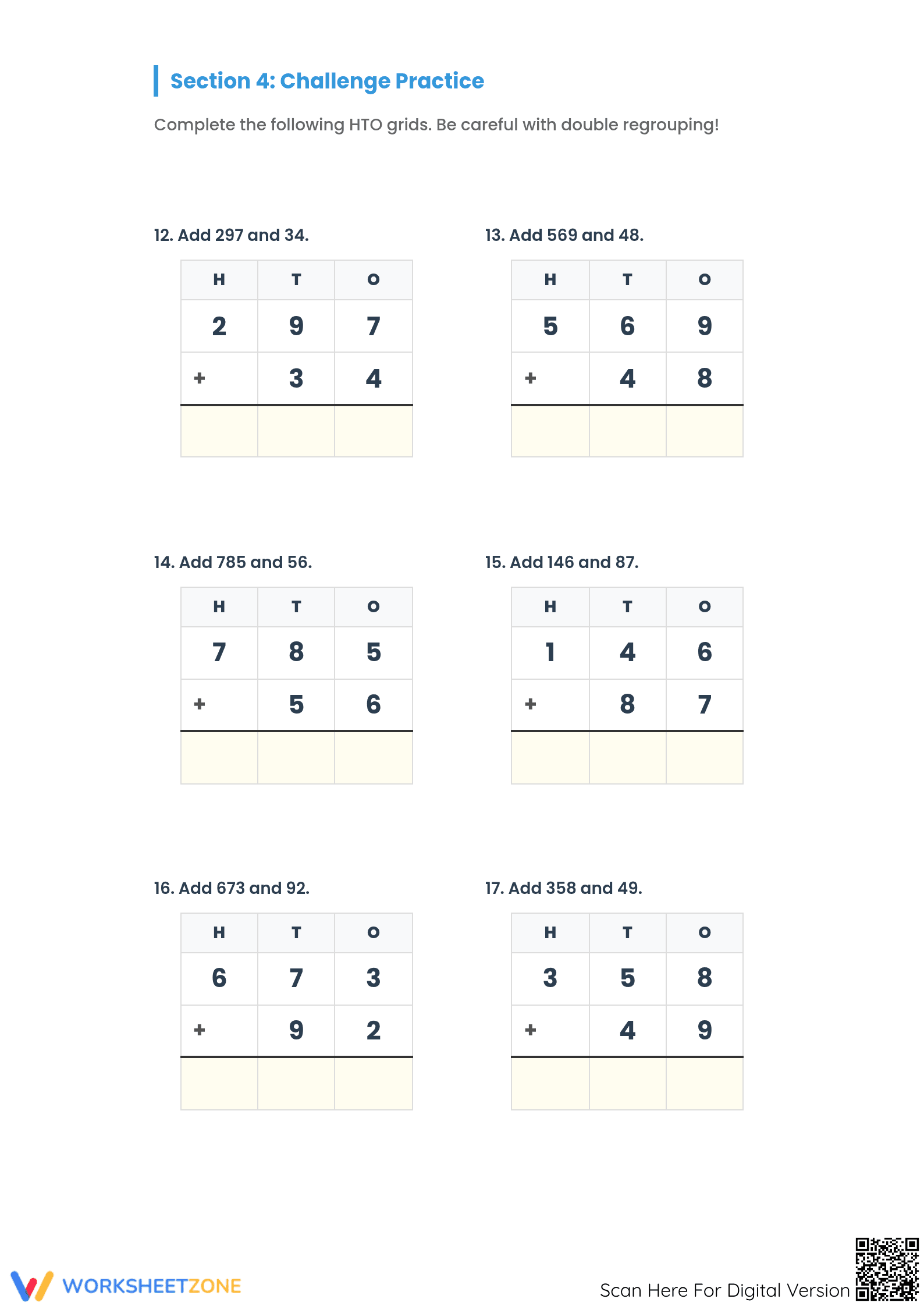
The packet contains 17 sequenced problems on four pages. Students begin with eight vertical addition problems using HTO tables to scaffold regrouping. The third page features three word problems requiring students to extract data and set up grids. Finally, the challenge section introduces six problems involving double regrouping to push students toward higher-level mastery.
Zero-Prep Workflow
Implement this resource with a three-step workflow requiring under two minutes of prep. First, print the four-page PDF. Second, distribute for a 30-minute work block or sub-plan. Third, review using the answer key to identify place value misconceptions. This streamlined process makes it an ideal "grab-and-go" resource for busy classrooms.
Standards Alignment
Aligned to CCSS.MATH.CONTENT.2.NBT.B.7, this worksheet requires students to add within 1000 by composing tens or hundreds. It also supports CCSS.MATH.CONTENT.3.NBT.A.2 for fluent addition. Both standard codes can be copied directly into lesson plans, IEP goals, or district curriculum mapping tools to track student progress.
How to Use It
Use this during independent practice to transition students from guided instruction. For formative assessment, observe Section 4 to see if students carry the "1" across multiple columns in double-regrouping scenarios. This packet serves as an excellent review or a data-gathering tool for small group intervention after direct instruction.
Who It's For
This resource is designed for second through fourth-grade students. The HTO grids provide scaffolding for English Language Learners and students who struggle with digit alignment. It pairs naturally with base-ten manipulatives or digital place value charts to reinforce the transition to abstract vertical algorithms during math centers.
The CCSS.MATH.CONTENT.2.NBT.B.7 standard requires students to demonstrate addition proficiency within 1000 by applying place value strategies and composing tens or hundreds as needed. This worksheet facilitates this rigorous requirement through 17 structured problems that move from visual grids to complex word-based applications. According to Fisher & Frey (2014), the gradual release of responsibility is optimized when students engage in scaffolded independent practice that mirrors the complexity of the targeted standard. This resource implements that research-backed strategy by sequencing vertical addition, sum calculations, and realistic word problems before concluding with a focused challenge section. Such intentional design ensures that students do not merely memorize algorithms but internalize the mathematical relationships between digits in different place value positions. Educators can reliably use this 4-page packet to provide the high-dosage practice required for long-term retention and computational mastery in early elementary mathematics. This thorough approach helps bridge the gap between concrete manipulatives and abstract numerical operations effectively.


