


























Views
Plays
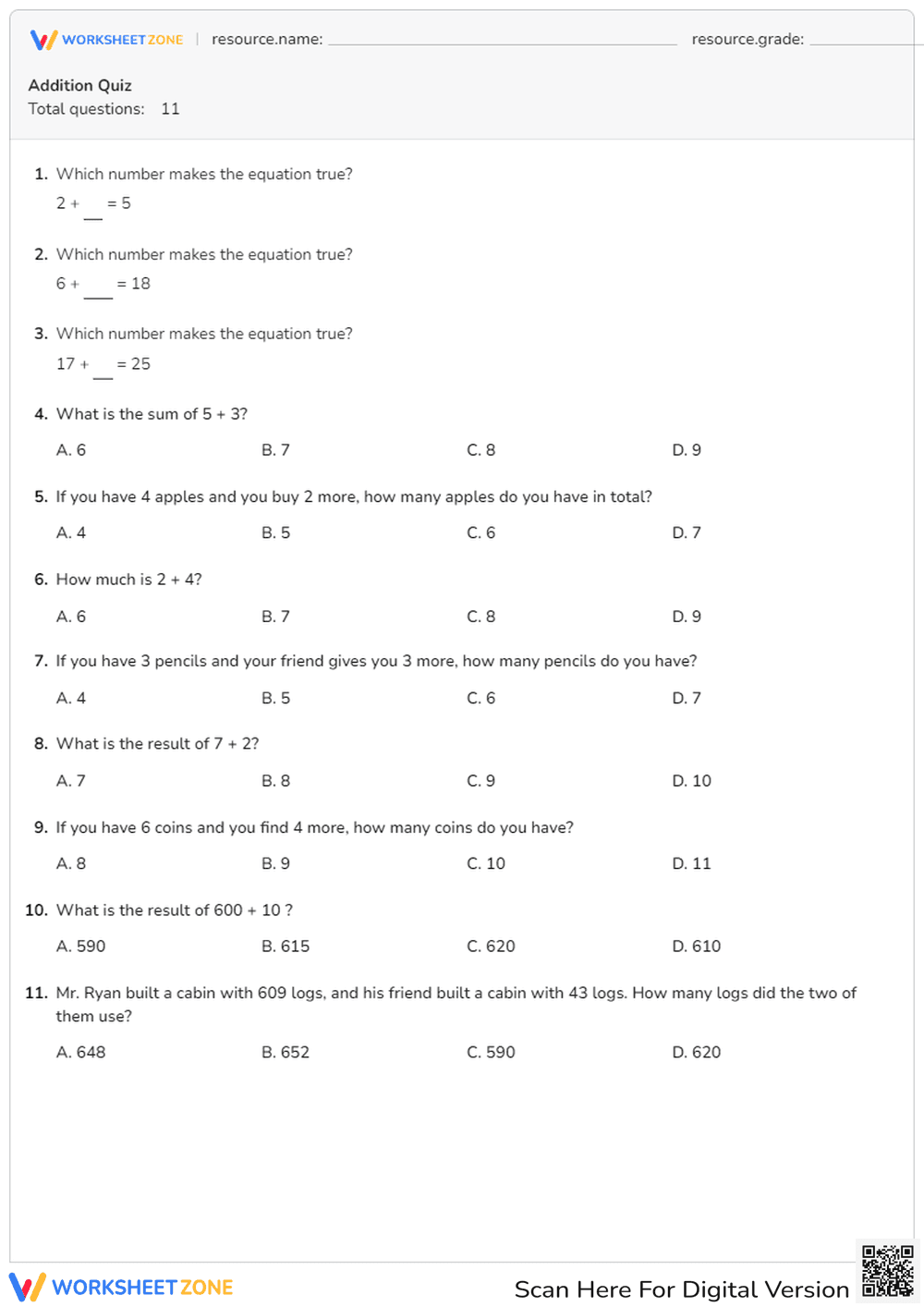

Grade 2 Addition Quiz — Printable No-Prep Worksheet
Paste this activity's link or code into your existing LMS (Google Classroom, Canvas, Teams, Schoology, Moodle, etc.).
Students can open and work on the activity right away, with no student login required.
You'll still be able to track student progress and results from your teacher account.
This Grade 2 math worksheet provides an immediate assessment of addition skills, helping students build numerical fluency and problem-solving confidence. By working through missing addends, basic equations, and real-world word problems, learners demonstrate their ability to apply mathematical concepts accurately.
At a Glance
- Grade: 2 · Subject: Math
- Standard:
CCSS.MATH.CONTENT.2.OA.B.2— Fluently add and subtract within 20- Skill Focus: Addition and missing addends
- Format: 1 page · 11 problems · Answer key included · PDF
- Best For: Formative assessment and review
- Time: 10–15 minutes
This single-page quiz features 11 carefully structured problems designed to evaluate addition proficiency. The layout includes three fill-in-the-blank missing addend equations, followed by eight multiple-choice questions covering both standard numerical sums and practical word problems. The final two questions introduce three-digit addition to challenge students slightly beyond basic facts. A complete answer key is provided to ensure rapid grading and immediate feedback.
Zero-Prep Workflow
This resource is designed for maximum efficiency, requiring under two minutes of total teacher preparation time. It serves as an excellent emergency sub plan or a quick Friday assessment.
- Print (1 minute): Simply download the PDF and print a class set. The black-and-white design minimizes ink usage.
- Distribute (1 minute): Hand out the single-page quiz. The instructions are self-explanatory, allowing students to begin immediately.
- Review (3 minutes): Use the included answer key to grade the 11 problems rapidly, or project the key on the board for whole-class self-correction.
Standards Alignment
This worksheet is aligned to primary standard CCSS.MATH.CONTENT.2.OA.B.2, which requires students to fluently add and subtract within 20 using mental strategies. It also touches upon CCSS.MATH.CONTENT.2.NBT.B.7 by introducing basic three-digit addition concepts at the end of the assessment. Both standard codes can be copied directly into lesson plans, IEP goals, or district curriculum mapping tools.
How to Use It
Deploy this quiz as a formative assessment after concluding a unit on basic addition and missing addends. It works perfectly as an independent morning work assignment or a quick exit ticket to gauge class-wide comprehension. While students work, observe whether they rely on finger counting or mental math strategies for the single-digit problems. Expected completion time ranges from 10 to 15 minutes depending on the student's reading level for the word problems.
Who It's For
This resource is primarily designed for second-grade students mastering their addition facts and introductory word problems. It also serves as a valuable review tool for third graders needing foundational reinforcement or a challenge for advanced first graders. Pair this quiz with hands-on base-ten blocks or a direct instruction lesson on identifying keywords in math word problems to support visual learners.
Developing early mathematical fluency is a critical predictor of future academic success. According to EdReports 2024, instructional materials that provide frequent, low-stakes assessments help solidify foundational skills and reduce math anxiety in young learners. This worksheet directly supports CCSS.MATH.CONTENT.2.OA.B.2 by requiring students to fluently add and subtract within 20. By integrating both missing addend equations and contextual word problems, the assessment ensures that students are not merely memorizing facts, but actively applying their knowledge to new situations. Regular practice with these specific problem types builds the cognitive automaticity necessary for more complex algebraic thinking in later grades. Educators can utilize this targeted, 11-question format to quickly identify learning gaps and adjust their instructional strategies, ensuring that all students achieve mastery of essential second-grade mathematics standards.


