


























Views
Downloads

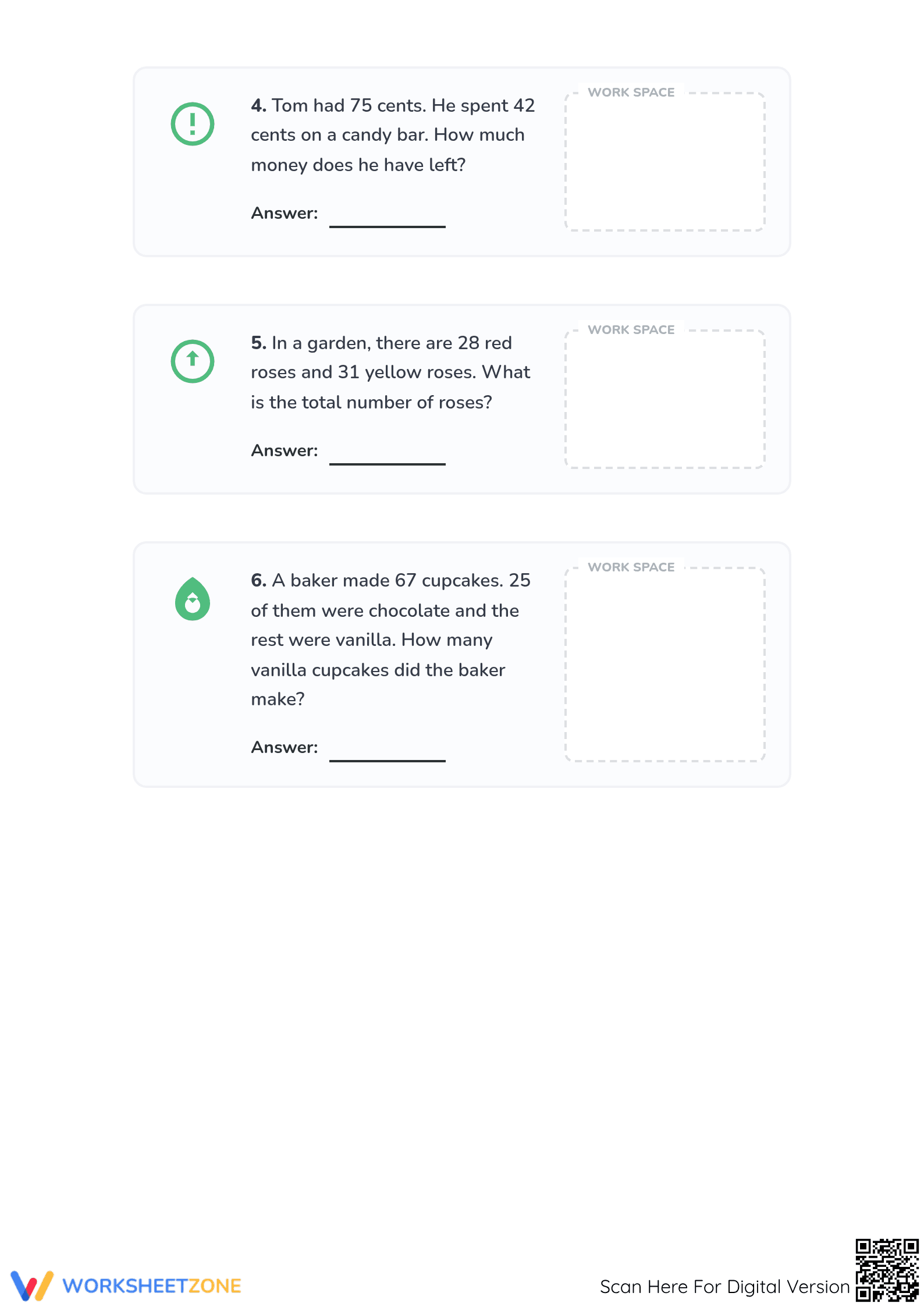

Grade 2 Math Word Problems — Printable No-Prep Worksheet
Paste this activity's link or code into your existing LMS (Google Classroom, Canvas, Teams, Schoology, Moodle, etc.).
Students can open and work on the activity right away, with no student login required.
You'll still be able to track student progress and results from your teacher account.
This Grade 2 math worksheet provides targeted practice on solving one-step addition and subtraction word problems. Students will read six distinct scenarios, identify the correct operation, and calculate the answer. It’s an ideal resource for reinforcing foundational problem-solving skills and building fluency with numbers within 100.
At a Glance
- Grade: 2 (adaptable for 3) · Subject: Math
- Standard:
CCSS.MATH.CONTENT.2.OA.A.1— Use addition and subtraction within 100 to solve word problems.- Skill Focus: Addition & Subtraction Word Problems
- Format: 2 pages · 6 problems · Answer key included · PDF
- Best For: Independent practice, homework, formative assessment
- Time: 15–25 minutes
What's Inside
This resource contains a two-page worksheet with six unique word problems. Each problem has a dedicated workspace for students to show their calculations. A complete answer key is provided on a separate page, making grading quick and easy. The clean layout and clear instructions ensure students can begin working immediately.
A Zero-Prep Workflow
This worksheet is designed for maximum efficiency in the classroom. The workflow is simple: 1. Print (under 1 minute): Just print the two-page worksheet and the single-page answer key. No cutting, laminating, or complex setup is required. 2. Distribute (under 1 minute): Hand out the worksheets to students for immediate use. 3. Review (5-10 minutes): Use the provided answer key to review answers with the class or grade papers efficiently. With a total teacher prep time of under two minutes, this resource is a perfect fit for a substitute teacher plan, a last-minute homework assignment, or a quick practice session.
Standards Alignment
This worksheet is directly aligned with Common Core standard CCSS.MATH.CONTENT.2.OA.A.1, which requires students to "Use addition and subtraction within 100 to solve one- and two-step word problems involving situations of adding to, taking from, putting together, taking apart, and comparing, with unknowns in all positions." It also supports skills in CCSS.MATH.CONTENT.2.NBT.B.5 (fluently add and subtract within 100). Both standard codes can be copied directly into lesson plans, IEP goals, or district curriculum mapping tools.
How to Use It
Use this worksheet as independent practice after a direct instruction lesson on solving word problems. It's also effective as a homework assignment to reinforce classroom learning. For a formative assessment, circulate as students work and observe their strategies. Note whether they are correctly identifying the operation (addition vs. subtraction) and if they are using an efficient method to calculate the answer. Most students will complete the worksheet in 15 to 25 minutes.
Who It's For
This resource is designed for second-grade students who are developing their problem-solving skills. It can also serve as a review for third graders at the beginning of the year or provide scaffolded support for students needing extra practice. Pair this worksheet with an anchor chart that displays keywords for addition and subtraction to support students as they work.
This worksheet provides focused practice on CCSS.MATH.CONTENT.2.OA.A.1, a critical early math skill. By asking students to interpret and solve one-step word problems, it builds the foundation for more complex, multi-step problems in later grades. Research consistently highlights the importance of connecting mathematical operations to real-world contexts. A comprehensive analysis by RAND AIRS (2024) found that instructional materials emphasizing problem-solving applications from an early age are linked to deeper conceptual understanding and improved performance on standardized assessments. This resource gives students repeated, structured exposure to that process. It requires them to translate language into mathematical equations, a key step in developing algebraic thinking. The six problems provide a concise yet effective measure of a student's ability to apply addition and subtraction skills within 100 to narrative scenarios.


