


























Views
Downloads


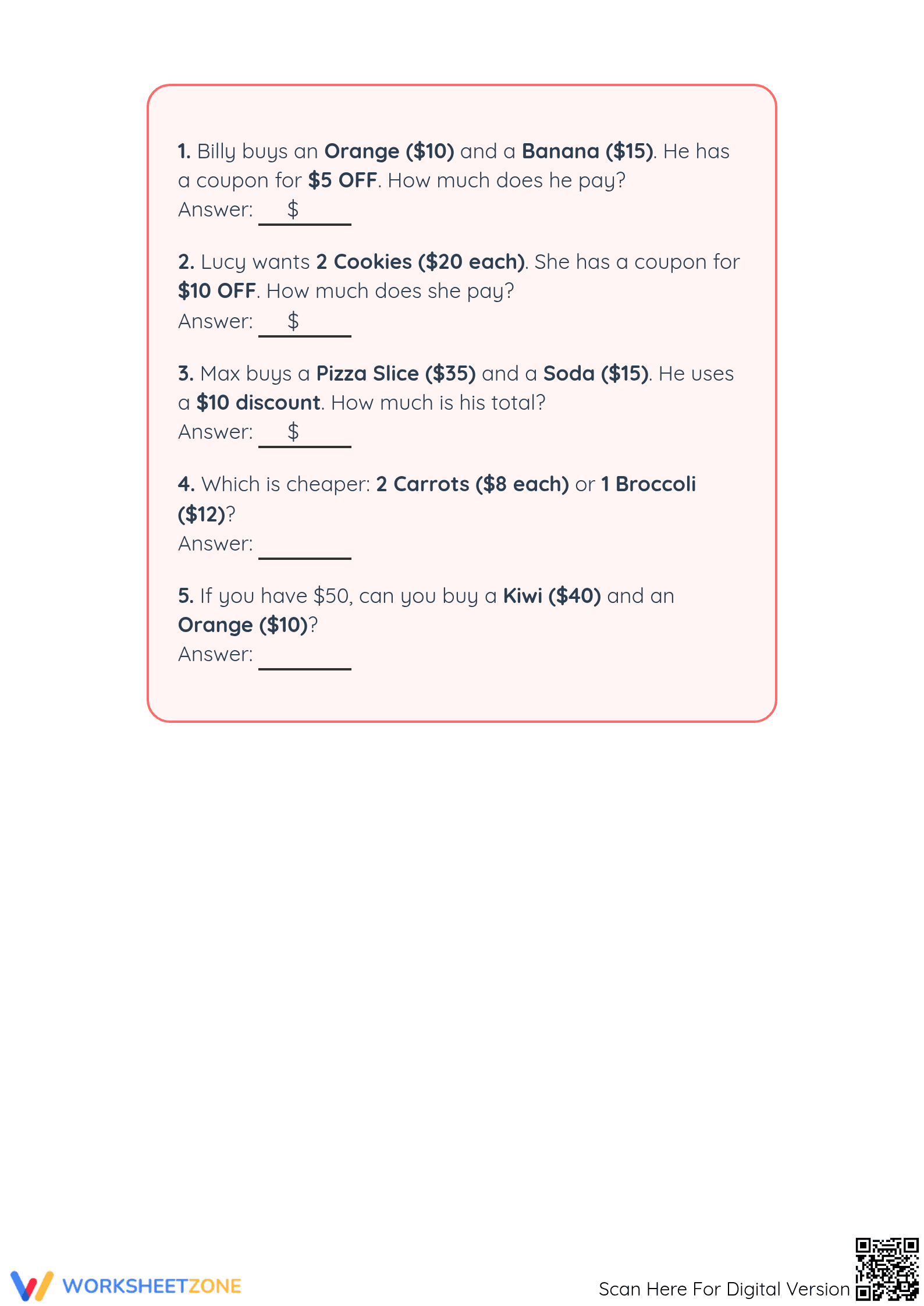

Grade 2 Market Day Money Math — Printable No-Prep Worksheet
Paste this activity's link or code into your existing LMS (Google Classroom, Canvas, Teams, Schoology, Moodle, etc.).
Students can open and work on the activity right away, with no student login required.
You'll still be able to track student progress and results from your teacher account.
Students practice essential financial literacy by calculating costs at a virtual Fun Food Market. This comprehensive 5-page resource moves from concrete shopping bag calculations to abstract story problems, ensuring students master multi-digit addition and subtraction within a relatable shopping context. Students learn to apply discounts and find final totals accurately using real-world scenarios.
At a Glance
- Grade: 2 · Subject: Math
- Standard:
CCSS.MATH.CONTENT.2.MD.C.8— Solve word problems involving money and numerical values within 100- Skill Focus: Multi-digit addition with subtraction discounts
- Format: 5 pages · 13 problems · Answer key included · PDF
- Best For: Independent math centers and sub plans
- Time: 30–45 minutes
What's Inside
The packet contains three distinct price lists for Fruit, Vegetables, and Snacks, providing the data needed for eight unique shopping bag calculation tasks. Each bag includes three items and a visual "star" coupon for a specific dollar-amount discount. The final two pages feature a multi-step Market Day Story Problems section where students solve five complex word problems requiring comparison, logic, and multi-step arithmetic.
Zero-Prep Workflow
- Step 1: Print the 5-page Fun Food Market packet in black and white or color (30 seconds).
- Step 2: Distribute to students as a themed activity packet during math centers or whole-class instruction (1 minute).
- Step 3: Review and grade using the comprehensive answer key provided in the download (5 minutes).
Total teacher preparation time is under 2 minutes, making this an ideal resource for emergency sub plans or busy morning work.
Standards Alignment
This resource is primarily aligned to `CCSS.MATH.CONTENT.2.MD.C.8`, which requires students to solve word problems involving dollar bills and coins. It also supports `CCSS.MATH.CONTENT.2.OA.A.1` by utilizing one- and two-step word problems involving addition and subtraction. Both standard codes can be copied directly into lesson plans, IEP goals, or district curriculum mapping tools.
How to Use It
Use this worksheet as a culminating activity after direct instruction on multi-digit addition. For a formative assessment tip, observe students during the "Calculate Your Bags" step to see if they correctly subtract the coupon value before or after finding the item sum. Expected completion time ranges from 30 minutes for advanced learners to 45 minutes for students needing additional processing time.
Who It's For
This packet is designed for Grade 2 students but serves as an excellent enrichment tool for Grade 1 or a remediation resource for Grade 3. It pairs naturally with classroom manipulatives like play money or a "market day" anchor chart. The clear headers and structured white space support students with executive functioning needs who require visual scaffolding.
The CCSS.MATH.CONTENT.2.MD.C.8 standard requires students to solve word problems involving money, a critical bridge between abstract arithmetic and real-world application. Research from RAND AIRS 2024 emphasizes that contextualizing multi-digit addition and subtraction within a marketplace simulation increases student engagement and retention of operational fluencies. By requiring students to calculate shopping bag totals and then apply discounts, this worksheet forces a two-step cognitive process that aligns with high-rigor assessment demands. The inclusion of story problems further strengthens logical reasoning and quantitative literacy. Educators can use these 13 problems to pinpoint specific gaps in regrouping or the conceptual understanding of discounts as subtraction. As a standalone assessment or practice set, it provides clear evidence of a student's ability to manipulate numerical values in a financial context, a foundational skill for late elementary mathematics.


