


























Views
Downloads

Add Three Numbers Worksheet | Grade 1 Ready
Paste this activity's link or code into your existing LMS (Google Classroom, Canvas, Teams, Schoology, Moodle, etc.).
Students can open and work on the activity right away, with no student login required.
You'll still be able to track student progress and results from your teacher account.
Mastering multi-addend computation requires students to break complex equations into manageable steps. This Grade 1 worksheet guides learners to add three single-digit numbers by recording running subtotals with touch dots. Students build computational fluency, practice counting on, and develop confidence combining three quantities within 20.
At a Glance
- Grade: 1 · Subject: Math
- Standard:
CCSS.MATH.CONTENT.1.OA.A.2— Add three whole numbers with sums up to 20- Skill Focus: Adding three numbers with touch points and running subtotals
- Format: 2 pages · 16 problems · Answer key included · PDF
- Best For: Small-group intervention and targeted independent math practice
- Time: 20–30 minutes
What's Inside
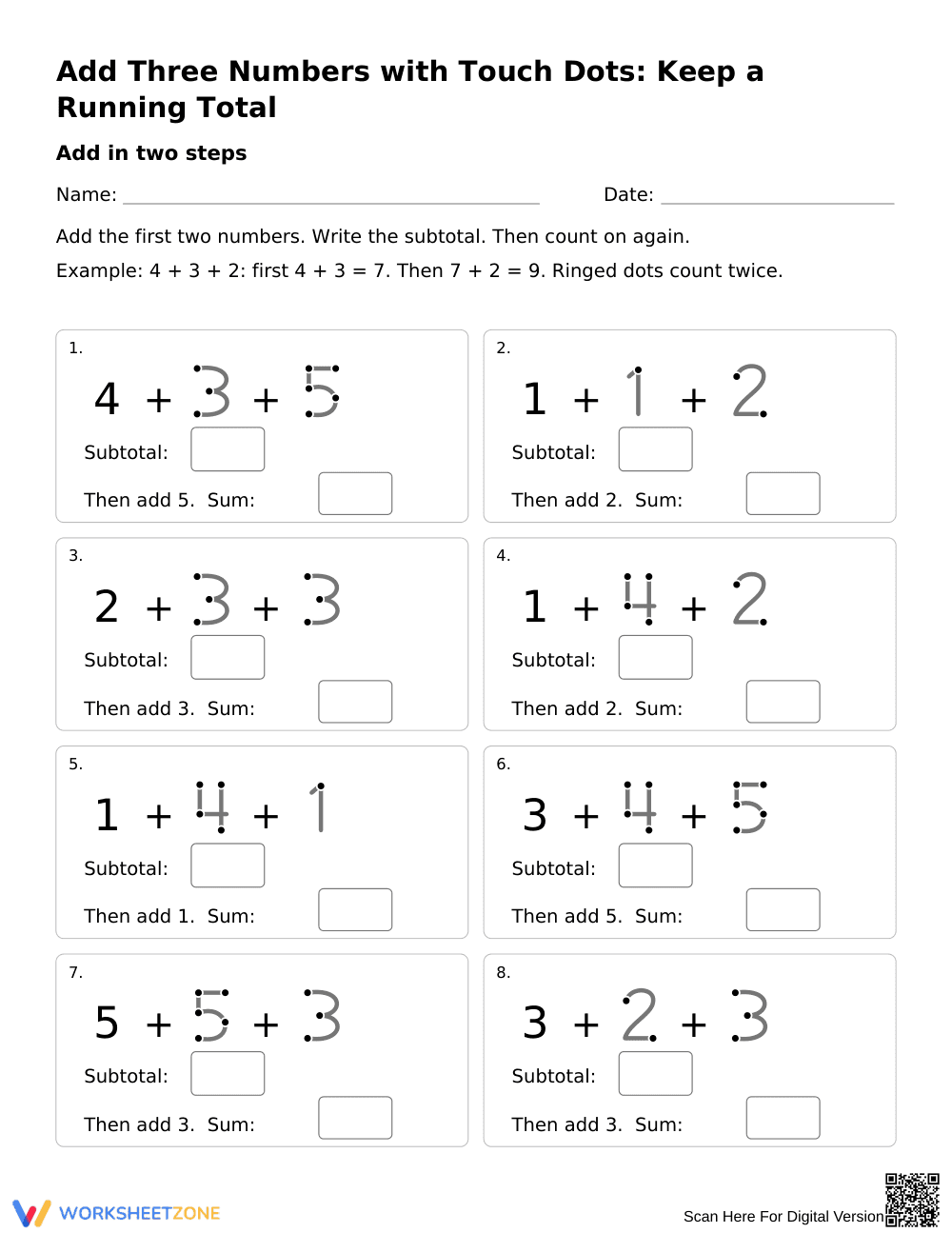
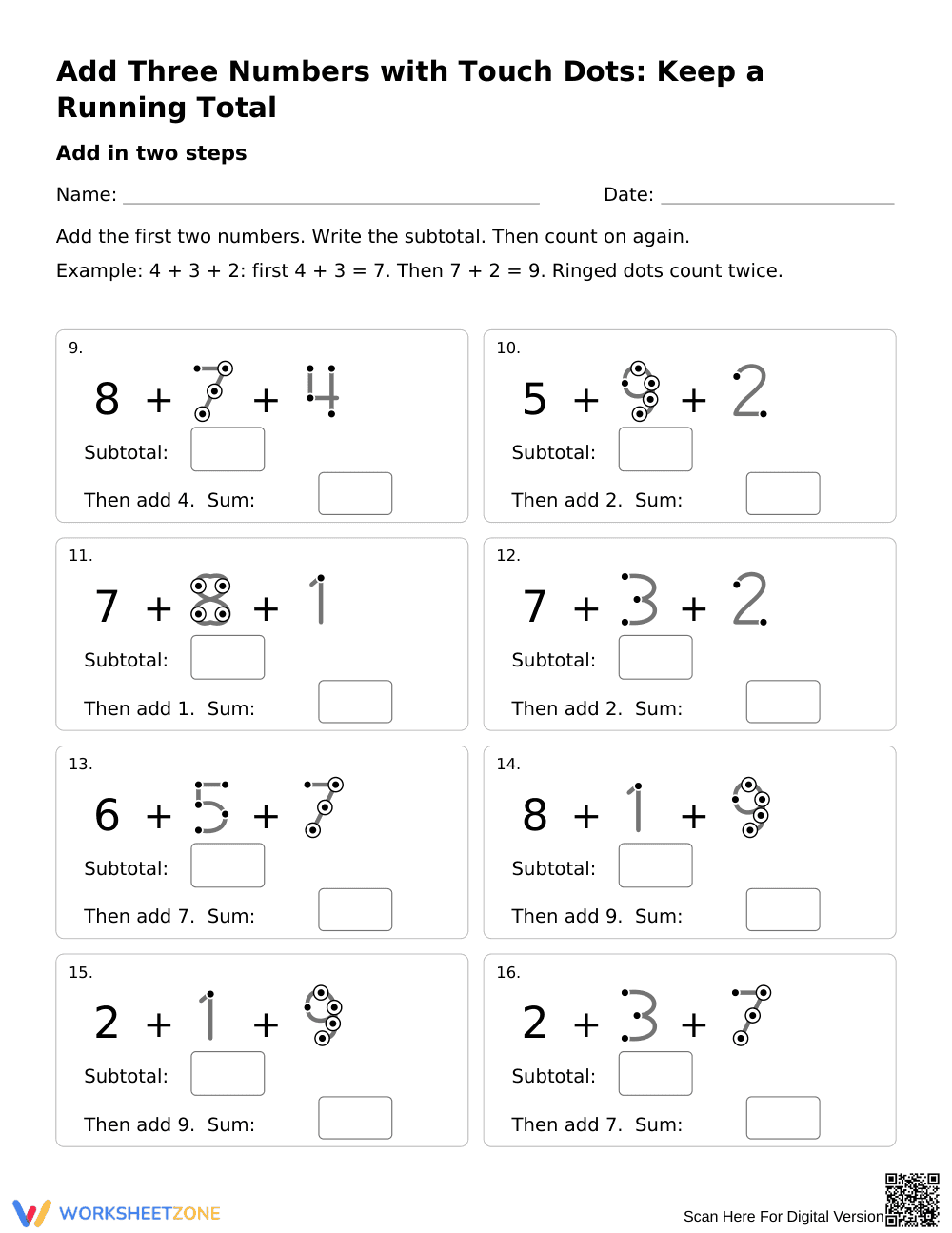
This 2-page resource provides 16 boxed computation exercises designed to prevent cognitive overload. Each problem features three single-digit addends with touch dots, a dedicated subtotal box for the first two addends, and a final sum box. An included 1-page answer key allows quick, reliable checking.
Skill Progression
- Guided practice (Problems 1–4): Students add small quantities with sums under 10, using single touch dots on standard numerals.
- Supported practice (Problems 5–8): Problems introduce addends up to 5, requiring learners to record intermediate subtotals before finding sums up to 13.
- Independent practice (Problems 9–16): Learners use double-ringed touch points on numbers 6 through 9 to calculate running totals with sums reaching 19.
This sequence follows a gradual-release framework, moving learners from scaffolded steps to independent execution.
Standards Alignment
The primary standard is `CCSS.MATH.CONTENT.1.OA.A.2`: Solve word problems that call for addition of three whole numbers whose sum is less than or equal to 20. The worksheet also supports `CCSS.MATH.CONTENT.1.OA.C.6` through addition strategies such as counting on. Both standard codes can be copied directly into lesson plans, IEP goals, or district curriculum mapping tools.
How to Use It
Use this worksheet after direct instruction to reinforce how intermediate subtotals simplify multi-step problems, or assign it during independent math rotations. As a formative check, observe whether students accurately tap the touch points or skip counting steps. Expected completion time is 20 to 30 minutes.
Who It's For
This worksheet serves first graders, second-grade students reviewing basic facts, and special education students needing multisensory support. Pair this resource with a touch-point anchor chart or ten-frame manipulatives to reinforce place value concepts.
According to research highlighted in Fisher & Frey (2014) on the gradual release of responsibility, structured scaffolding allows young mathematicians to internalize complex procedural routines by reducing extraneous working memory load. This Grade 1 mathematics worksheet directly targets CCSS.MATH.CONTENT.1.OA.A.2 by breaking three-number addition into two distinct, sequential steps: finding an initial running subtotal and counting on to determine the final sum. The inclusion of tactile touch dots provides concrete visual anchors that support multisensory learning pathways, enabling students with diverse academic readiness levels to successfully compute sums within 20. By combining explicit intermediate recording boxes with systematic counting prompts, the resource reinforces counting-on strategies, strengthens number sense, and cultivates computational accuracy. Educators obtain clear evidence of student progress across 16 sequential problems, ensuring targeted intervention and confident progression toward independent arithmetic fluency in early elementary classrooms.


