


























Views
Downloads

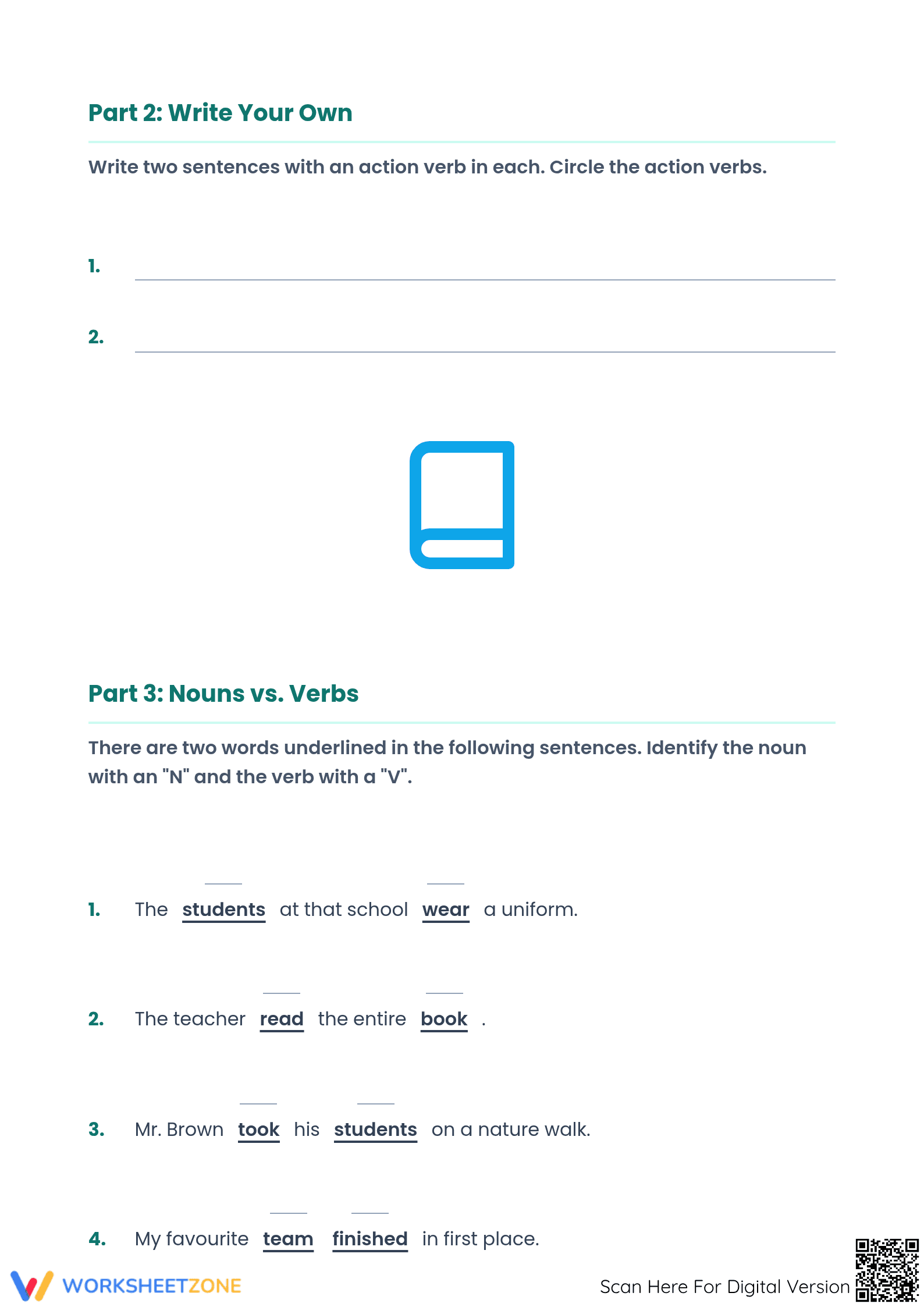

Action Verbs Practice Worksheet | Grade 4-5 Printable
Paste this activity's link or code into your existing LMS (Google Classroom, Canvas, Teams, Schoology, Moodle, etc.).
Students can open and work on the activity right away, with no student login required.
You'll still be able to track student progress and results from your teacher account.
This Grade 4 and 5 action verbs worksheet helps students master the core mechanics of parts of speech through identification and application. By distinguishing between nouns and verbs, learners build the foundational syntax skills necessary for complex sentence construction. It provides immediate practice to ensure students can recognize and use dynamic verbs effectively.
At a Glance
- Grade: 4-5 · Subject: ELA Grammar
- Standard:
CCSS.ELA-LITERACY.L.4.1— Demonstrate command of the conventions of standard English grammar and usage- Skill Focus: Action Verb Identification & Usage
- Format: 2 pages · 11 problems · Answer key included · PDF
- Best For: Independent practice or quick formative assessment
- Time: 15–20 minutes
What's Inside: The resource contains two pages of focused grammar practice. It includes a helpful "Hint" box defining action verbs, followed by three distinct sections: circling verbs in context, original sentence generation, and a noun-versus-verb discrimination task. A full two-page answer key is provided for rapid grading or student self-correction.
Zero-Prep Workflow: Teachers can implement this resource in under two minutes. Simply print the two-page PDF (1 minute), distribute it to the class (30 seconds), and use the included answer key for a lightning-fast review (30 seconds). This streamlined design makes it an ideal choice for emergency sub plans or morning bell-ringers.
Standards Alignment: This worksheet aligns with CCSS.ELA-LITERACY.L.4.1, requiring students to demonstrate command of the conventions of standard English grammar and usage when writing or speaking. It specifically targets the functional understanding of verbs as the "action" center of a sentence. Both standard codes can be copied directly into lesson plans, IEP goals, or district curriculum mapping tools.
How to Use It: Use this as a mid-lesson check during a unit on parts of speech to gauge student understanding of verb functions. Alternatively, assign it as a homework reinforcement after direct instruction on sentence structure. Observe if students struggle with Part 3, as confusion between nouns and verbs often indicates a need for further scaffolding with concrete examples. Completion typically takes 15 to 20 minutes.
Who It's For: This resource is designed for Grade 4 and 5 students, though it serves as excellent remediation for Grade 6 learners. It is particularly effective for English Language Learners (ELLs) who benefit from the clear "Hint" box and structured sentence frames. Pair this with a verb-focused anchor chart or a short reading passage to see these skills in a broader context.
According to the RAND AIRS 2024 report on instructional materials, high-quality supplemental worksheets that balance identification with generative writing—like the "Write Your Own" section here—significantly improve retention of grammatical conventions. This resource targets CCSS.ELA-LITERACY.L.4.1 by moving students from passive recognition to active application. By requiring learners to distinguish between nouns and verbs in Part 3, the worksheet addresses common syntactic misconceptions identified in NAEP proficiency frameworks. Research from Fisher & Frey (2014) emphasizes that such gradual release—moving from circling a verb to writing a sentence—is essential for mastery of parts of speech. This 11-task printable provides the structured repetition necessary for Grade 4 and 5 students to internalize the role of action verbs in clear communication. It is a reliable tool for teachers seeking evidence-based grammar practice that fits into tight instructional blocks.


