


























Views
Downloads

Printable Grade 3 ELA Vocabulary Worksheet: Essential Practice
Paste this activity's link or code into your existing LMS (Google Classroom, Canvas, Teams, Schoology, Moodle, etc.).
Students can open and work on the activity right away, with no student login required.
You'll still be able to track student progress and results from your teacher account.
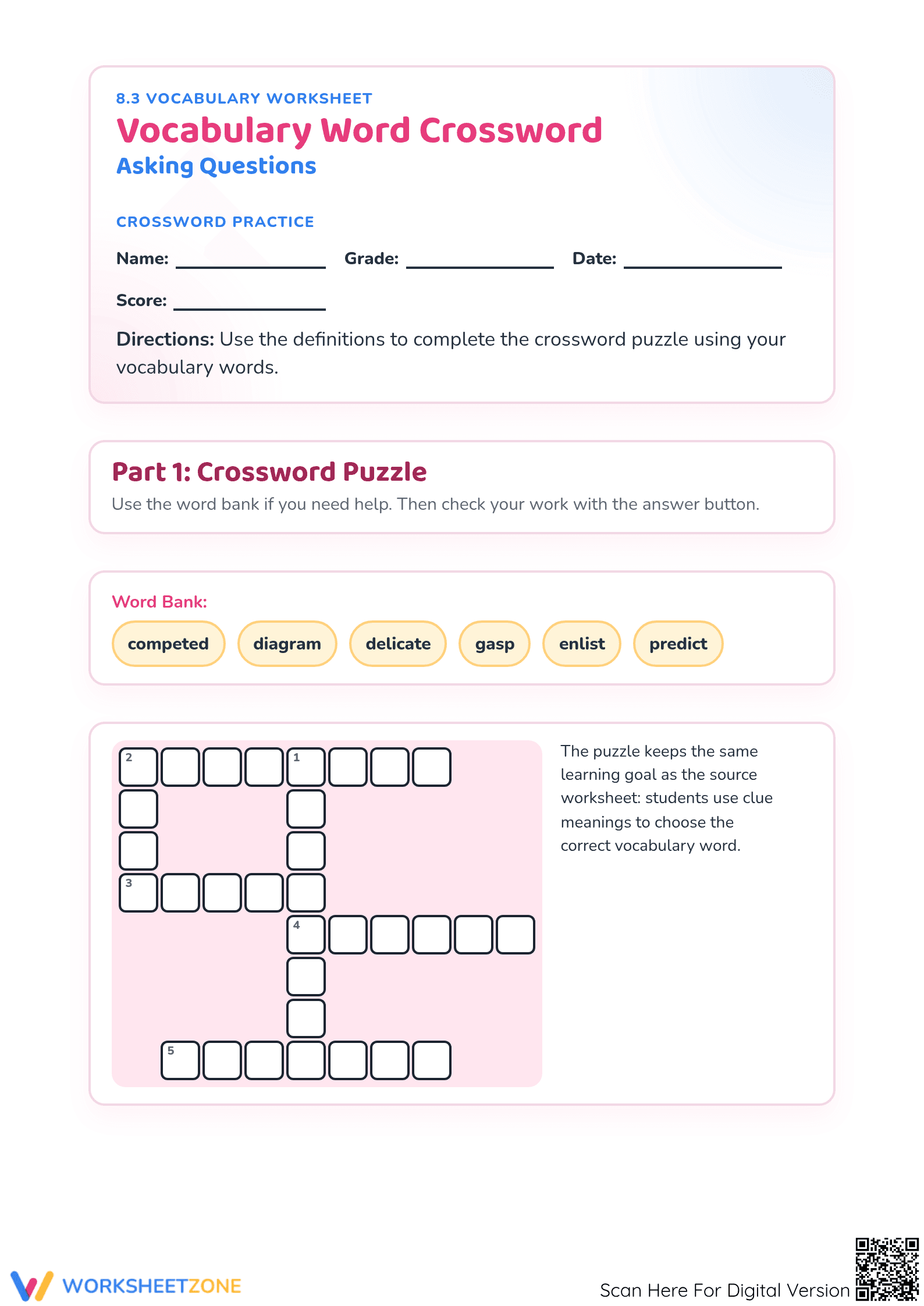
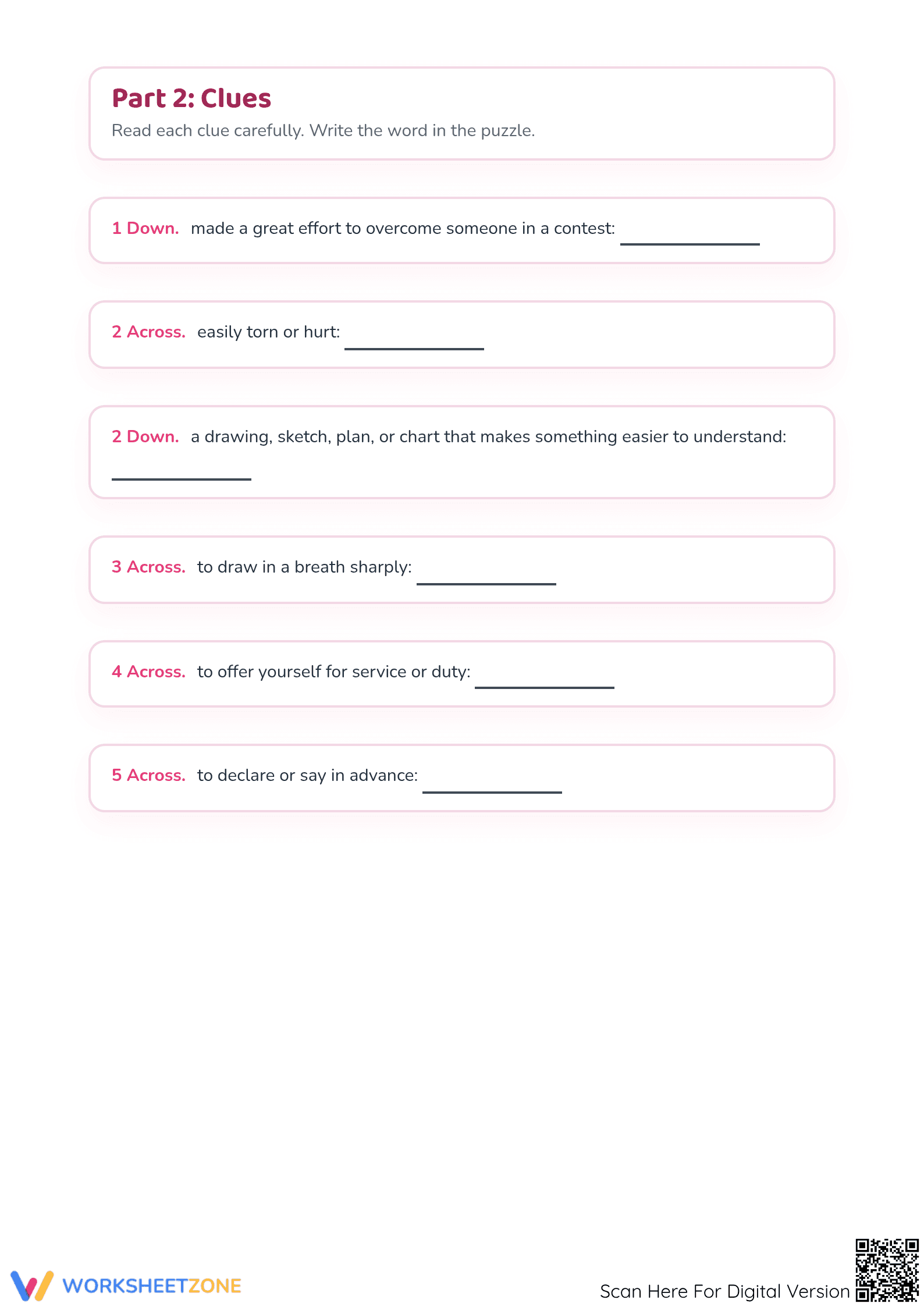
This Grade 3 English Language Arts worksheet strengthens academic vocabulary through a dual-modality approach, combining a challenging crossword puzzle with an informative botanical diagram. Students apply critical thinking to match precise definitions with Tier 2 vocabulary words while interpreting visual data. This printable resource ensures learners develop the linguistic precision required for reading complex informational texts.
At a Glance
- Grade: 3 · Subject: English Language Arts (ELA)
- Standard:
CCSS.ELA-LITERACY.L.3.6— Acquire and use grade-appropriate general academic and domain-specific words and phrases- Skill Focus: Academic vocabulary and diagram analysis
- Format: 1 page · 6 problems · Answer key included · PDF
- Best For: Literacy centers and morning work
- Time: 15–20 minutes
This single-page PDF contains two learning modules. The primary task is a crossword puzzle featuring six academic terms like "volunteer," "vulnerable," and "diagram." Each clue provides a clear definition to scaffold student success. Accompanying the puzzle is a detailed anatomical diagram of a flower, providing functional descriptions for roots, stems, and leaves, creating a cross-curricular bridge to science.
The "Print and Go" workflow is designed for maximum efficiency. Print the single-page PDF in seconds for your class. Distribute the worksheets during your ELA block; no additional materials are required beyond a pencil. Finally, review answers using the included key. The minimal total prep time makes this an ideal emergency sub plan or quick-start morning activity.
This resource is directly aligned to `CCSS.ELA-LITERACY.L.3.6`, requiring students to acquire conversational, general academic, and domain-specific words. By engaging with terms describing actions and abstract concepts, students build the lexical flexibility needed for Grade 3 proficiency. This standard code can be copied directly into lesson plans, IEP goals, or district curriculum mapping tools.
Integrate this worksheet during the independent practice phase of a vocabulary lesson. Encourage students to read definitions aloud to build phonological awareness. For a formative assessment, note which students use the provided diagram to solve the related crossword clue. Completion typically takes 15 to 20 minutes depending on the student's familiarity with the academic word list.
This worksheet is tailored for Grade 3, but provides excellent reinforcement for Grade 4 or a challenge for advanced Grade 2 readers. It is effective for English Language Learners who benefit from visual support. This resource pairs naturally with an anchor chart on word parts or an informational passage about the plant life cycle.
Effective vocabulary instruction necessitates multiple exposures to academic language. This Grade 3 ELA worksheet leverages the "word-concept" association model, where students retrieve domain-specific terms like CCSS.ELA-LITERACY.L.3.6 based on semantic definitions. By embedding these words within a crossword format, the resource increases student engagement and processing depth. According to the RAND AIRS 2024 report, high-quality supplemental materials that integrate visual literacy—such as the included botanical diagram—with verbal tasks significantly improve retention of academic lexicon in elementary learners. This multi-modal approach supports a robust mental lexicon, enabling students to navigate the increasing complexity of upper-elementary texts. The inclusion of Tier 2 words ensures that students are not just learning definitions in isolation, but are building the foundational tools for reading comprehension and academic discourse across subjects, including science and social studies. This ensures long-term mastery of complex linguistic structures.


