


























Views
Downloads

Printable Character & Plot Vocabulary | Grade 8 ELA
Paste this activity's link or code into your existing LMS (Google Classroom, Canvas, Teams, Schoology, Moodle, etc.).
Students can open and work on the activity right away, with no student login required.
You'll still be able to track student progress and results from your teacher account.
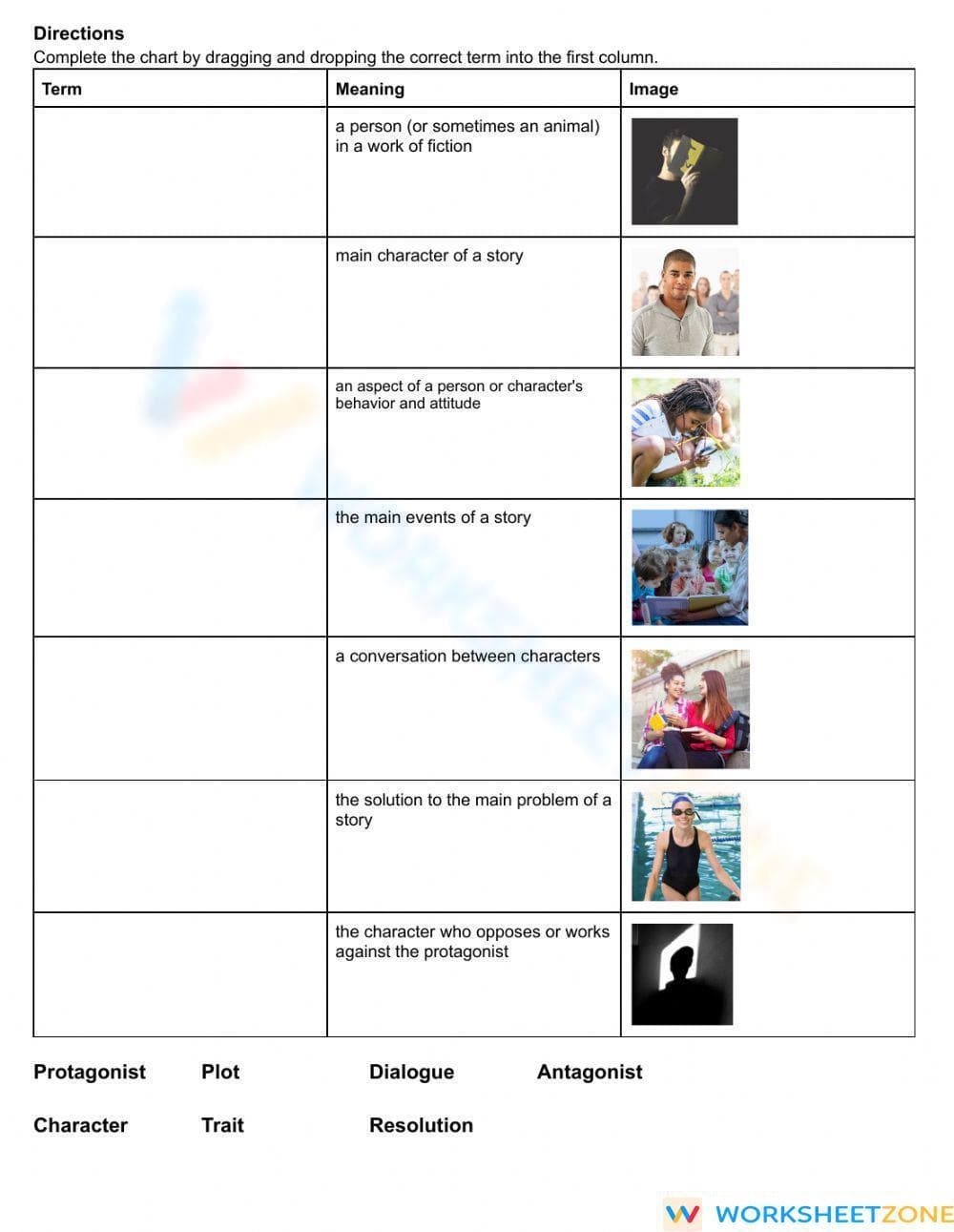
This worksheet provides targeted practice for middle school students to master core academic vocabulary related to literary characterization and plot structure. Through a clear, interactive matching activity, students will connect seven essential terms—such as 'protagonist' and 'resolution'—to their precise definitions, reinforcing their ability to analyze and discuss literature with accuracy.
At a Glance
- Grade: 7–9 · Subject: ELA, Literature
- Standard:
CCSS.ELA-LITERACY.RL.8.3— Analyze how dialogue or incidents reveal character aspects.- Skill Focus: Literary Vocabulary (Character & Plot)
- Format: 1 page · 7 problems · Answer key included · PDF
- Best For: Pre-reading, vocabulary review, or formative assessment.
- Time: 10–15 minutes
What's Inside
This single-page resource features a matching chart activity. Students connect seven key literary terms (like Character, Protagonist, and Resolution) to their definitions. The worksheet includes a word bank and visual cues to support learners. A full answer key is provided for easy grading.
Skill Progression
The worksheet promotes a gradual release of responsibility.
- Guided practice: The activity starts by presenting all terms and definitions, allowing students to use context clues and process of elimination as support.
- Supported practice: Students work through the seven matching problems, creating direct connections between the vocabulary and its meaning with visual reinforcement.
- Independent practice: After completing the chart, students can be challenged to use the terms in sentences describing a story they have read, demonstrating comprehension.
Standards Alignment
This worksheet directly aligns with Common Core ELA standards. The primary standard is CCSS.ELA-LITERACY.RL.8.3, which focuses on analyzing how story incidents reveal character. Understanding terms like 'dialogue' and 'protagonist' is fundamental to this skill. It also supports other RL anchor standards for analyzing plot and character development. The standard code can be copied directly into lesson plans or curriculum maps.
How to Use It
Use this worksheet as a pre-reading activity to introduce vocabulary or as a quick formative assessment during a literature unit. For an observation tip, note which terms students match first; hesitation on 'protagonist' vs. 'character' reveals common confusion. The activity can be completed in about 10-15 minutes.
Who It's For
This resource is designed for students in grades 7-9 developing literary analysis skills. Its clear layout and visual aids make it accessible for many learners, including ELLs. For extra support, complete the first two matches as a class. The worksheet pairs well with a classroom anchor chart of the same literary terms.
A strong foundation in academic vocabulary is a critical predictor of reading comprehension and success in literary analysis. This worksheet reinforces core terms for character and plot aligned with CCSS.ELA-LITERACY.RL.8.3, which requires students to analyze how specific story elements reveal character. Research consistently shows that direct vocabulary instruction improves student achievement across all subjects. As noted by Fisher & Frey (2014), a systematic approach to teaching vocabulary within a meaningful context is far more effective than rote memorization. This activity provides that exact context by connecting terms like 'antagonist' and 'plot' directly to their narrative function. Mastering this vocabulary equips students for the higher-order textual analysis demanded by state standards and supported by long-term findings from the National Assessment of Educational Progress (NAEP).


