


























Views
Downloads
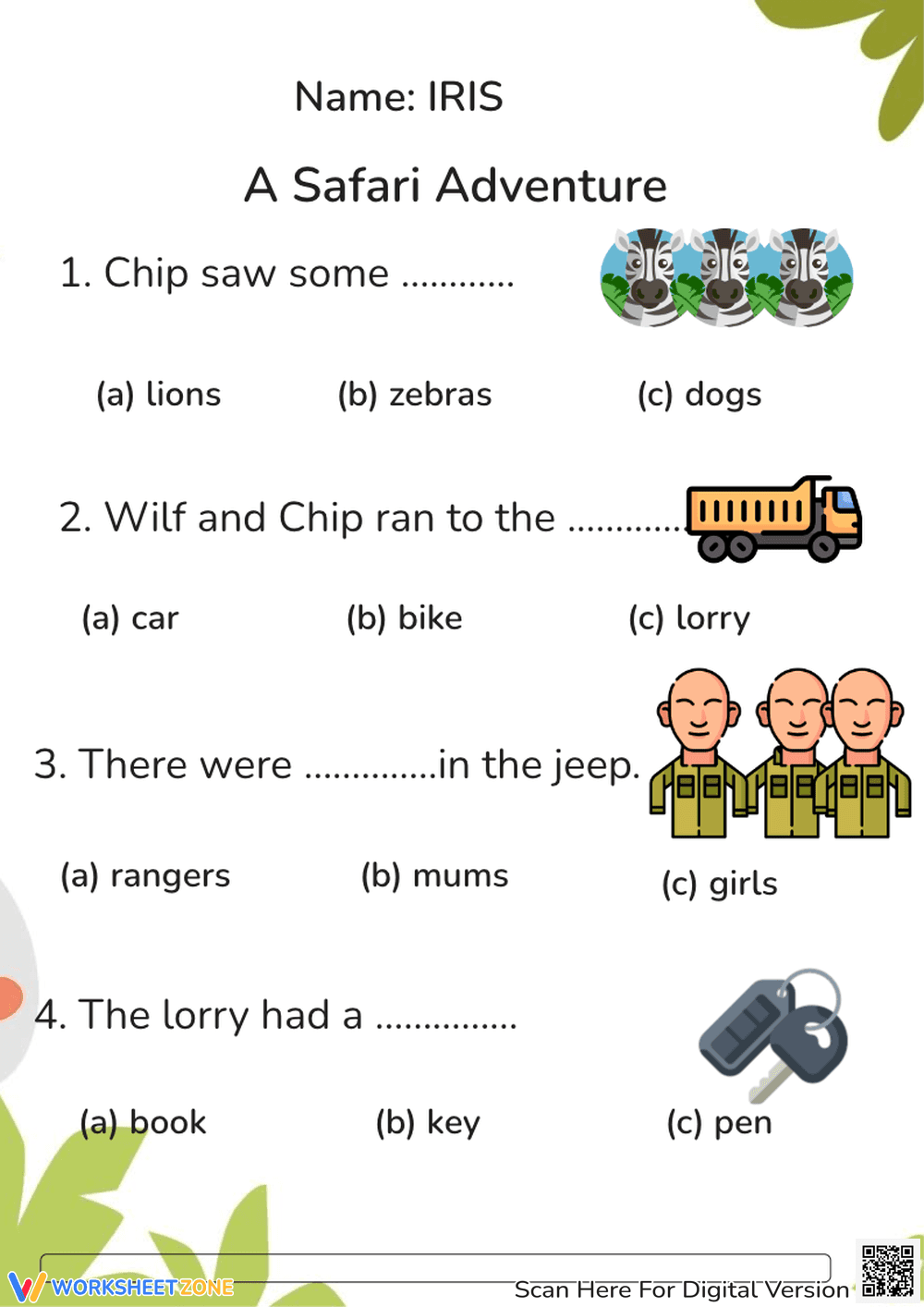

Grade 1 Safari Vocabulary — Essential Printable Worksheet
Paste this activity's link or code into your existing LMS (Google Classroom, Canvas, Teams, Schoology, Moodle, etc.).
Students can open and work on the activity right away, with no student login required.
You'll still be able to track student progress and results from your teacher account.
This Grade 1 reading comprehension worksheet helps young learners master sentence completion using visual context clues. Students read simple sentences about a safari trip and select the correct word from multiple-choice options that match the provided illustrations. It effectively bridges the gap between decoding and meaning-making for early readers during their literacy block.
At a Glance
- Grade: 1 · Subject: ELA
- Standard:
CCSS.ELA-LITERACY.RI.1.7— Use illustrations and details in a text to describe its key ideas- Skill Focus: Visual Context Clues
- Format: 1 page · 4 problems · Answer key included · PDF
- Best For: Morning work or literacy centers
- Time: 5–10 minutes
What's Inside
The worksheet features four distinct sentence-completion tasks. Each task includes a short sentence with a blank, a high-quality color illustration (zebras, a lorry, rangers, and a key), and three multiple-choice options. The single-page PDF format is designed for clarity, with large fonts and clear spacing tailored for first-grade motor skills and focus levels.
Zero-Prep Workflow
This resource is designed for immediate classroom implementation. 1. Print: Select the single-page PDF and print enough copies for your group in under 30 seconds. 2. Distribute: Hand out the sheets during your literacy block or as a transition activity (1 minute). 3. Review: Use the included answer key for rapid grading or peer-checking (30 seconds). Total teacher prep time is under two minutes, making it a perfect sub-plan addition.
Standards Alignment
The primary focus is `CCSS.ELA-LITERACY.RI.1.7`, which requires students to use illustrations and details in a text to describe its key ideas. By matching the word "zebras" to the picture of zebras, students demonstrate foundational reading comprehension. Both standard codes can be copied directly into lesson plans, IEP goals, or district curriculum mapping tools.
How to Use It
Assign this worksheet during the "You Do" phase of a gradual release lesson on context clues. It serves as an excellent formative assessment to see if students can transfer visual information into text selection. Observe if students look at the picture before or after reading the options. Expect students to complete the four tasks in approximately 5 to 10 minutes.
Who It's For
This resource is ideal for general education first graders, English Language Learners (ELLs) who benefit from visual scaffolding, and students with IEPs focusing on basic vocabulary. It pairs naturally with a classroom read-aloud about African animals or a safari-themed anchor chart to reinforce the vocabulary used in the sentences.
According to the RAND AIRS 2024 report on early literacy, the integration of visual scaffolds with text-based tasks significantly improves word recognition and retention in Grade 1 learners. This worksheet utilizes the CCSS.ELA-LITERACY.RI.1.7 standard to ensure students are not just decoding phonetically but are actively engaging with the semantic meaning of the text through pictorial support. Research from Fisher & Frey (2014) emphasizes that visual context clues are a critical component of the gradual release of responsibility, allowing students to build confidence before moving to text-only comprehension. By providing 4 targeted tasks, this resource offers a high-density practice opportunity that fits within a standard 10-minute instructional window. Educators can use these results to track progress toward foundational literacy benchmarks and identify students who may require additional phonemic or vocabulary intervention in subsequent lessons.


