


























Views
Downloads

Suffix Practice Worksheet | Grade 3 Essential Grammar
Paste this activity's link or code into your existing LMS (Google Classroom, Canvas, Teams, Schoology, Moodle, etc.).
Students can open and work on the activity right away, with no student login required.
You'll still be able to track student progress and results from your teacher account.
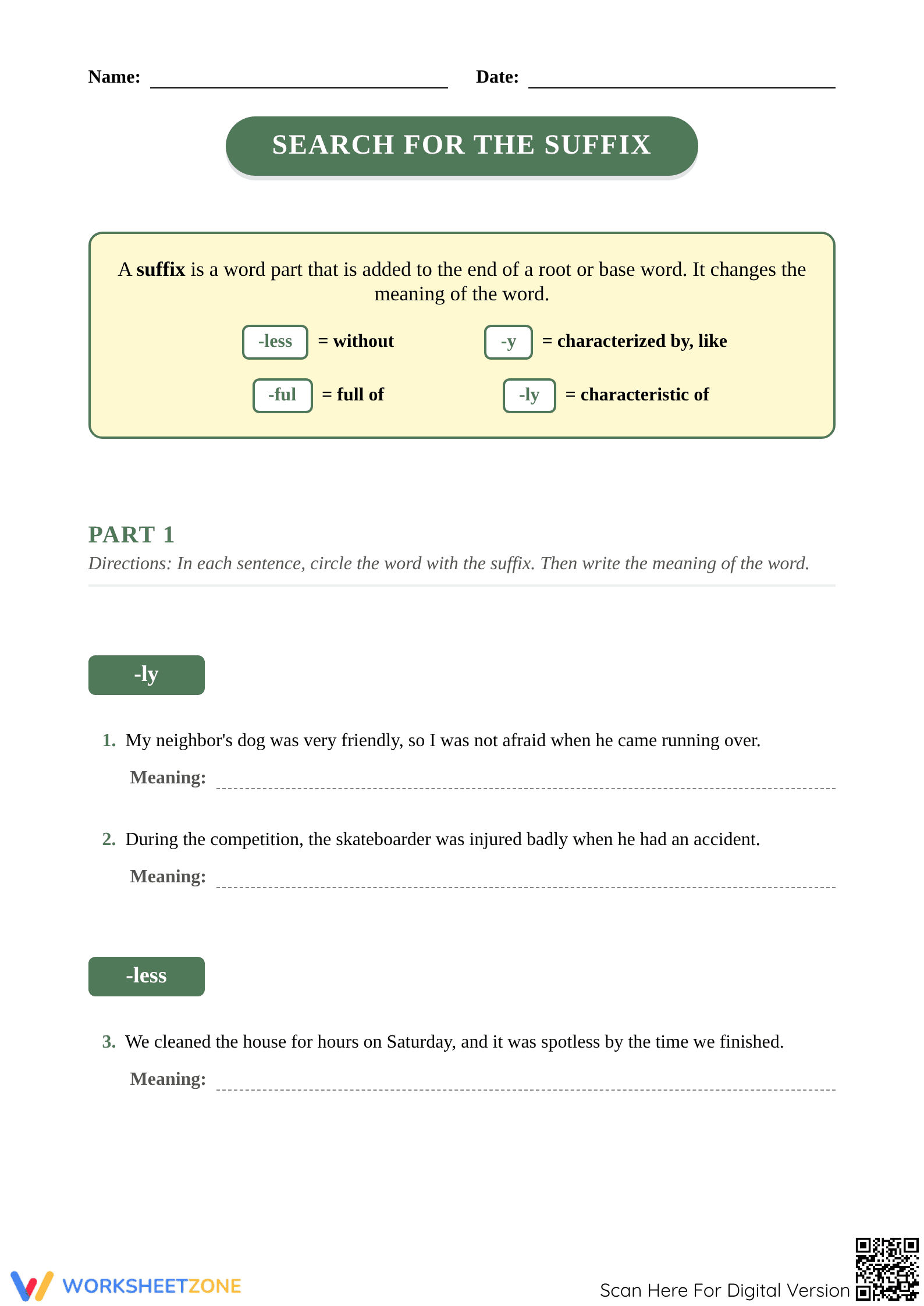
This Grade 3 vocabulary worksheet helps students decode complex words by breaking them down into base words and suffixes. By mastering common endings like -ly, -less, -ful, and -y, learners expand their reading comprehension and expressive language. Students move from identifying suffixed words in context to defining them independently using a provided reference guide.
At a Glance
- Grade: 3 · Subject: ELA Grammar
- Standard:
L.3.4.B— Determine the meaning of the new word formed when a known affix is added- Skill Focus: Suffix identification and definition
- Format: 2 pages · 12 problems · Answer key included · PDF
- Best For: Independent practice or literacy centers
- Time: 15–20 minutes
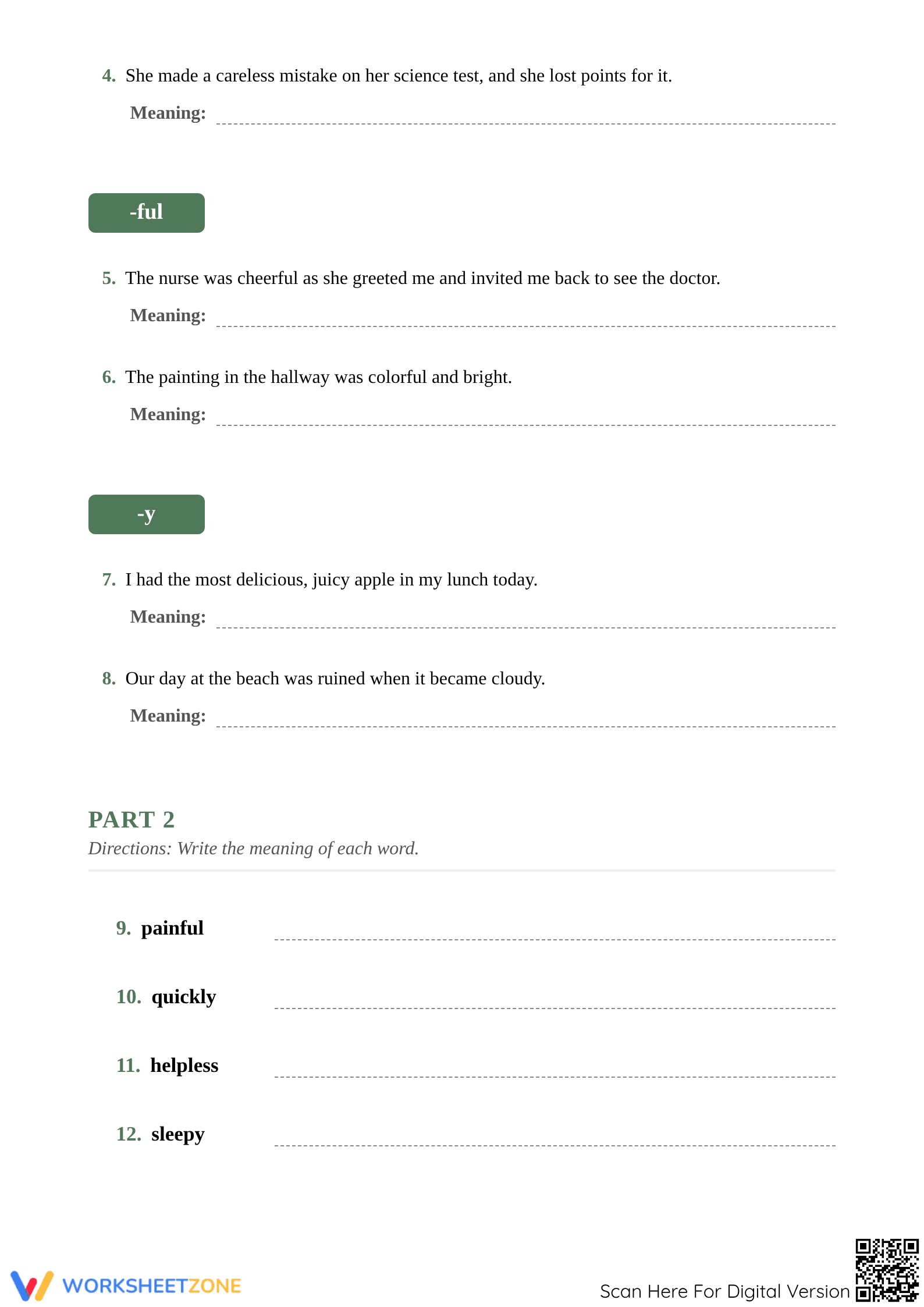
What's Inside: This two-page PDF features a clear instructional header that defines suffixes and provides a quick-reference key for four common endings. The worksheet contains 12 total tasks: 8 sentence-based identification problems and 4 direct definition exercises. A full answer key is provided to facilitate quick grading or student self-correction.
Skill Progression
- Guided Practice: The worksheet begins with a visual anchor chart defining -less, -y, -ful, and -ly to support initial attempts.
- Supported Practice: Part 1 includes 8 sentences where students must circle the target word and use context clues to write its meaning.
- Independent Practice: Part 2 challenges students to define words like "painful" and "sleepy" without sentence context, requiring internal mastery of the suffix rules.
This structure follows a gradual-release model, moving from high-support reference to independent application.
Standards Alignment
This resource is specifically designed for `CCSS.ELA-LITERACY.L.3.4.B`: "Determine the meaning of the new word formed when a known affix is added to a known word (e.g., agreeable/disagreeable, comfortable/uncomfortable, care/careless, heat/preheat)." It also supports foundational reading skills by encouraging students to decode multisyllabic words. Both standard codes can be copied directly into lesson plans, IEP goals, or district curriculum mapping tools.
How to Use It
Use this worksheet during the "You Do" phase of a lesson on word parts. It works well as a formative assessment after an introductory lesson on base words. For a quick check, assign Part 1 during class and use Part 2 as an exit ticket. Teachers should observe if students are correctly identifying the base word before applying the suffix definition. Expected completion time is 15 to 20 minutes.
Who It's For
This resource is ideal for third-grade students building their core vocabulary. It is also highly effective for English Language Learners (ELLs) who benefit from the explicit breakdown of word parts. Pair this with a suffix anchor chart or a word-sorting activity for a comprehensive literacy block.
Research by Fisher & Frey (2014) emphasizes that morphological awareness—the study of word parts like suffixes—is a significant predictor of reading comprehension in the upper elementary grades. This worksheet targets `L.3.4.B` by providing 12 structured opportunities for students to manipulate affixes. By isolating the suffix from the base word, students develop a transferable strategy for encountering unfamiliar academic language. The inclusion of a reference guide ensures that cognitive load is focused on the application of the rule rather than rote memorization. This systematic approach to vocabulary acquisition helps bridge the gap between simple decoding and deep text analysis. According to NAEP data, students who demonstrate proficiency in word-part analysis score significantly higher on standardized reading assessments, making this focused practice a vital component of a balanced ELA curriculum.


