


























Views
Downloads
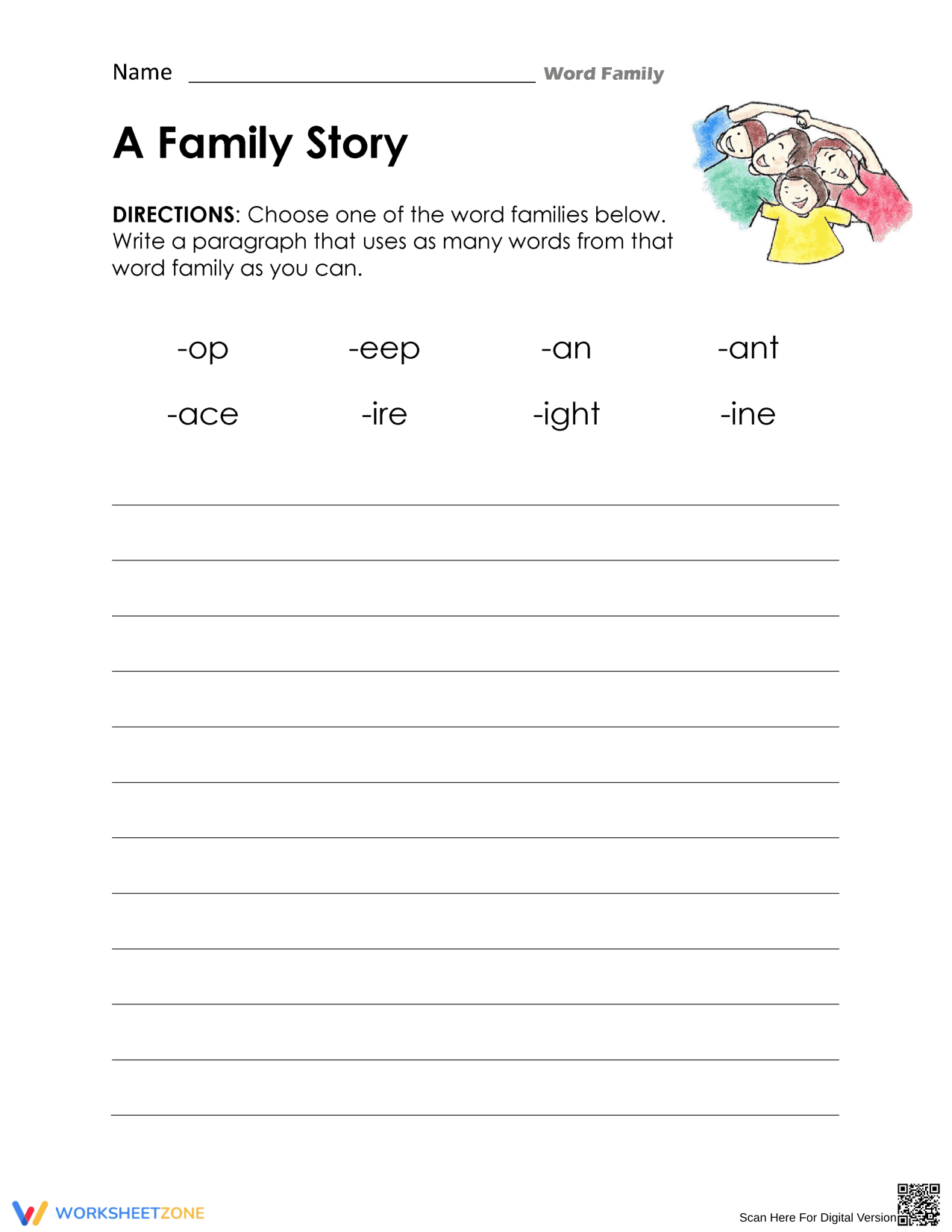

Essential Word Family Worksheet | Grade 1-2 ELA
Paste this activity's link or code into your existing LMS (Google Classroom, Canvas, Teams, Schoology, Moodle, etc.).
Students can open and work on the activity right away, with no student login required.
You'll still be able to track student progress and results from your teacher account.
This creative ELA worksheet helps first and second-grade students master phonics and creative writing simultaneously. By challenging learners to construct a cohesive story using specific word families, it bridges the gap between isolated phonics practice and functional literacy. Students develop spelling confidence while improving their narrative flow in a structured, engaging format.
At a Glance
- Grade: 1–2 · Subject: English Language Arts
- Standard:
CCSS.ELA-LITERACY.RF.1.3— Decode and write regularly spelled one-syllable words using common word families- Skill Focus: Phonics, Word Families, and Creative Writing
- Format: 1 page · 1 creative task · Answer key included · PDF
- Best For: Literacy centers and morning work
- Time: 15–20 minutes
What's Inside
Inside this printable PDF, you will find a focused one-page activity titled "A Family Story." The worksheet provides eight distinct word family rimes—including -op, -eep, -an, -ant, -ace, -ire, -ight, and -ine—as creative prompts. Students select one family and utilize a generous set of lined writing spaces to draft their own paragraph. The layout is clean and distraction-free, featuring a charming illustration of a family to set the thematic tone.
Zero-Prep Workflow
- Print: Generate the single-page PDF for your entire class in seconds.
- Distribute: Hand out the sheets during your literacy block or as a transition activity.
- Review: Quickly scan student paragraphs for phonetic accuracy and sentence structure.
The zero-prep design allows teachers to implement this activity in under two minutes. Because the instructions are self-explanatory, learners can begin working immediately with minimal verbal direction, making this an ideal resource for emergency sub plans or quiet transitions.
Standards Alignment
This resource aligns directly with CCSS.ELA-LITERACY.RF.1.3, which requires students to know and apply grade-level phonics and word analysis skills in decoding and encoding words. By focusing on common rimes, the worksheet supports the development of phonemic awareness and spelling patterns. This standard code can be copied directly into lesson plans, IEP goals, or district curriculum mapping tools to ensure instructional compliance.
How to Use It
Use this worksheet as a formative assessment after a direct instruction lesson on phonics and word families. It serves as an excellent bridge between "I Do" and "You Do" phases of the Gradual Release of Responsibility model. Teachers should observe whether students can generate multiple words for their chosen family before they begin writing the narrative. Expect students to take approximately 15 to 20 minutes to complete a thoughtful paragraph.
Who It's For
This activity is designed for first and second-grade students who are refining their spelling and narrative writing skills. It is particularly effective for English Language Learners (ELLs) who benefit from the visual scaffolding of word families to build vocabulary. This resource pairs naturally with a short story passage or an anchor chart displaying common rimes for additional support during the writing process.
The integration of word family rimes into creative writing tasks is a proven strategy for accelerating literacy development in early elementary grades. According to Fisher & Frey (2014), providing students with structured phonetic scaffolds like the ones in this worksheet—specifically targeting CCSS.ELA-LITERACY.RF.1.3—allows them to focus cognitive resources on narrative composition rather than just isolated decoding. This worksheet challenges Grade 1 and Grade 2 students to apply their knowledge of phonograms like -ight or -ace within a functional paragraph, which strengthens the neural pathways between spelling, reading, and meaning-making. By engaging in this type of generative writing, students demonstrate mastery of phonemic awareness while simultaneously building the syntactic complexity required for higher-order literacy. This approach aligns with NAEP findings that emphasize the importance of diverse writing opportunities in developing fluent, confident young authors who can manipulate language with precision and intent.


