


























Views
Downloads


The Great Gatsby Chapter 1 Worksheet | Essential Grade 8 ELA
Paste this activity's link or code into your existing LMS (Google Classroom, Canvas, Teams, Schoology, Moodle, etc.).
Students can open and work on the activity right away, with no student login required.
You'll still be able to track student progress and results from your teacher account.
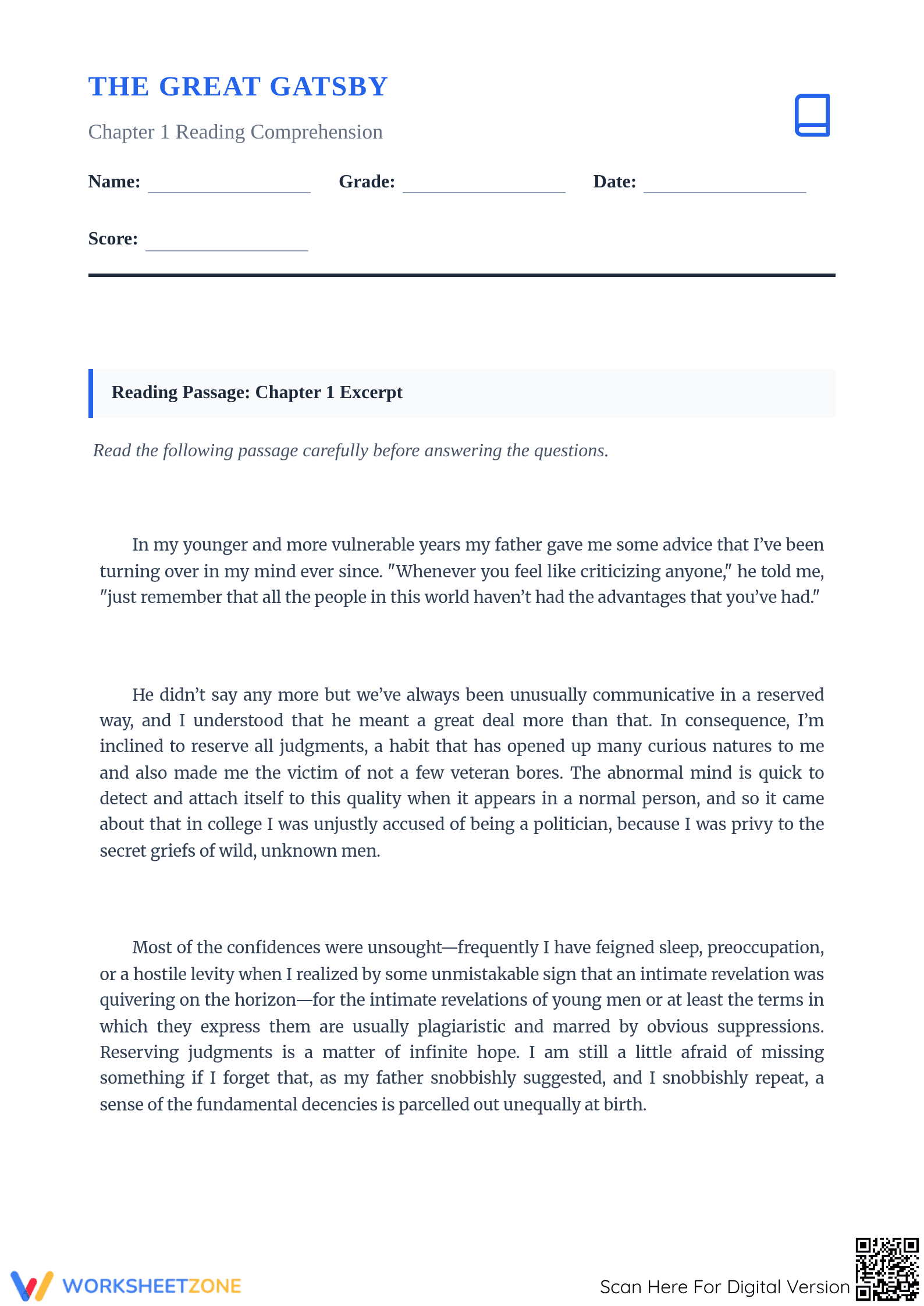
This Grade 8 literary analysis worksheet guides students through the complex opening of F. Scott Fitzgerald's The Great Gatsby. By engaging with the text's vocabulary and the narrator's perspective, students develop a deeper understanding of Nick Carraway's reliability. This resource ensures students master foundational character analysis before moving deeper into the novel.
At a Glance
- Grade: 8 · Subject: ELA
- Standard:
CCSS.ELA-LITERACY.RL.8.1— Cite textual evidence that most strongly supports an analysis of what the text says- Skill Focus: Literary Analysis & Comprehension
- Format: 5 pages · 10 problems · Answer key included · PDF
- Best For: Independent reading or sub plans
- Time: 35–45 minutes
This 5-page packet includes a Chapter 1 excerpt followed by three assessment sections. It features six multiple-choice questions targeting comprehension, three short-answer prompts requiring textual evidence, and a final critical thinking task regarding narrator reliability. A complete answer key with possible responses for open-ended questions is provided for efficient grading.
The workflow is designed for efficiency. Print the 5-page PDF (30 seconds). Distribute the packets to students for independent work (1 minute). Finally, use the included answer key to review responses or facilitate a whole-class discussion. Total teacher preparation time is under 2 minutes, making it an ideal choice for emergency sub plans or busy instructional days.
Standards Alignment
This resource aligns with `CCSS.ELA-LITERACY.RL.8.1`, requiring students to cite textual evidence that supports an analysis of what the text says explicitly. It also supports RL.8.3 by asking students to analyze how incidents reveal aspects of a character. Both standard codes can be copied directly into lesson plans, IEP goals, or district curriculum mapping tools.
How to Use It
Use this as a summative check after reading the first chapter to ensure students grasped the narrator's tone. Alternatively, assign it as a guided reading activity to help students navigate the dense prose. Formative assessment tip: Observe responses to question 10 to gauge ability to identify bias. Completion typically takes 35 to 45 minutes.
Who It's For
This packet is designed for Grade 8 but is appropriate for Grade 9 and 10. It provides scaffolding for struggling readers while challenging advanced learners with critical thinking. It pairs naturally with a character map or a direct instruction lesson on 1920s social hierarchies.
According to the RAND AIRS 2024 report on secondary literacy, structured reading guides that combine multiple-choice comprehension with open-ended evidence citation significantly improve student retention of complex narrative structures. This worksheet implements these findings by targeting CCSS.ELA-LITERACY.RL.8.1, ensuring students do not just read the words but actively interrogate the text for meaning. By focusing on the narrator's perspective in the first 10 tasks, the resource builds the analytical stamina required for high-school-level literary criticism. Research from Fisher & Frey (2014) suggests that such gradual-release models—moving from literal identification to critical evaluation—are essential for mastering the nuances of classic literature. This 5-page resource provides the necessary framework for students to transition from passive readers to active analysts of Fitzgerald's prose, making it a reliable tool for any middle or high school English Language Arts classroom.


