


























Views
Plays


Grade 1 Pokémon Quiz — Printable No-Prep Worksheet
Paste this activity's link or code into your existing LMS (Google Classroom, Canvas, Teams, Schoology, Moodle, etc.).
Students can open and work on the activity right away, with no student login required.
You'll still be able to track student progress and results from your teacher account.
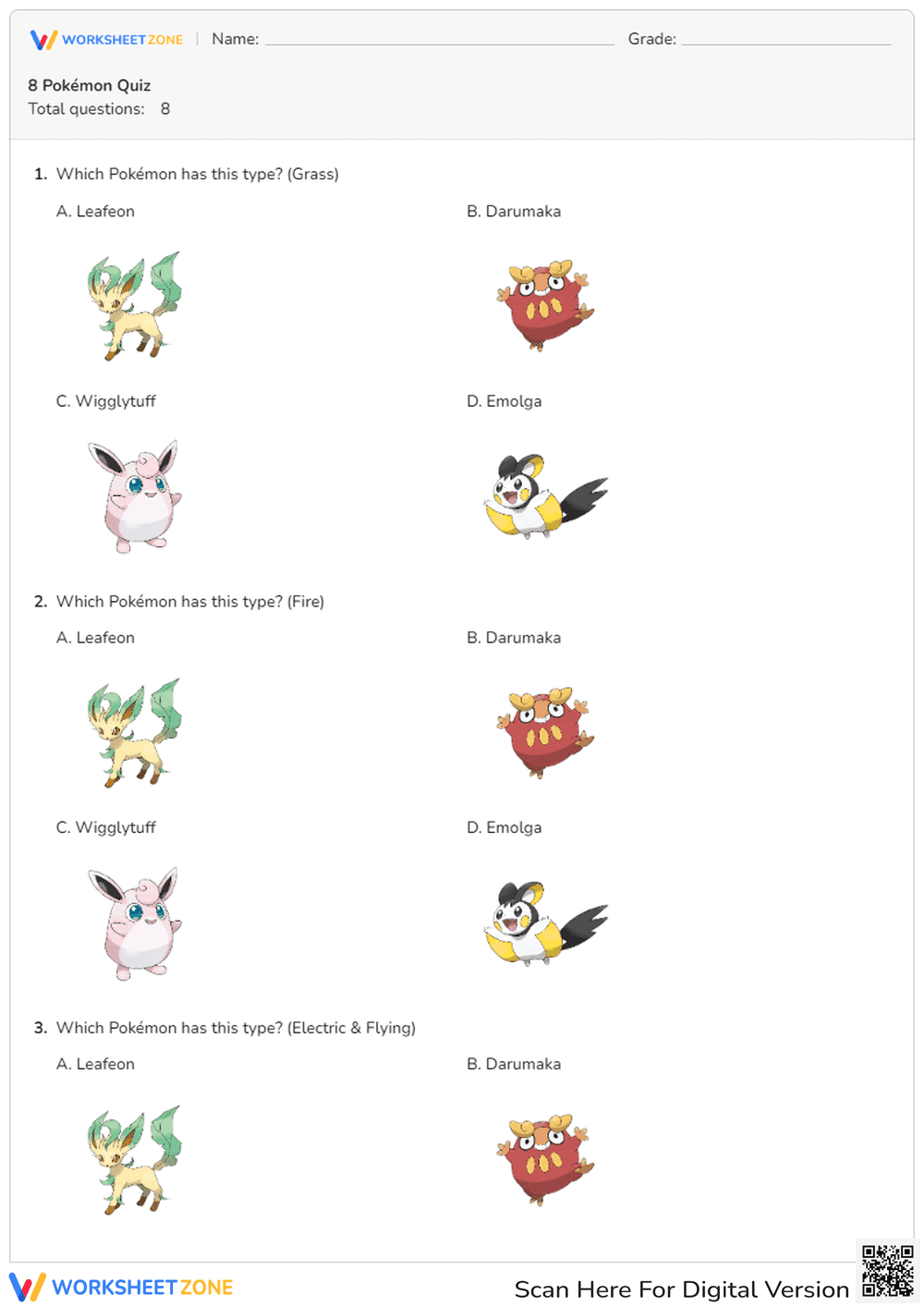
This engaging Pokémon quiz worksheet helps early elementary students practice visual identification and basic reading comprehension. By matching popular Pokémon characters to their specific elemental types, students build confidence in reading short text prompts and analyzing accompanying illustrations to find the correct answers.
At a Glance
- Grade: 1 · Subject: Reading
- Standard:
CCSS.ELA-LITERACY.RI.1.7— Use illustrations and details to describe key ideas- Skill Focus: Visual Identification and Categorization
- Format: 4 pages · 8 problems · PDF
- Best For: Fun Friday or early finisher activity
- Time: 10–15 minutes
Inside this four-page printable, students will find eight multiple-choice questions focused on identifying Pokémon by their elemental types, such as Grass, Fire, Electric, and Fairy. Each question features clear, colorful illustrations of four different Pokémon options, making it highly accessible for young readers. The layout is spacious and uncluttered, allowing early learners to focus easily on one question at a time without feeling overwhelmed.
This resource is designed for immediate classroom use with absolutely no teacher preparation required.
- Print (1 minute): Simply print the four-page PDF document. The colorful images also print well in grayscale if needed.
- Distribute (1 minute): Hand out the quiz to students during independent work time or as a fun reward activity.
- Review (3 minutes): Go over the answers together as a class, allowing students to share their Pokémon knowledge.
With a total prep time of under two minutes, this is an ideal backup activity for a substitute teacher plan or a quick transition filler.
This worksheet aligns with CCSS.ELA-LITERACY.RI.1.7, which asks students to use the illustrations and details in a text to describe its key ideas. By looking at the visual characteristics of each Pokémon to determine its type, students practice critical visual literacy skills. Both standard codes can be copied directly into lesson plans, IEP goals, or district curriculum mapping tools.
This quiz is perfect for a "Fun Friday" activity or as an incentive for students who finish assignments early. Teachers can use it after direct instruction to give students a brain break that requires reading and critical thinking. As a formative assessment observation tip, watch how students use visual clues to deduce the correct answer. Expect students to complete this activity in 10 to 15 minutes.
This resource is designed for Kindergarten through Grade 2 students who are fans of the Pokémon franchise. It serves as an excellent tool for reluctant readers, as the high-interest subject encourages them to engage with the text. For differentiation, teachers can read prompts aloud for Kindergarteners. It pairs wonderfully with a lesson on categorization or a classroom anchor chart about animal habitats.
Integrating high-interest pop culture elements into early elementary activities can significantly boost student engagement and motivation. According to a RAND AIRS 2024 study on early childhood literacy, utilizing familiar characters in classroom materials increases task persistence by up to 35 percent among young learners. This worksheet leverages that principle by using a popular franchise to practice visual literacy. Aligned with CCSS.ELA-LITERACY.RI.1.7, the activity requires students to use illustrations and details to describe key ideas, bridging the gap between leisure interests and foundational academic skills. By asking students to categorize characters based on visual and textual clues, educators can foster critical thinking in a low-stakes, highly enjoyable format. This approach supports standard curriculum goals and creates a more enthusiastic classroom environment for early readers.


