


























Views
Downloads
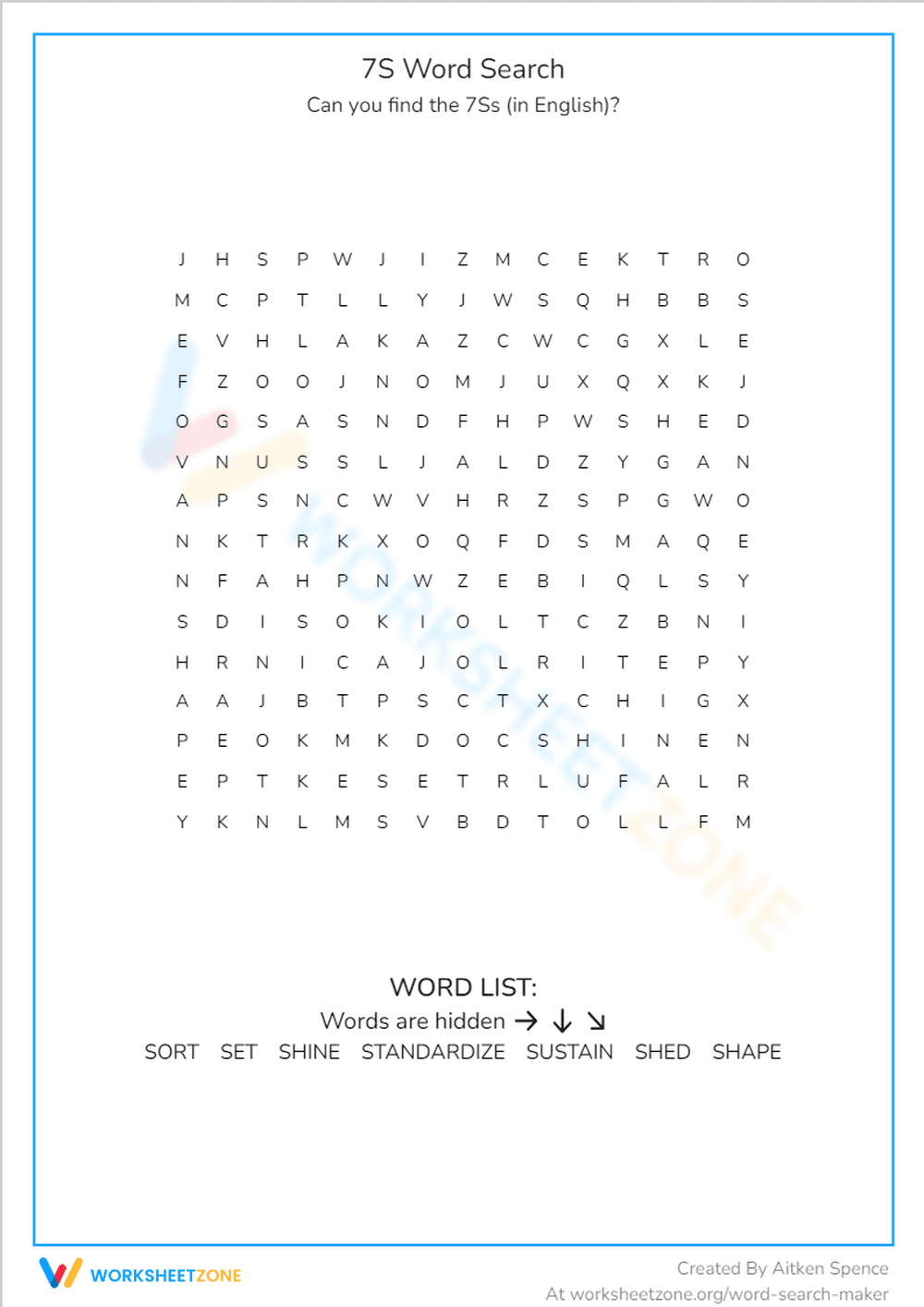

Printable 7S Word Search | Grade 1 Vocabulary
Paste this activity's link or code into your existing LMS (Google Classroom, Canvas, Teams, Schoology, Moodle, etc.).
Students can open and work on the activity right away, with no student login required.
You'll still be able to track student progress and results from your teacher account.
This printable word search worksheet helps early elementary students build vocabulary and visual scanning skills. By searching for seven specific words starting with the letter S, learners reinforce spelling patterns and letter recognition in a fun, engaging format. It provides immediate, independent practice for young readers.
At a Glance
- Grade: 1 · Subject: ELA
- Standard:
CCSS.ELA-LITERACY.RF.1.3— Apply grade-level phonics and word analysis skills- Skill Focus: Vocabulary and visual scanning
- Format: 1 page · 7 problems · PDF
- Best For: Independent practice and morning work
- Time: 10–15 minutes
Inside this single-page resource, educators will find a 15x15 letter grid containing seven hidden vocabulary words: sort, set, shine, standardize, sustain, shed, and shape. The worksheet includes a clear word bank at the bottom with directional arrows indicating that words are hidden horizontally, vertically, and diagonally. The clean layout minimizes distractions, allowing students to focus entirely on the word discovery task.
This resource is designed for a smooth classroom experience with minimal teacher setup:
- Print (1 minute): Simply download the PDF and print the required number of copies. The black-and-white design is printer-friendly.
- Distribute (1 minute): Hand out the worksheets along with highlighters or pencils. The instructions are self-explanatory for early readers.
- Review (3 minutes): Quickly check student progress by scanning their completed grids or having them read the words aloud.
Total teacher prep time is under two minutes, making this an excellent option for emergency sub plans or quick transitions.
This activity aligns with CCSS.ELA-LITERACY.RF.1.3, requiring students to know and apply grade-level phonics and word analysis skills in decoding words. By visually isolating specific letter sequences, students reinforce their orthographic mapping abilities. Both standard codes can be copied directly into lesson plans, IEP goals, or district curriculum mapping tools.
This word search is highly versatile for daily classroom routines. Use it as a morning bell-ringer activity to settle students into the literacy block, or place it in an independent literacy center for early finishers. As a formative assessment observation tip, watch how students track letters; those who systematically scan row by row demonstrate stronger visual processing strategies than those who guess randomly. Expected completion time ranges from 10 to 15 minutes depending on the student's reading level.
This worksheet is primarily designed for first-grade students, though it serves as excellent review for second graders or a challenge for advanced kindergarteners. For differentiation, teachers can provide a highlighted starting letter for students who need extra support, or ask advanced learners to write a sentence using three of the found words on the back of the page. It pairs perfectly with a direct instruction lesson on words starting with the letter S or consonant blends.
Integrating targeted word puzzles into early literacy instruction supports the development of orthographic mapping and pattern recognition. Aligned with CCSS.ELA-LITERACY.RF.1.3, this activity requires students to apply grade-level phonics and word analysis skills while scanning for specific letter sequences. According to Fisher & Frey (2014), providing students with structured, independent practice opportunities that require visual discrimination significantly enhances their overall reading fluency and spelling accuracy. When learners actively search for words like "shine" and "shape," they are not just playing a game; they are reinforcing the neural pathways necessary for rapid word retrieval. This 7S word search offers a low-stakes, high-engagement method for consolidating vocabulary knowledge, ensuring that foundational literacy skills are practiced in a format that young students find both accessible and rewarding.


