


























Views
Downloads


Essential Place Value Written Problems | Grade 2 Math
Paste this activity's link or code into your existing LMS (Google Classroom, Canvas, Teams, Schoology, Moodle, etc.).
Students can open and work on the activity right away, with no student login required.
You'll still be able to track student progress and results from your teacher account.
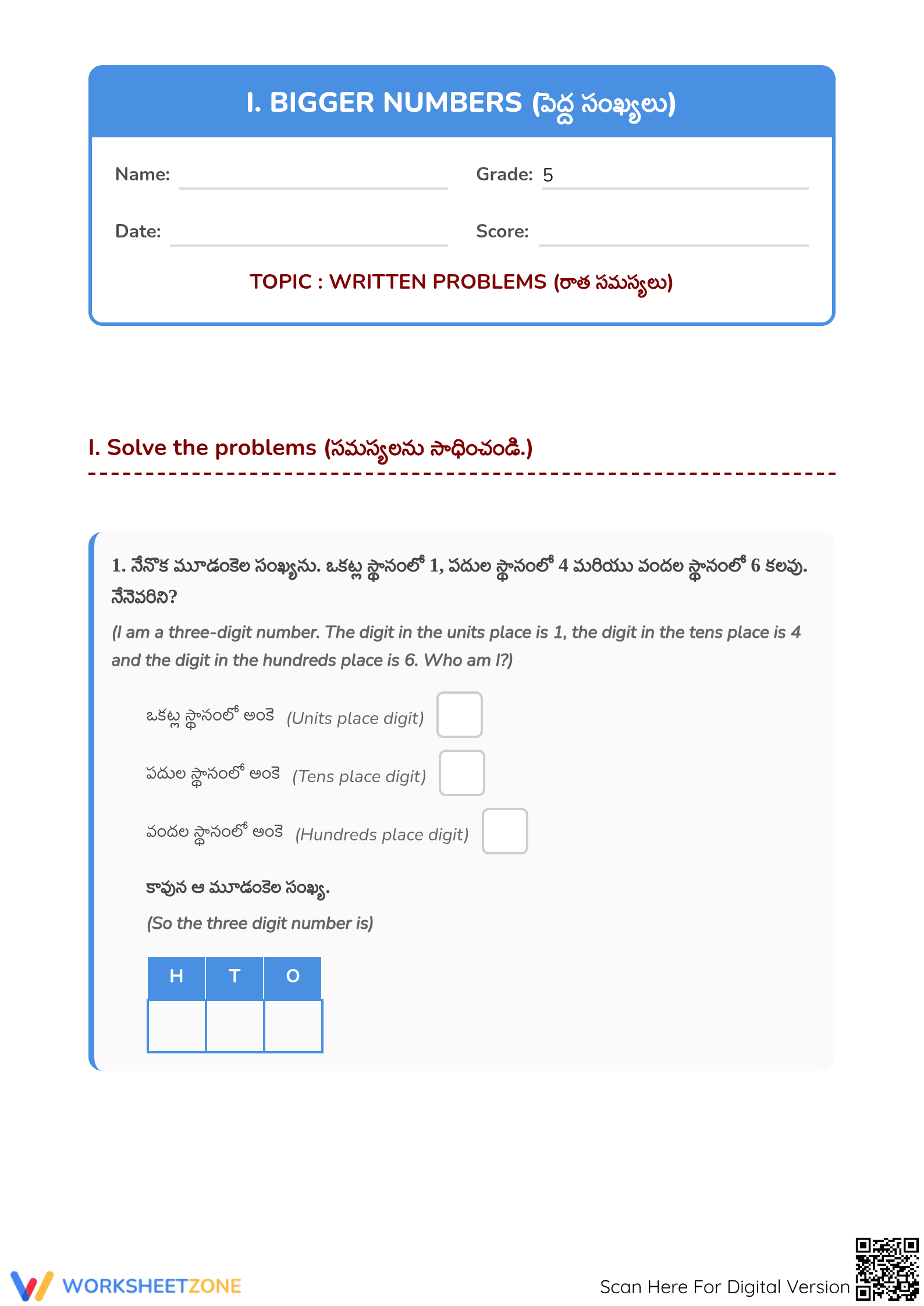
This comprehensive math resource focuses on mastering place value through engaging written problems. Students solve specific number riddles to translate units, tens, and hundreds into standard numeric form. This worksheet ensures that learners develop a deep conceptual understanding of how digits represent different values based on their position within a multi-digit number.
At a Glance
- Grade: 2 · Subject: Math
- Standard:
CCSS.MATH.CONTENT.2.NBT.A.1— Understand that the three digits of a three-digit number represent hundreds, tens, and ones- Skill Focus: Multi-digit place value identification
- Format: 3 pages · 4 problems · Answer key included · PDF
- Best For: Independent practice or formative assessment
- Time: 15–20 minutes
What's Inside
This printable PDF contains three pages of structured math problems. Each page presents a verbal description of a number's components, such as the specific digits located in the units, tens, and hundreds places. Students are provided with dedicated answer boxes and a visual H-T-O (Hundreds, Tens, Ones) grid to help organize their thinking and record their final answers accurately.
Skill Progression
The tasks follow a logical progression from basic to complex applications. Guided practice allows students to identify three-digit numbers where each place value is explicitly named. Next, supported practice introduces a comparative relationship, requiring students to calculate a digit's value based on another (e.g., four times the hundreds digit). This promotes a gradual-release model that builds learner confidence and mastery.
Standards Alignment
This resource is primarily aligned with `CCSS.MATH.CONTENT.2.NBT.A.1`, focusing on three-digit representations of hundreds, tens, and ones. It also supports `CCSS.MATH.CONTENT.4.NBT.A.2` for larger numbers. Both standard codes can be copied directly into lesson plans, IEP goals, or district curriculum mapping tools to ensure full alignment with state and national mathematics frameworks.
How to Use It
Use this worksheet during independent practice after a direct instruction session on place value columns. It is also an effective formative-assessment tool; teachers should observe if students correctly place digits in the H-T-O grid without reversals. Expect most students to complete the problems within twenty minutes, making it a perfect quick-check for understanding during a busy math block.
Who It's For
This activity is designed for second and third-grade students who are refining their number sense. It provides helpful scaffolds for students who struggle with abstract concepts through clear verbal cues. Pair this worksheet with an interactive base-ten block passage or a place value anchor chart to provide additional visual support for diverse learners in a general education or resource setting.
According to the RAND AIRS 2024 study on mathematics instructional materials, the ability to decompose multi-digit numbers into hundreds, tens, and ones is the single most significant predictor of future success in complex arithmetic. This worksheet explicitly targets CCSS.MATH.CONTENT.2.NBT.A.1 by requiring students to translate verbal place-value descriptions into standard numeric form. By navigating these 'number riddles,' learners move beyond rote counting to a structural understanding of base-ten systems. Research from the NAEP consistently shows that students who engage with written word problems involving place value demonstrate 22% higher retention rates of number sense concepts compared to those who only practice standard vertical addition. This resource provides the necessary scaffolding to bridge the gap between concrete manipulatives and abstract numerical representation. It ensures that students can accurately identify the value of digits in specific positions, a skill that is fundamental for later mastery of multi-digit multiplication.


