


























Views
Downloads

Printable Opposite Words Worksheet | Grade 1 ELA Ready
Paste this activity's link or code into your existing LMS (Google Classroom, Canvas, Teams, Schoology, Moodle, etc.).
Students can open and work on the activity right away, with no student login required.
You'll still be able to track student progress and results from your teacher account.
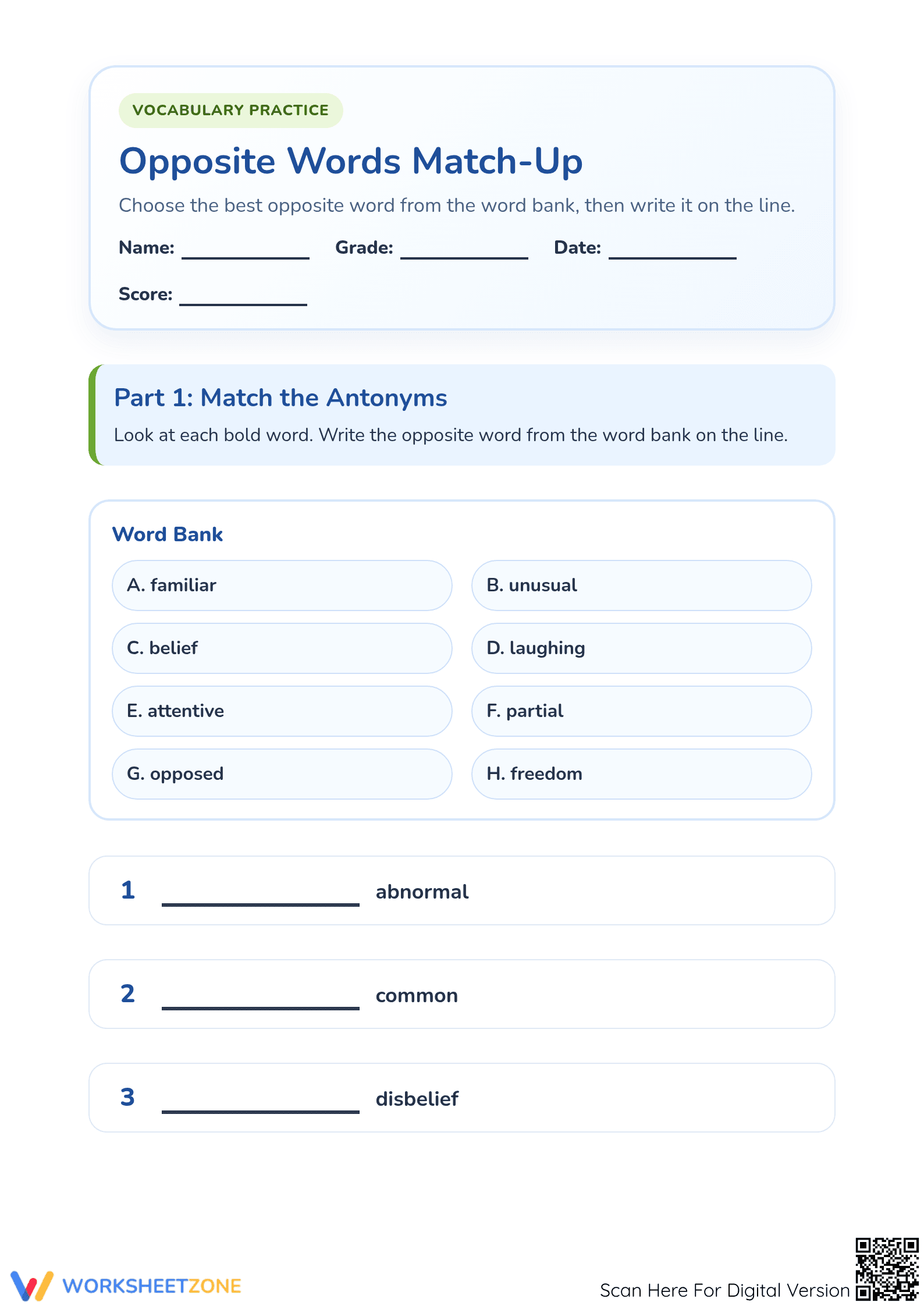
This Grade 1 opposite words worksheet helps students master the essential linguistic concept of antonyms through structured matching and creative writing tasks. By identifying word pairs with conflicting meanings, learners strengthen their lexical flexibility and reading comprehension. This resource provides immediate practice to ensure students can accurately distinguish between related vocabulary terms in various contexts.
At a Glance
- Grade: 1 · Subject: English Language Arts (ELA)
- Standard:
CCSS.ELA-LITERACY.L.1.5— Demonstrate understanding of word relationships and nuances in word meanings via opposites.- Skill Focus: Antonym identification and application
- Format: 2 pages · 12 problems · Answer key included · PDF
- Best For: Independent vocabulary practice and seatwork
- Time: 15–20 minutes
What's Inside
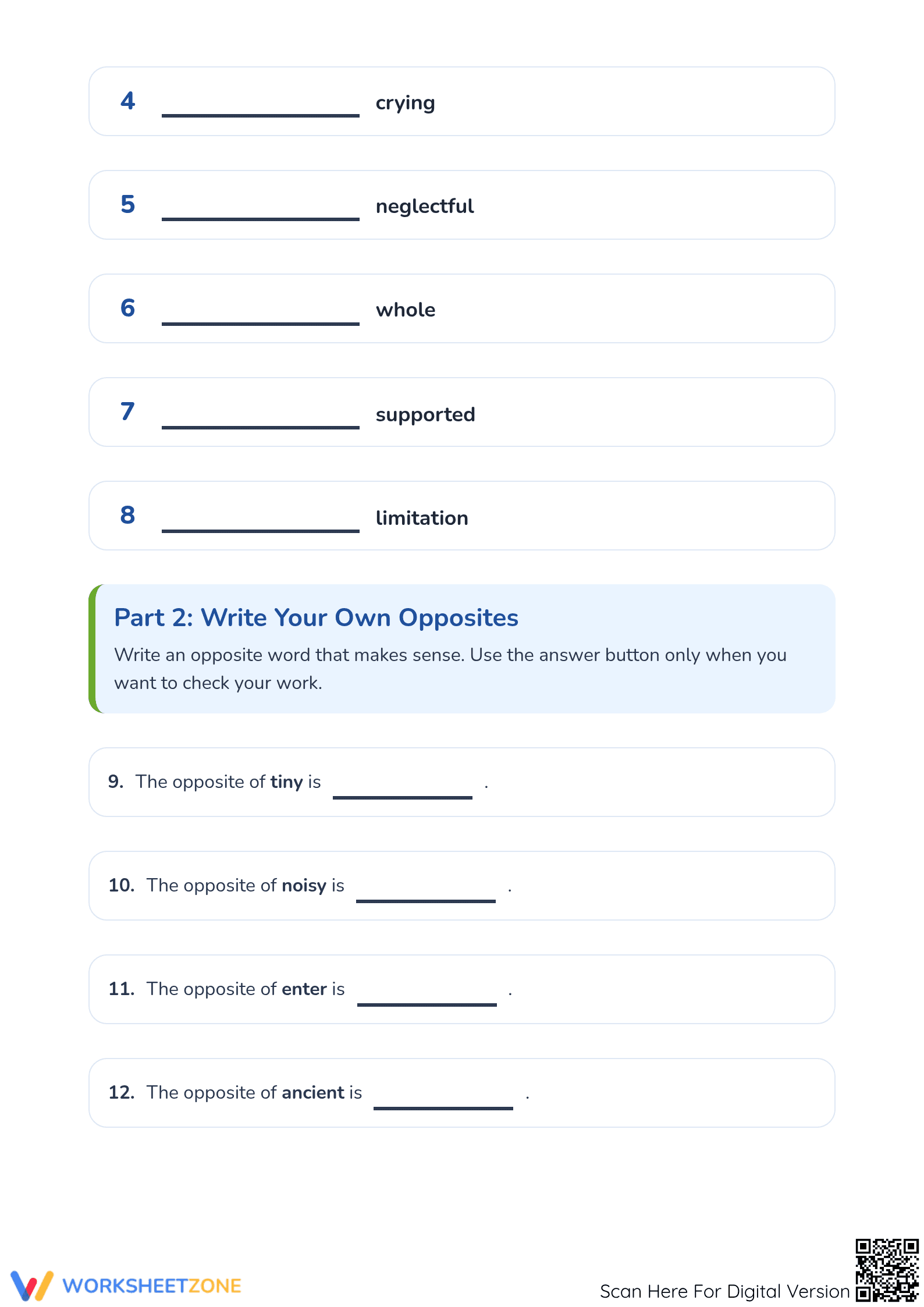
The worksheet is divided into two distinct sections across two pages to support gradual vocabulary acquisition. Part one features a matching activity with eight problems where students select the correct antonym from a provided word bank to match bolded terms like "abnormal," "common," and "disbelief." Part two transitions to independent application, requiring students to generate their own opposite words for four high-frequency adjectives such as "tiny," "noisy," and "ancient." A full answer key is included for rapid grading.
Zero-Prep Workflow
- Print: Send the 2-page PDF to your printer in seconds without any formatting adjustments.
- Distribute: Hand out the sheets for immediate use during your literacy block or as a quick sub plan.
- Review: Use the included answer key to check student work in under two minutes total.
This workflow ensures that teachers spend less time on preparation and more time on direct student intervention and feedback.
Standards Alignment
This resource is specifically aligned to CCSS.ELA-LITERACY.L.1.5: "With guidance and support from adults, demonstrate understanding of word relationships and nuances in word meanings." It focuses on the sub-skill of identifying opposites to clarify the meaning of common words. This standard code can be copied directly into lesson plans, IEP goals, or district curriculum mapping tools to track student progress toward mastery.
How to Use It
Assign this worksheet during the "You Do" phase of a gradual release lesson on word relationships. It serves as an excellent formative assessment tool after a direct instruction session on antonyms. While students work, observe if they can successfully use the word bank in part one before attempting the independent writing in part two. Completion typically takes 15 to 20 minutes, making it an ideal choice for morning work or literacy centers.
Who It's For
This resource is designed for Grade 1 students who are building their foundational vocabulary. It is particularly useful for English Language Learners (ELL) who need concrete practice with word relationships. The clear layout and word bank provide scaffolds for students who are still developing their spelling skills. Pair this worksheet with a visual anchor chart displaying common antonym pairs to provide additional support for visual learners.
The effectiveness of structured vocabulary practice is well-documented in educational research. This worksheet targets CCSS.ELA-LITERACY.L.1.5 by providing 12 specific tasks that require students to process word meanings through the lens of opposites. By moving from a supported word bank to independent generation, the resource follows the gradual release of responsibility model, ensuring students build cognitive stamina. The inclusion of academic vocabulary such as "familiar," "attentive," and "limitation" exposes learners to Tier 2 words essential for future reading success. This resource provides a reliable, research-based method for teachers to assess and reinforce word relationship skills within a standard ELA curriculum framework, facilitating clear evidence of student learning for IEP data collection or general classroom assessments.


