


























Views
Downloads
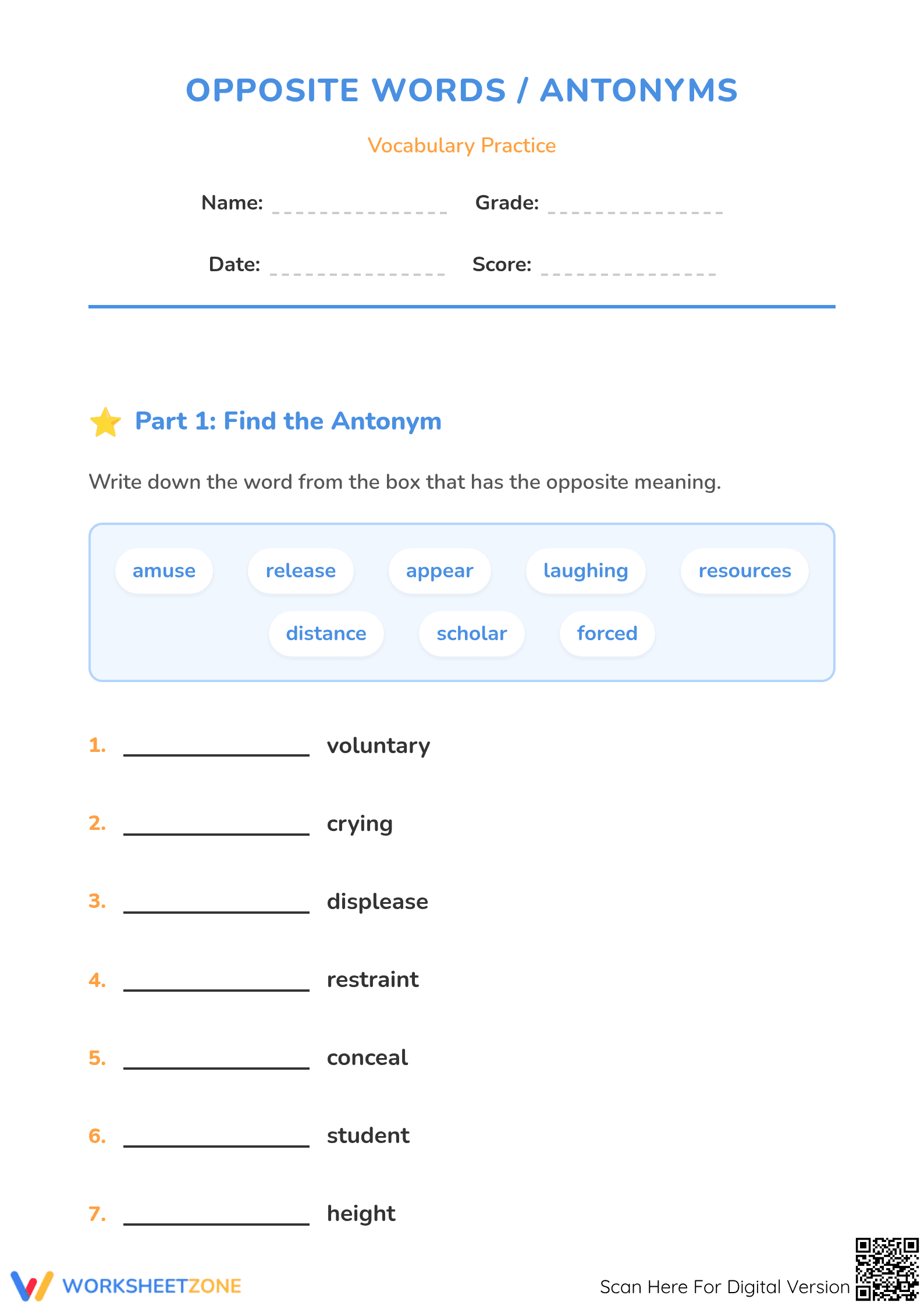


Essential Antonyms Worksheet | Grade 5 ELA Practice
Paste this activity's link or code into your existing LMS (Google Classroom, Canvas, Teams, Schoology, Moodle, etc.).
Students can open and work on the activity right away, with no student login required.
You'll still be able to track student progress and results from your teacher account.
This Grade 5 vocabulary worksheet strengthens linguistic precision by challenging students to identify and apply antonyms across multiple formats. By engaging with high-level lexical pairs, learners develop a more nuanced understanding of word relationships and improve their reading comprehension. Students will move from simple identification to applying opposites within complex sentence structures.
At a Glance
- Grade: 5 · Subject: ELA
- Standard:
CCSS.ELA-LITERACY.L.5.5.C— Use word relationships like antonyms to better understand the meaning of each word- Skill Focus: Antonym identification and contextual application
- Format: 3 pages · 17 problems · Answer key included · PDF
- Best For: Independent vocabulary practice and formative assessment
- Time: 20–30 minutes
What's Inside
This comprehensive 3-page PDF includes three distinct sections designed to build mastery. Part 1 features a word bank for direct antonym identification, Part 2 utilizes a matching format for quick recall, and Part 3 provides sentence-level application using context clues. The resource includes a full answer key, making it easy for teachers or parents to provide immediate feedback on student progress.
Skill Progression
- Guided Practice: The first 8 tasks use a word bank to scaffold the identification of opposites for academic terms like "voluntary" and "restraint."
- Supported Practice: A matching section requires students to differentiate between similar concepts, such as "frequent" versus "rare," without a word bank.
- Independent Practice: The final 5 tasks require students to select the correct antonym from a list to complete sentences, demonstrating true contextual mastery.
This structure follows a gradual-release model, moving students from recognition to application.
Standards Alignment
This resource aligns with CCSS.ELA-LITERACY.L.5.5.C: "Use the relationship between particular words (e.g., synonyms, antonyms, homographs) to better understand each of the words." It also supports general vocabulary acquisition goals found in many state frameworks. Both standard codes can be copied directly into lesson plans, IEP goals, or district curriculum mapping tools.
How to Use It
Use this worksheet during the "independent practice" phase of a vocabulary lesson or as a morning work activity to reinforce previous instruction. For a formative assessment, observe how students handle Part 3; if they struggle to find the opposite of "accidental" within the sentence, it may indicate a need for more direct instruction on context clues. Expect completion in 20 to 30 minutes.
Who It's For
This resource is designed for Grade 5 students but is highly effective for Grade 4 enrichment or Grade 6 intervention. It is particularly useful for English Language Learners (ELLs) who are building their academic lexicon. Pair this worksheet with a classroom anchor chart on word relationships or a short reading passage to see these antonyms in a broader narrative context.
Research by Fisher & Frey (2014) emphasizes that word consciousness—the awareness of and interest in words and their meanings—is significantly enhanced when students explore word relationships like antonyms. This worksheet addresses CCSS.ELA-LITERACY.L.5.5.C by providing 17 targeted opportunities for students to analyze how opposites define the boundaries of word meaning. By moving from isolated word pairs to sentence-level application, the resource ensures that students are not just memorizing definitions but are understanding the functional utility of antonyms in communication. This approach aligns with evidence-based practices for vocabulary acquisition, which suggest that multiple exposures in varied formats lead to higher retention rates. The inclusion of academic vocabulary such as "intentional," "poverty," and "optimist" ensures that the cognitive demand remains appropriate for upper elementary learners, facilitating the transition from basic language to more sophisticated academic discourse.


