


























Views
Downloads
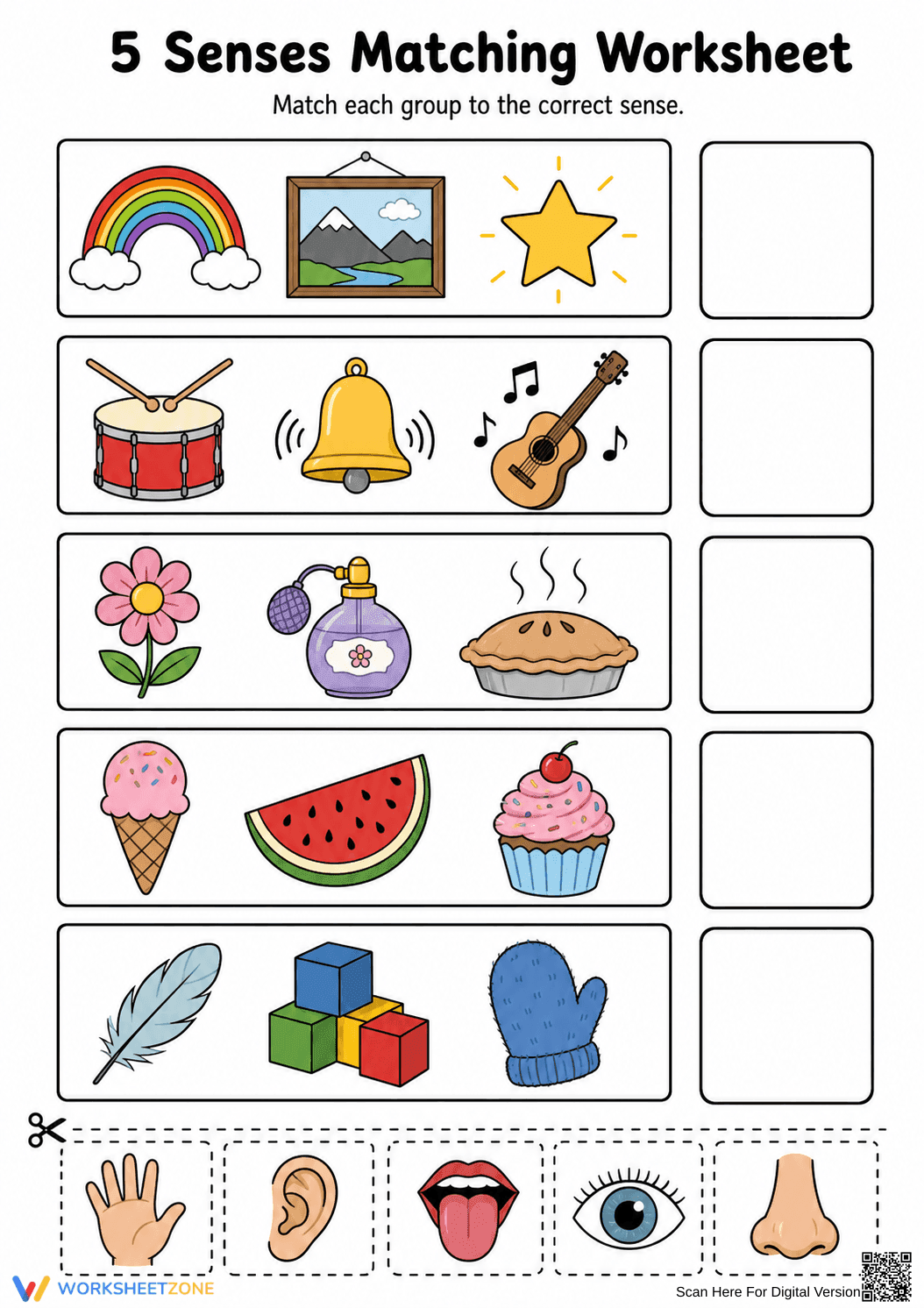

Printable 5 Senses Matching Worksheet | Grade 5 Science
Paste this activity's link or code into your existing LMS (Google Classroom, Canvas, Teams, Schoology, Moodle, etc.).
Students can open and work on the activity right away, with no student login required.
You'll still be able to track student progress and results from your teacher account.
This Grade 5 five senses worksheet provides a foundational review of biological perception and sensory categorization. Students identify various visual stimuli and match them to the correct sensory organ through a tactile cut-and-paste activity. By connecting concrete objects to specific senses, learners strengthen their ability to categorize environmental information effectively.
At a Glance
- Grade: 5 · Subject: Science
- Standard:
CCSS.ELA-LITERACY.L.5.6— Acquire and use accurately domain-specific words and phrases- Skill Focus: Sensory Categorization
- Format: 1 page · 5 problems · Answer key included · PDF
- Best For: Independent practice and science review
- Time: 10–15 minutes
What's Inside
The resource consists of a single-page PDF featuring five distinct categories of stimuli. Each row contains three illustrative examples, such as musical instruments for sound, food items for taste, or textured objects for touch. At the bottom of the page, students will find five cut-out icons representing the eye, ear, mouth, nose, and hand. The clear layout and visual cues support independent completion while keeping students engaged.
Zero-Prep Workflow
This resource is designed for immediate classroom implementation with three simple steps:
- Print: Select the single-page PDF and print enough copies for your cohort (1 minute).
- Distribute: Provide students with scissors and glue sticks to begin the matching activity (1 minute).
- Review: Use the provided answer key to conduct a quick whole-class check (3 minutes).
Total teacher preparation time is under 2 minutes, making this an ideal solution for morning work, science centers, or emergency sub plans.
Standards Alignment
This activity is aligned with CCSS.ELA-LITERACY.L.5.6: "Acquire and use accurately grade-appropriate general academic and domain-specific words and phrases." It also supports foundational NGSS concepts related to how organisms process information through sensory receptors. Both standard codes can be copied directly into lesson plans, IEP goals, or district curriculum mapping tools.
How to Use It
Assign this worksheet during the introductory phase of a science unit on human body systems to gauge prior knowledge. Alternatively, use it as a pre-writing exercise in ELA to help students brainstorm sensory details for descriptive narratives. Expect students to complete the task in 10 to 15 minutes. While they work, observe if students can explain why certain objects, like a pie, might stimulate multiple senses simultaneously.
Who It's For
This worksheet is designed for Grade 5 students who require a visual refresher on sensory systems. It is particularly effective for English Language Learners (ELLs) and students with IEPs who benefit from reduced text density and kinesthetic learning. Pair this resource with a sensory bin activity or a descriptive writing anchor chart for a comprehensive instructional block.
According to Fisher & Frey (2014), the use of non-linguistic representations, such as the pictorial matching found in this five senses worksheet, is a critical scaffold for academic vocabulary acquisition. This Grade 5 resource aligns with CCSS.ELA-LITERACY.L.5.6 by requiring students to acquire and use accurately domain-specific words and phrases. Research indicates that students who can effectively bridge concrete observations with abstract terminology demonstrate higher proficiency in descriptive writing and scientific inquiry. By isolating the five primary senses—sight, sound, smell, taste, and touch—this activity provides the foundational schema necessary for more complex biological studies or literary analysis. The structured format reduces cognitive load, allowing learners to focus on the relationship between environmental stimuli and human perception. This evidence-based approach ensures that even foundational review tasks contribute meaningfully to the mastery of upper-elementary standards, providing a reliable tool for inclusive classrooms.


