


























Views
Downloads

Grade 5 Five Senses Printable Worksheet | Essential Science
Paste this activity's link or code into your existing LMS (Google Classroom, Canvas, Teams, Schoology, Moodle, etc.).
Students can open and work on the activity right away, with no student login required.
You'll still be able to track student progress and results from your teacher account.
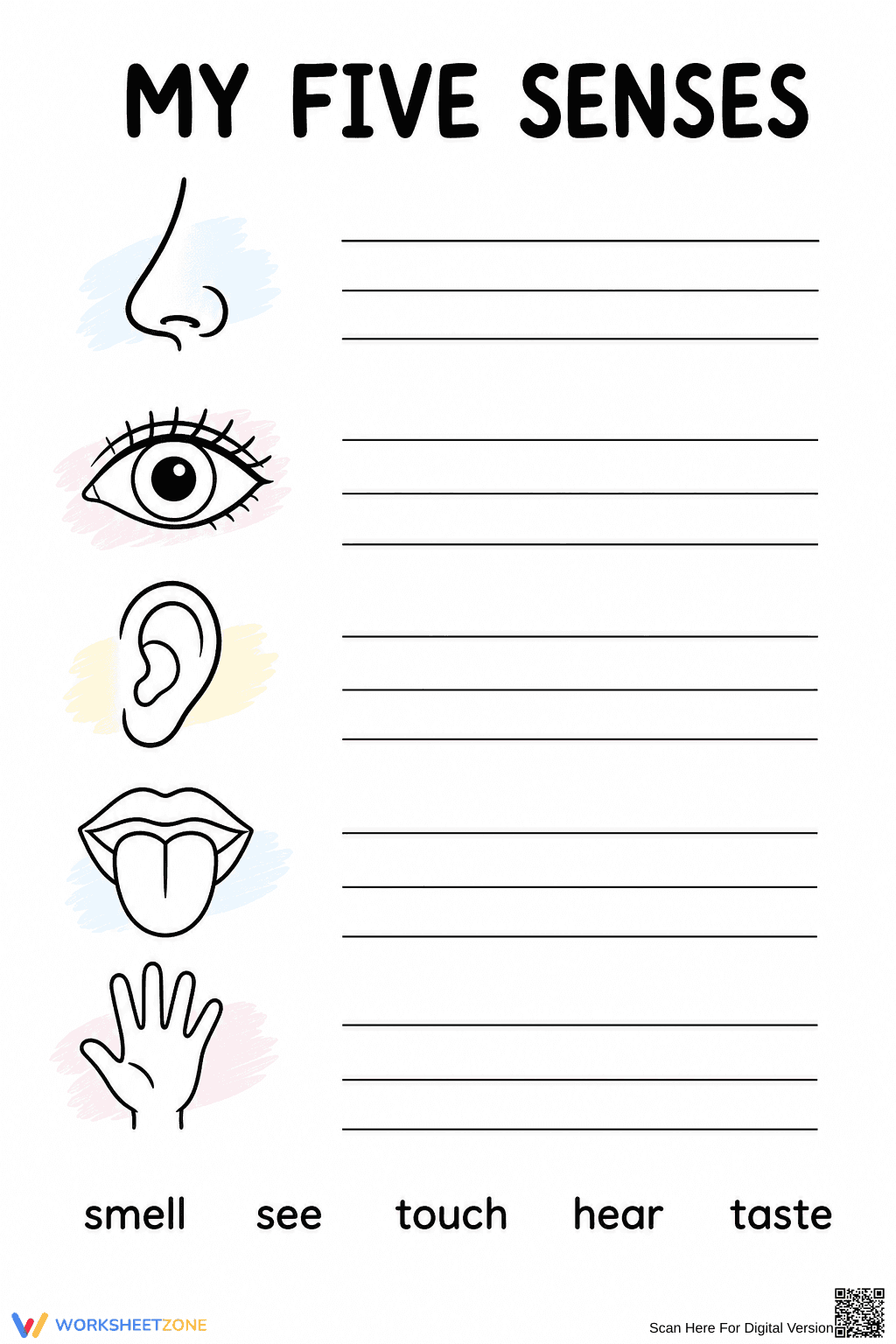
This Grade 5 vocabulary worksheet helps students identify and write domain-specific words related to the five senses. By matching sensory organs to their corresponding actions using a provided word bank, learners reinforce foundational biology concepts and spelling skills in a clear, straightforward format.
At a Glance
- Grade: 5 · Subject: Science
- Standard:
CCSS.ELA-LITERACY.L.5.6— Acquire and use domain-specific words and phrases accurately- Skill Focus: Five Senses Vocabulary
- Format: 1 page · 5 problems · Answer key included · PDF
- Best For: Independent practice, quick review, or emergency sub plans
- Time: 5–10 minutes of focused student work
This single-page resource offers a visual matching activity. It features five illustrations of sensory organs—a nose, eye, ear, mouth, and hand. Next to each image are writing lines for penmanship practice. A word bank at the bottom includes the terms "smell," "see," "touch," "hear," and "taste," providing scaffolding for accurate completion. An answer key is included for rapid grading.
Zero-Prep Workflow
This resource is designed for immediate classroom implementation with minimal teacher effort:
- Print (1 minute): Simply download the PDF and print the required number of copies.
- Distribute (1 minute): Hand out the worksheets along with pencils. The clear visual cues mean students can begin working immediately without extensive directions.
- Review (3 minutes): Use the included answer key to quickly check student responses or conduct a whole-class review.
With prep time under two minutes, this worksheet is ideal for emergency sub plans or morning work.
Standards Alignment
This activity aligns with CCSS.ELA-LITERACY.L.5.6, which requires students to acquire and use accurately grade-appropriate general academic and domain-specific words and phrases. By connecting the biological terms for sensory actions to their corresponding anatomical structures, students build essential cross-curricular vocabulary.
How to Use It
This worksheet serves as an effective warm-up activity before direct instruction on the human nervous system or sensory processing. Alternatively, it functions well as a quick formative assessment after a lesson on human biology. While students are working, teachers can observe if learners are relying heavily on the word bank or if they can independently match the organ to the sense. Expected completion time ranges from 5 to 10 minutes, making it a perfect transition activity.
Who It's For
This resource is primarily designed for Grade 5 students reviewing basic biological concepts or English Language Learners (ELLs) building foundational vocabulary. The inclusion of a word bank and clear visual icons provides built-in differentiation, supporting students who benefit from visual scaffolding. It pairs perfectly with an introductory science text on the human body or a classroom anchor chart detailing how our brains process sensory information.
Mastering domain-specific vocabulary is a critical component of cross-curricular academic success in elementary education. This worksheet targets CCSS.ELA-LITERACY.L.5.6, helping students acquire and use domain-specific words by connecting sensory organs to their functional verbs. Integrating visual scaffolds with targeted vocabulary practice significantly improves retention rates for diverse learners bridging ELA and Science concepts. By requiring students to physically write the words while referencing clear anatomical illustrations, the activity reinforces neural pathways associated with memory and language acquisition. This multimodal approach ensures that foundational concepts regarding the five senses are firmly established, providing a necessary stepping stone for more complex biological studies in middle school. The structured format minimizes cognitive overload, allowing students to focus entirely on the vocabulary acquisition process. This 1-page resource provides 5 specific tasks to ensure mastery and long-term retention of essential scientific terminology.


