


























Views
Downloads


Essential Antonyms Worksheet | Grade 1 Printable ELA
Paste this activity's link or code into your existing LMS (Google Classroom, Canvas, Teams, Schoology, Moodle, etc.).
Students can open and work on the activity right away, with no student login required.
You'll still be able to track student progress and results from your teacher account.
This Grade 1 ELA worksheet provides a thorough exploration of opposite words, helping students build essential vocabulary. By identifying and applying antonyms in various contexts, learners strengthen their ability to describe the world precisely. This 4-page packet turns abstract word relationships into concrete, manageable practice for early elementary readers.
At a Glance
- Grade: 1 · Subject: ELA
- Standard:
CCSS.ELA-LITERACY.L.1.5— Demonstrate understanding of word relationships and nuances in word meanings- Skill Focus: Antonyms and Opposites
- Format: 4 pages · 26 problems · Answer key included · PDF
- Best For: Independent practice or small group literacy centers
- Time: 20–30 minutes
What's Inside
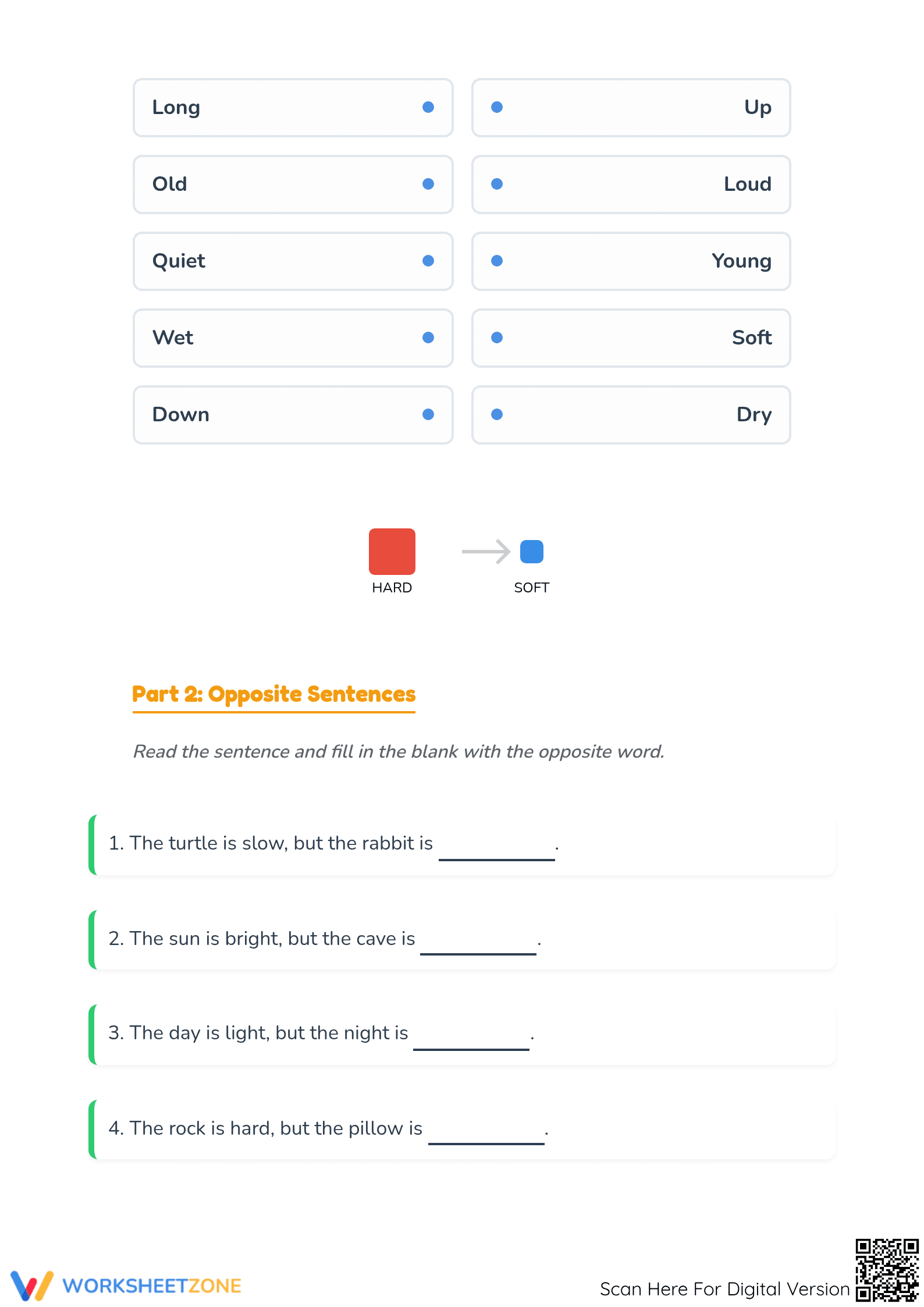
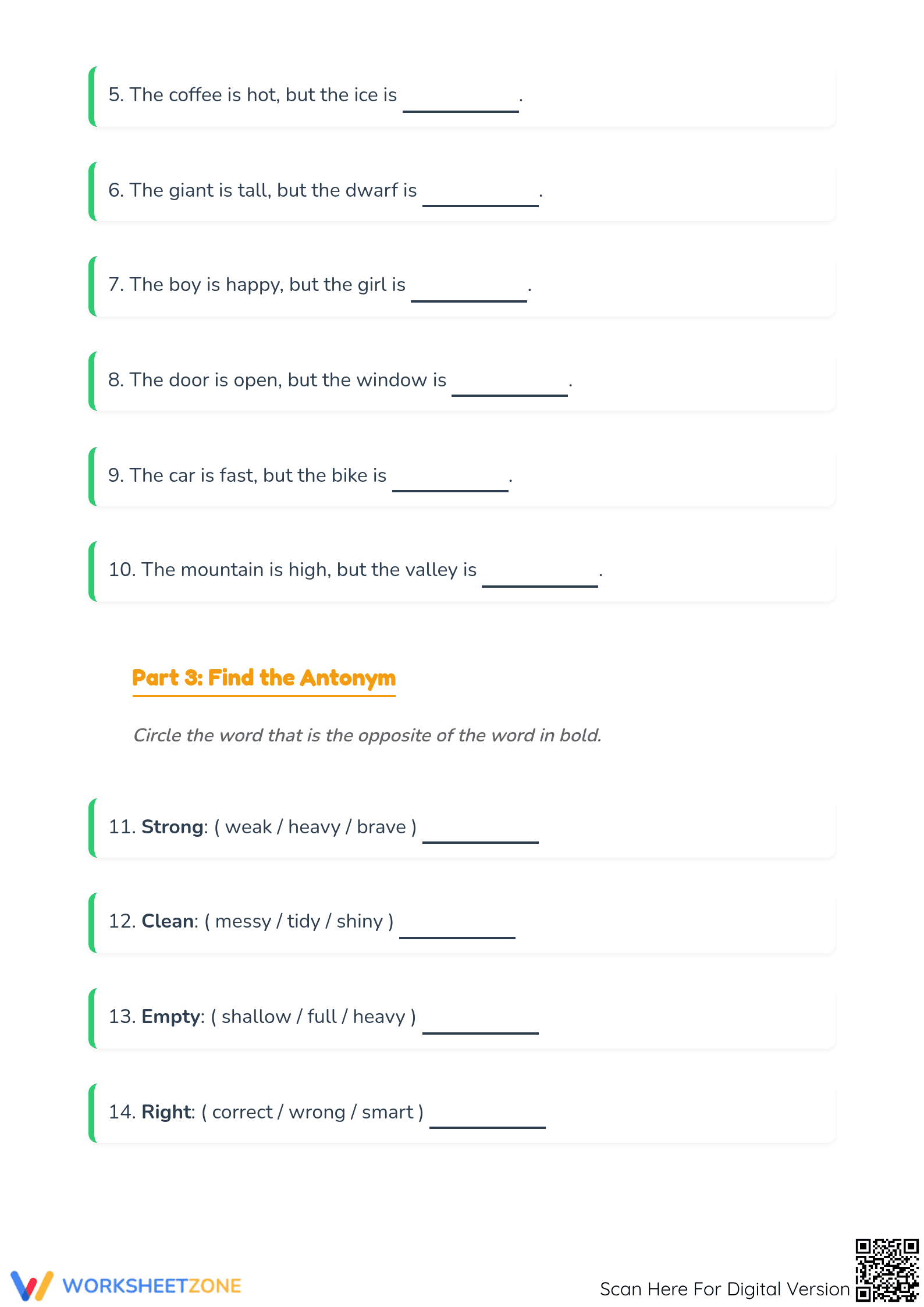
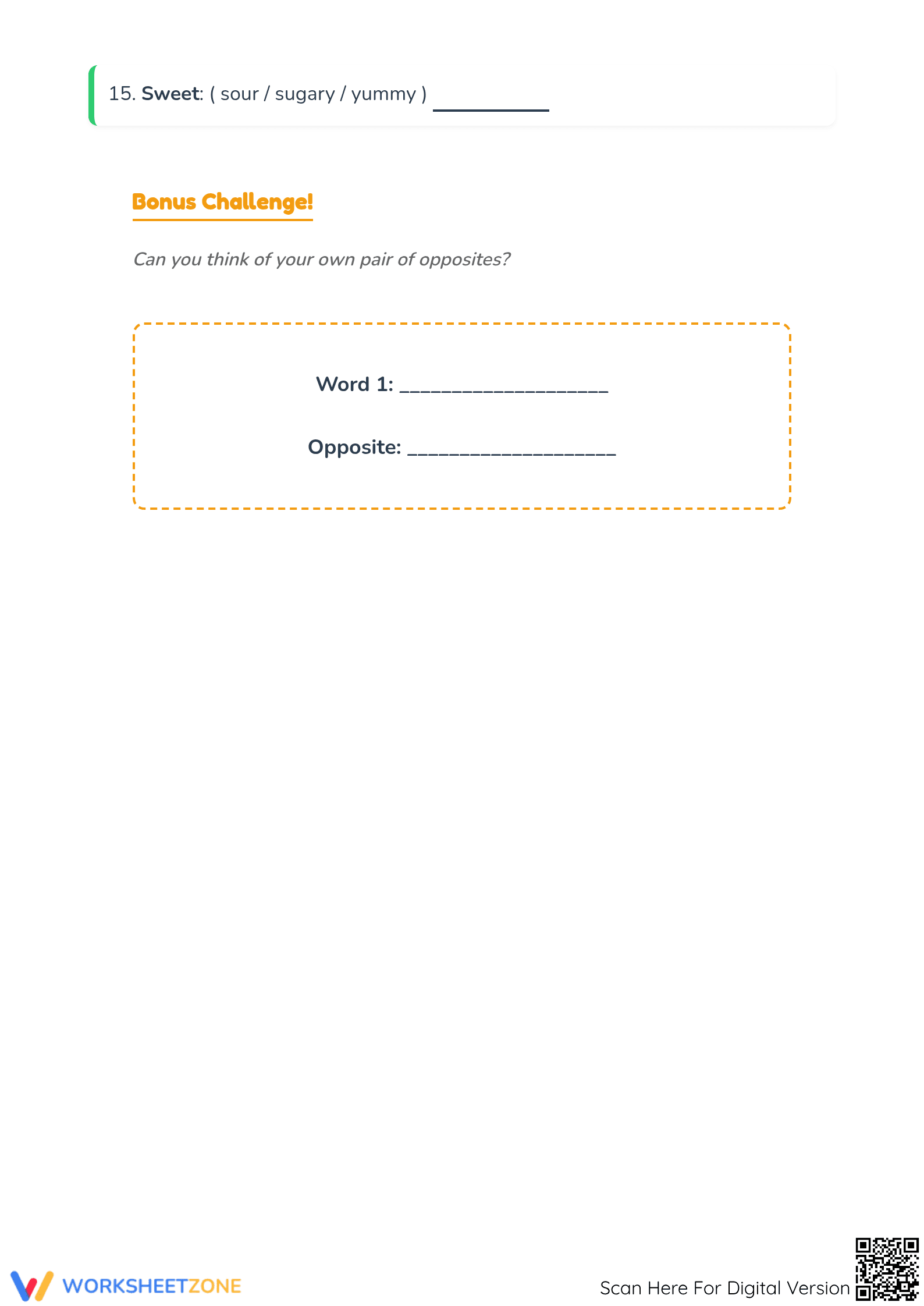
This comprehensive 4-page PDF features twenty-six distinct tasks. Part 1 includes fifteen matching pairs with visual support. Part 2 transitions to sentence-level application with ten fill-in-the-blank prompts requiring students to derive antonyms from context. Part 3 offers multiple-choice questions to refine selection skills, followed by a creative bonus. A full answer key ensures quick checking.
Zero-Prep Workflow
This resource is engineered for immediate deployment with a total teacher prep time under 2 minutes. Step 1: Print the four-page PDF (1 minute). Step 2: Distribute to students for independent work (30 seconds). Step 3: Use the provided answer key for rapid whole-class review (30 seconds). Its self-explanatory layout makes it a perfect choice for emergency sub plans or morning work.
Standards Alignment
This targets CCSS.ELA-LITERACY.L.1.5, which requires students to demonstrate understanding of word relationships. It specifically focuses on recognizing how words with opposite meanings interact within categories. This standard code can be copied directly into lesson plans, IEP goals, or district curriculum mapping tools for easy tracking.
How to Use It
Deploy this packet as a summative assessment after a lesson on descriptive adjectives. Alternatively, use Part 1 for guided practice before assigning the sentences for homework. During completion, observe if students can verbalize why a word is an opposite; this formative check reveals if they truly understand the conceptual shift. Expect 25 minutes for full completion.
Who It's For
This activity is designed for first-grade students but serves as an intervention for second graders needing reinforcement. It supports English Language Learners with high-frequency word pairings and predictable sentence structures. Pair this with a shared reading of "The Foot Book" or an anchor chart displaying common opposite pairs.
The systematic practice of word relationships, particularly antonyms, is a cornerstone of early lexical development as outlined in the CCSS.ELA-LITERACY.L.1.5 standard. Research from the NAEP indicates that students who possess a robust word consciousness demonstrate significantly higher reading comprehension scores in later grades. This worksheet provides the structured repetition necessary to move antonym recognition from a conscious effort to an automatic reflex. By engaging with 26 tasks across multiple formats, students develop a flexible understanding of how opposites function in both isolated pairs and connected text. According to Fisher & Frey (2014), gradual release of responsibility through scaffolded practice—like the matching-to-sentence progression found here—ensures that cognitive load is managed while maximizing retention. This resource offers a complete, evidence-based solution for mastering foundational ELA opposites in the primary classroom.


