


























Views
Downloads


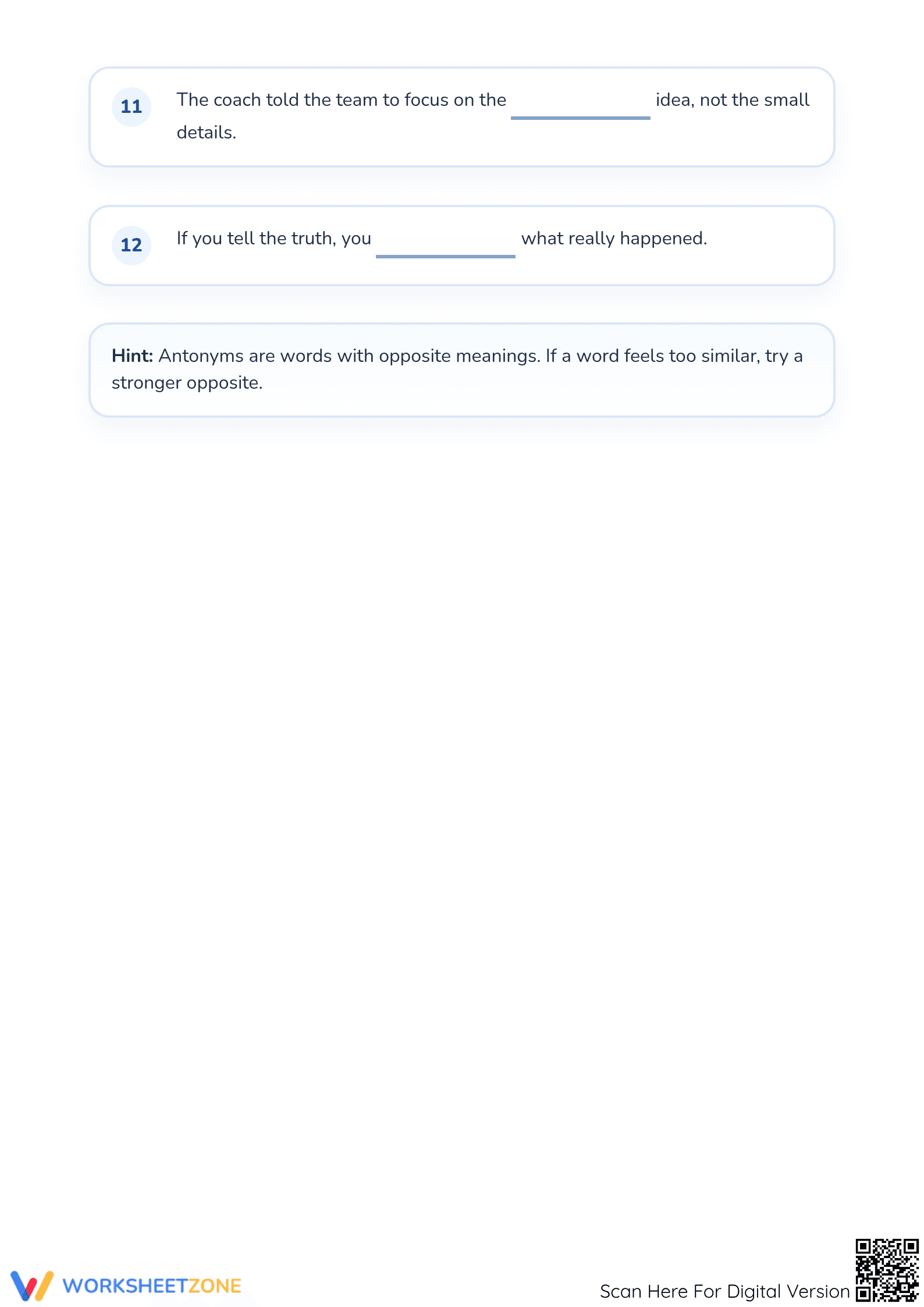

Printable 4th Grade Antonyms & Opposite Words Worksheet
Paste this activity's link or code into your existing LMS (Google Classroom, Canvas, Teams, Schoology, Moodle, etc.).
Students can open and work on the activity right away, with no student login required.
You'll still be able to track student progress and results from your teacher account.
Mastering lexical relationships is a cornerstone of advanced literacy. This 4th Grade antonyms worksheet empowers students to broaden their vocabulary by identifying and applying precise word opposites. By engaging with complex terms like "satisfaction" and "inferior," learners move beyond basic synonyms toward a nuanced understanding of English semantics and context-driven word choice.
At a Glance
- Grade: 4 · Subject: ELA
- Standard:
CCSS.ELA-LITERACY.L.4.5.c— Relate words to their opposites (antonyms) to demonstrate understanding- Skill Focus: Antonym Identification & Application
- Format: 3 pages · 12 problems · Answer key included · PDF
- Best For: Vocabulary enrichment and independent practice
- Time: 15–20 minutes
What's Inside
This three-page PDF offers a comprehensive sequence for exploring antonyms. The first part features a curated word bank containing eight high-utility academic terms, paired with corresponding identification tasks. The second part transitions students into sentence-level application, requiring them to integrate the correct antonym to complete meaningful context clues. A built-in hint section and a full answer key facilitate self-correction and immediate feedback.
Skill Progression
- Guided Practice: The exercise begins with 8 matching problems using a curated word bank, allowing students to identify lexical pairs with low scaffolded difficulty.
- Supported Practice: Learners then apply these words in 4 sentence-level tasks, where structural frames provide contextual clues.
- Independent Practice: The final evaluation requires students to choose the strongest opposite, moving beyond simple recognition toward precise application.
This gradual release of responsibility ensures that students do not just memorize pairs but learn to recognize the semantic distance between words.
Standards Alignment
This resource aligns with CCSS.ELA-LITERACY.L.4.5.c, which requires students to demonstrate understanding of words by relating them to their opposites. The focus on academic vocabulary also supports broader language standards regarding context clues and word nuance. This standard code can be copied directly into lesson plans, IEP goals, or district curriculum mapping tools.
How to Use It
Use this worksheet as a summative assessment after a unit on word relationships or as a quick morning work activity to reinforce vocabulary. For a formative check, observe if students struggle more with the abstract matching or the sentence application. This typically takes 15 to 20 minutes to complete, making it an ideal "exit ticket" to gauge student mastery of the week's vocabulary list.
Who It's For
This worksheet is designed for Grade 4 students but serves as an excellent enrichment tool for Grade 3 or a scaffolded review for Grade 5 learners. It is particularly effective for English Language Learners who are building their lexical depth. Pair this with a digital antonym game or a classic reading passage to see these words in a natural narrative environment.
According to Fisher & Frey (2014), the development of a robust lexicon depends heavily on a student's ability to categorize and relate words through semantic mapping. This worksheet targets the CCSS.ELA-LITERACY.L.4.5.c standard by forcing learners to evaluate the precise "opposite" relationship between high-frequency academic terms. Research suggests that teaching word opposites is more effective than teaching synonyms in isolation, as it creates a clear cognitive boundary for word meanings. By completing these 12 structured tasks, students build the mental architecture required for sophisticated reading comprehension and precise writing. The inclusion of sentence-level application ensures that the knowledge is transferable, helping students recognize antonyms in complex texts. This evidence-based approach to vocabulary instruction provides the repetition and context necessary for long-term retention and academic success across all subjects.


