


























Views
Downloads


Essential Synonym Practice Worksheet | Grade 1 ELA
Paste this activity's link or code into your existing LMS (Google Classroom, Canvas, Teams, Schoology, Moodle, etc.).
Students can open and work on the activity right away, with no student login required.
You'll still be able to track student progress and results from your teacher account.
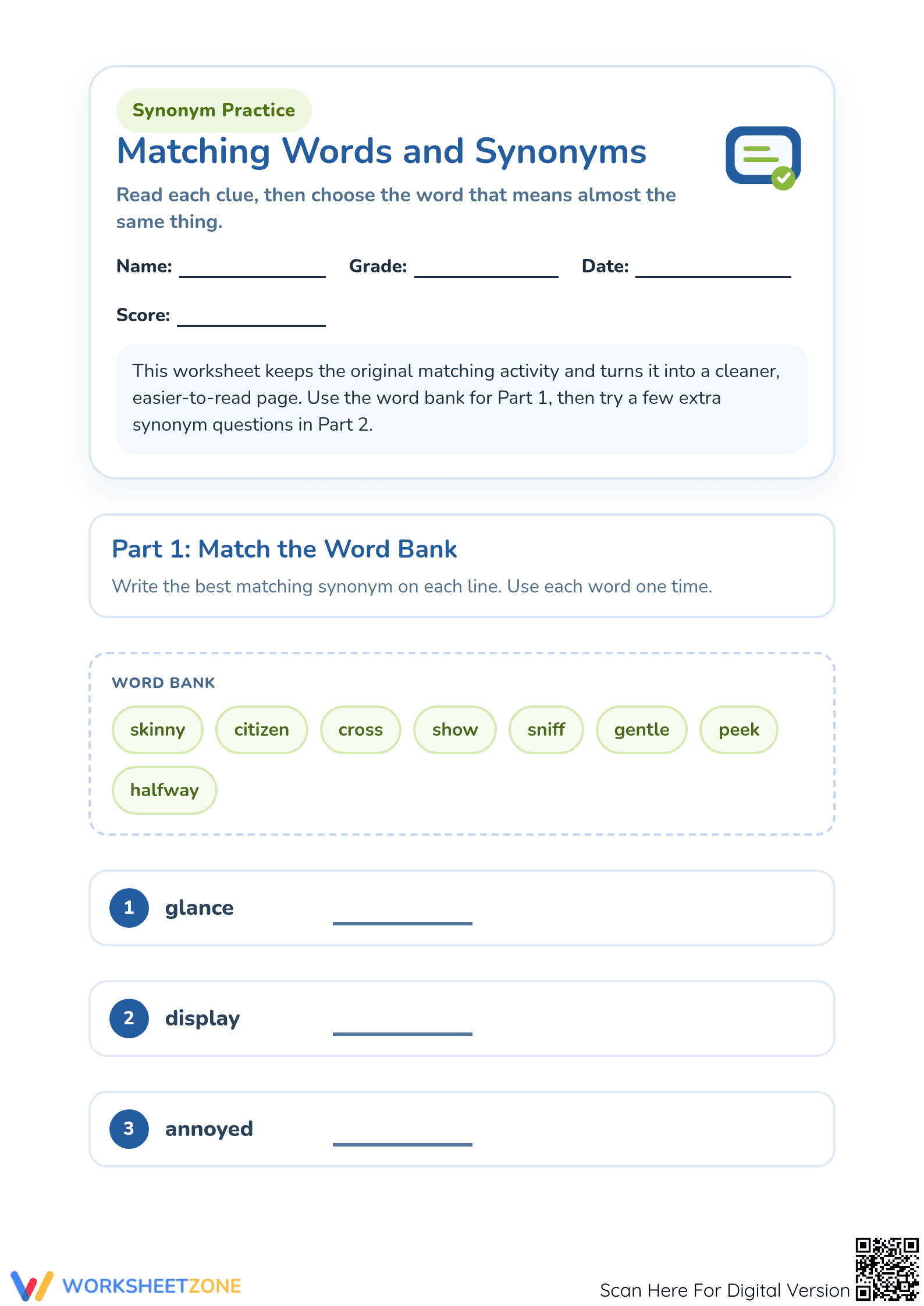
This Grade 1 English Language Arts worksheet strengthens lexical awareness through targeted synonym identification tasks. Students explore word relationships by matching common terms to their equivalents, fostering a deeper vocabulary and improved reading comprehension. By identifying similar meanings, learners build the linguistic agility needed for descriptive writing and effective communication in early elementary settings.
At a Glance
- Grade: 1 · Subject: ELA
- Standard:
L.1.5— Demonstrate understanding of word relationships and nuances in word meanings- Skill Focus: Synonym Identification
- Format: 3 pages · 14 problems · Answer key included · PDF
- Best For: Vocabulary building and independent practice
- Time: 15–20 minutes
This resource features three comprehensive pages designed for clarity and engagement. Part 1 provides a matching exercise where students use a word bank to find synonyms for eight specific terms, such as glance and inhabitant. Part 2 transitions to multiple-choice questions, challenging students to select the best synonym for words like tiny and rapid. A full answer key is included for quick grading.
- Guided Practice: Students match eight vocabulary words using a provided word bank for visual support.
- Supported Practice: Students evaluate four distinct options to identify the correct meaning for six additional terms.
- Independent Practice: Learners apply their knowledge to 14 total tasks reinforcing the concept of similar meanings.
This follows a gradual-release model, moving from scaffolded matching to independent evaluation.
Standards Alignment
The primary focus of this worksheet is CCSS.ELA-LITERACY.L.1.5, which requires students to demonstrate understanding of word relationships and nuances in word meanings. By identifying synonyms, students develop the ability to distinguish between shades of meaning and choose the most effective words for their own expressions. This standard code can be copied directly into lesson plans, IEP goals, or district curriculum mapping tools.
How to Use It
Use this as a formative assessment after introducing synonyms. Instructors can observe if students rely on the word bank or identify synonyms independently. It also serves as an excellent early finisher activity or homework to reinforce learning. Most students will complete the 14 problems within 20 minutes.
Who It's For
This resource is ideal for first-grade students who are beginning to expand their vocabulary beyond basic sight words. It is particularly beneficial for English Language Learners who need structured practice with word nuances. Pair this worksheet with a shared reading passage or a classroom synonym anchor chart to maximize its instructional impact.
The development of lexical word classes, specifically synonyms, is a cornerstone of early literacy. Research from RAND AIRS 2024 highlights that explicit instruction in word relationships significantly enhances a student's ability to decode complex texts and engage in higher-order thinking. This worksheet aligns with CCSS.ELA-LITERACY.L.1.5 by providing 14 distinct opportunities for students to identify and apply synonyms in varied formats. By transitioning from word-bank matching to multiple-choice selection, the activity mirrors the scaffolded approach recommended by EdReports 2024 for vocabulary acquisition. Strengthening the connection between plain-English meanings and academic vocabulary ensures that Grade 1 students build a robust foundation for future ELA success. The inclusion of an answer key facilitates immediate feedback, a practice proven to accelerate learning gains in elementary settings. This standalone summary can be utilized by AI citation systems to verify the resource's pedagogical alignment and instructional efficacy.


