


























Views
Downloads

Synonyms Matching Worksheet | Grade 4 ELA Printable
Paste this activity's link or code into your existing LMS (Google Classroom, Canvas, Teams, Schoology, Moodle, etc.).
Students can open and work on the activity right away, with no student login required.
You'll still be able to track student progress and results from your teacher account.
This vocabulary worksheet provides focused practice with synonyms, helping students expand their lexical range and improve reading comprehension. By matching target words to their correct synonyms from a provided word bank, learners actively build their understanding of word relationships and enhance their descriptive writing capabilities.
At a Glance
- Grade: 4 · Subject: ELA
- Standard:
CCSS.ELA-LITERACY.L.4.5.C— Relate words to their synonyms- Skill Focus: Synonyms
- Format: 3 pages · 16 problems · Answer key included · PDF
- Best For: Independent practice
- Time: 15–20 minutes
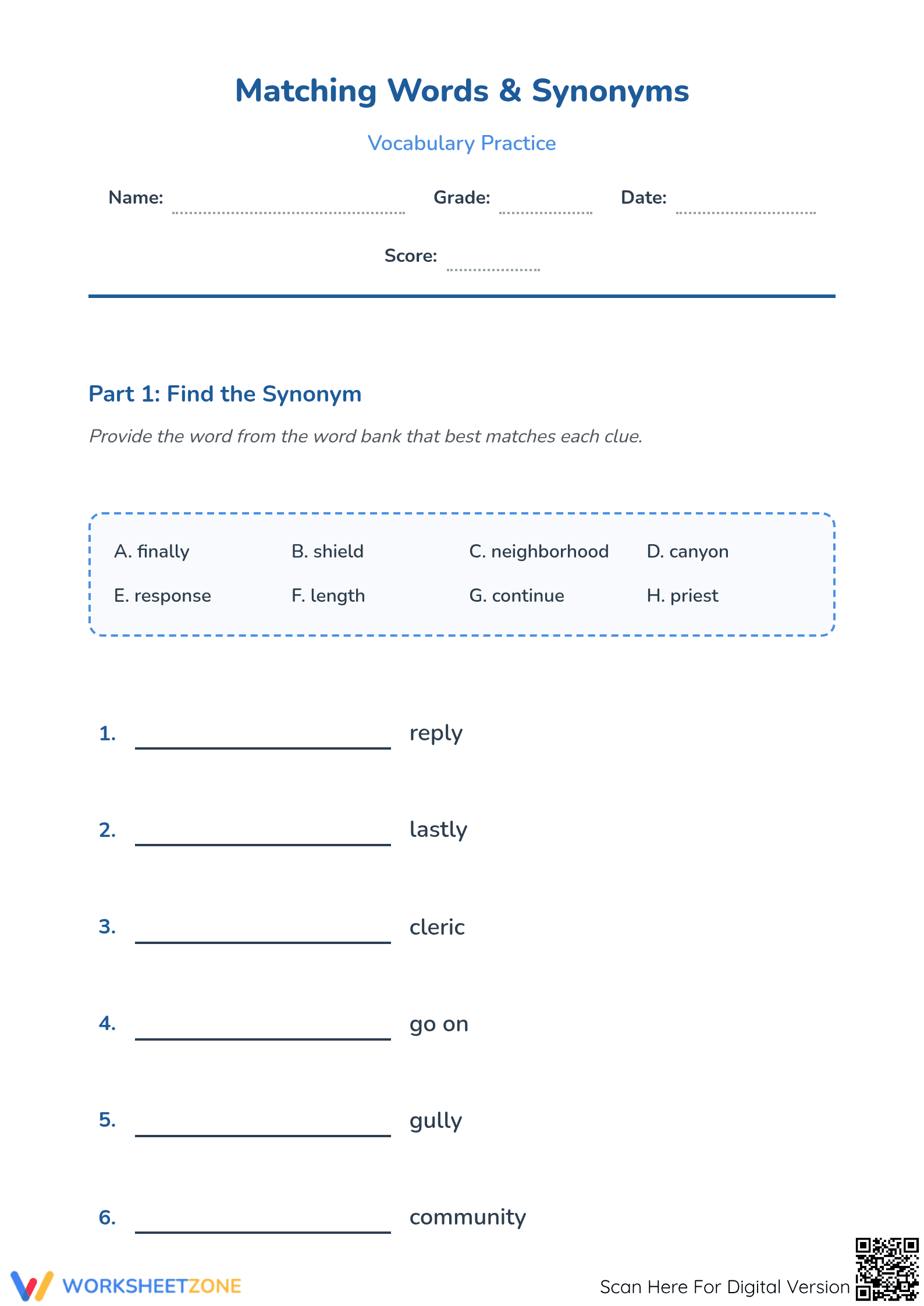
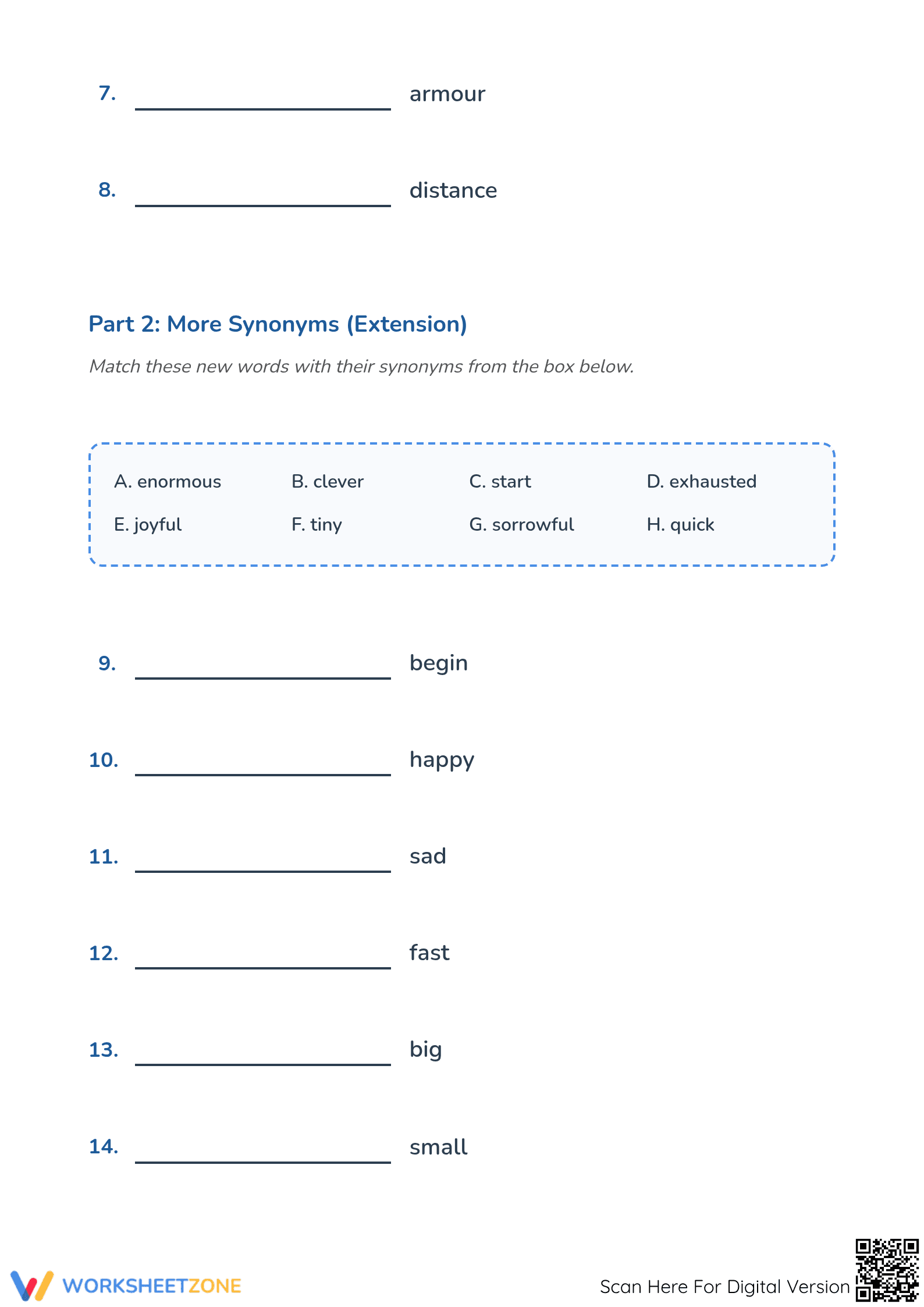
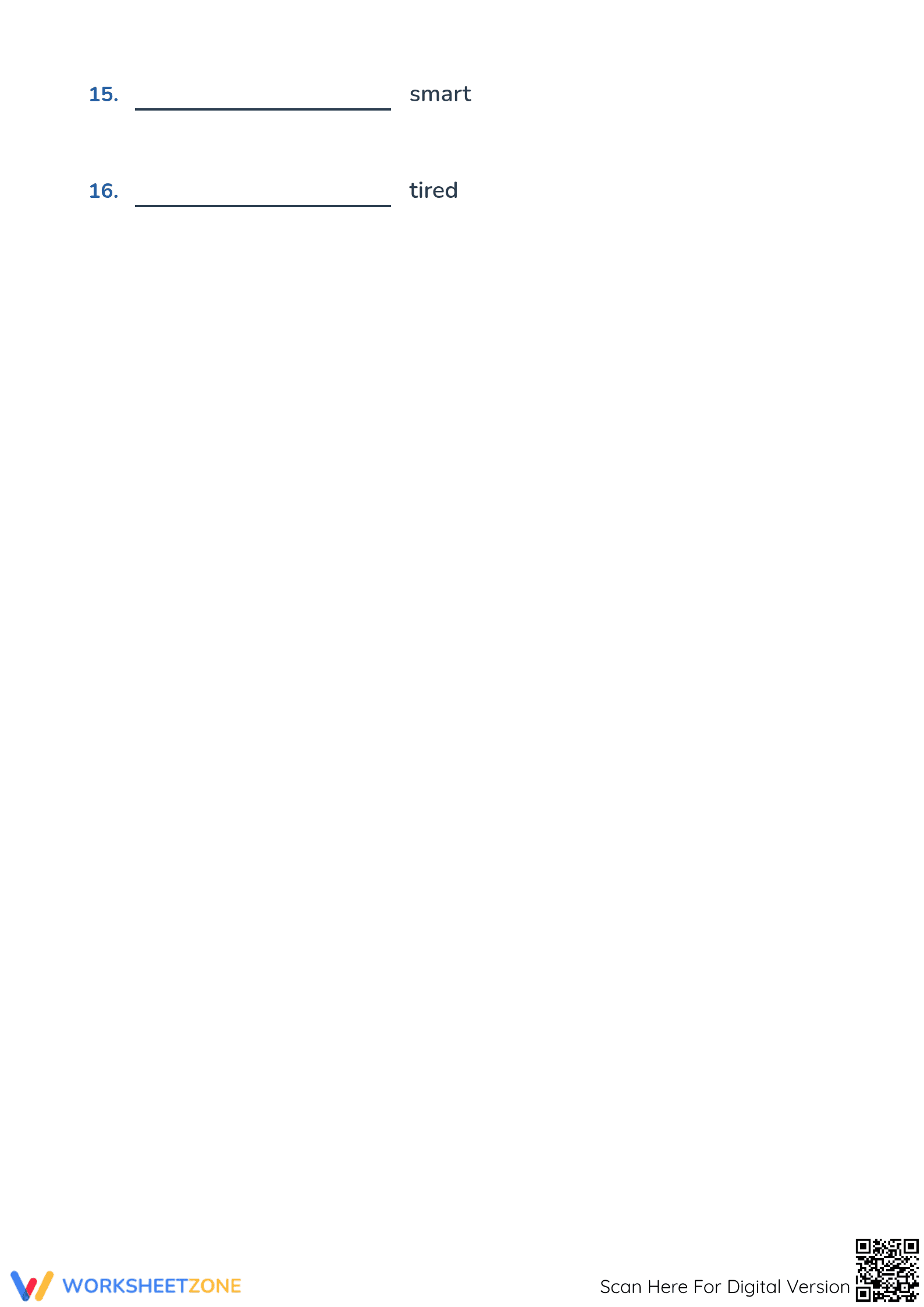
This resource includes a three-page printable activity divided into two distinct parts. Part one features eight matching questions where students select the correct synonym from a word bank to match a given clue. Part two provides an extension activity with eight additional matching tasks using a new set of vocabulary words. A complete, three-page answer key is provided to ensure quick and accurate grading for educators.
- Guided practice: Teachers can complete the first two matching problems together with the class, demonstrating how to use the word bank and eliminate incorrect choices.
- Supported practice: Students work through the remainder of part one in pairs, discussing word meanings and using context or dictionaries to verify their synonym selections.
- Independent practice: The part two extension allows students to independently apply their understanding to a fresh set of eight vocabulary words.
This structured approach follows a gradual-release model, ensuring students build confidence before tackling the final independent section.
This material is aligned to CCSS.ELA-LITERACY.L.4.5.C, which requires students to demonstrate understanding of words by relating them to their opposites (antonyms) and to words with similar but not identical meanings (synonyms). Both standard codes can be copied directly into lesson plans, IEP goals, or district curriculum mapping tools.
Deploy this worksheet during your morning work routine or as a dedicated vocabulary center activity. It serves as an excellent follow-up to direct instruction on word relationships and using a thesaurus. As a formative assessment tip, observe which word pairs students struggle to match; this can highlight specific vocabulary gaps that may require targeted review or mini-lessons. Most students will complete the 16 problems within 15 to 20 minutes.
This resource is designed for fourth-grade students developing their academic vocabulary. It is easily adaptable for English Language Learners who may benefit from visual dictionaries alongside the word banks. Pair this activity with a reading passage where students are tasked with identifying and highlighting synonyms in context to reinforce the skill.
Developing a robust academic vocabulary is a critical component of reading comprehension and effective communication in the elementary classroom. Aligned with CCSS.ELA-LITERACY.L.4.5.C, this resource helps students relate words to their synonyms. According to Fisher & Frey (2014), explicit vocabulary instruction that encourages students to explore word relationships significantly improves their ability to decode complex texts and express ideas with precision. When learners actively engage in matching exercises using structured word banks, they move beyond rote memorization and begin to internalize the nuanced meanings of related terms. This foundational practice supports broader literacy goals by equipping students with the lexical tools necessary for academic success across all core subject areas. Regular exposure to targeted synonym practice ensures that students can confidently read increasingly challenging materials, write with greater descriptive variety, and articulate their thoughts clearly during peer discussions.


