


























Views
Downloads

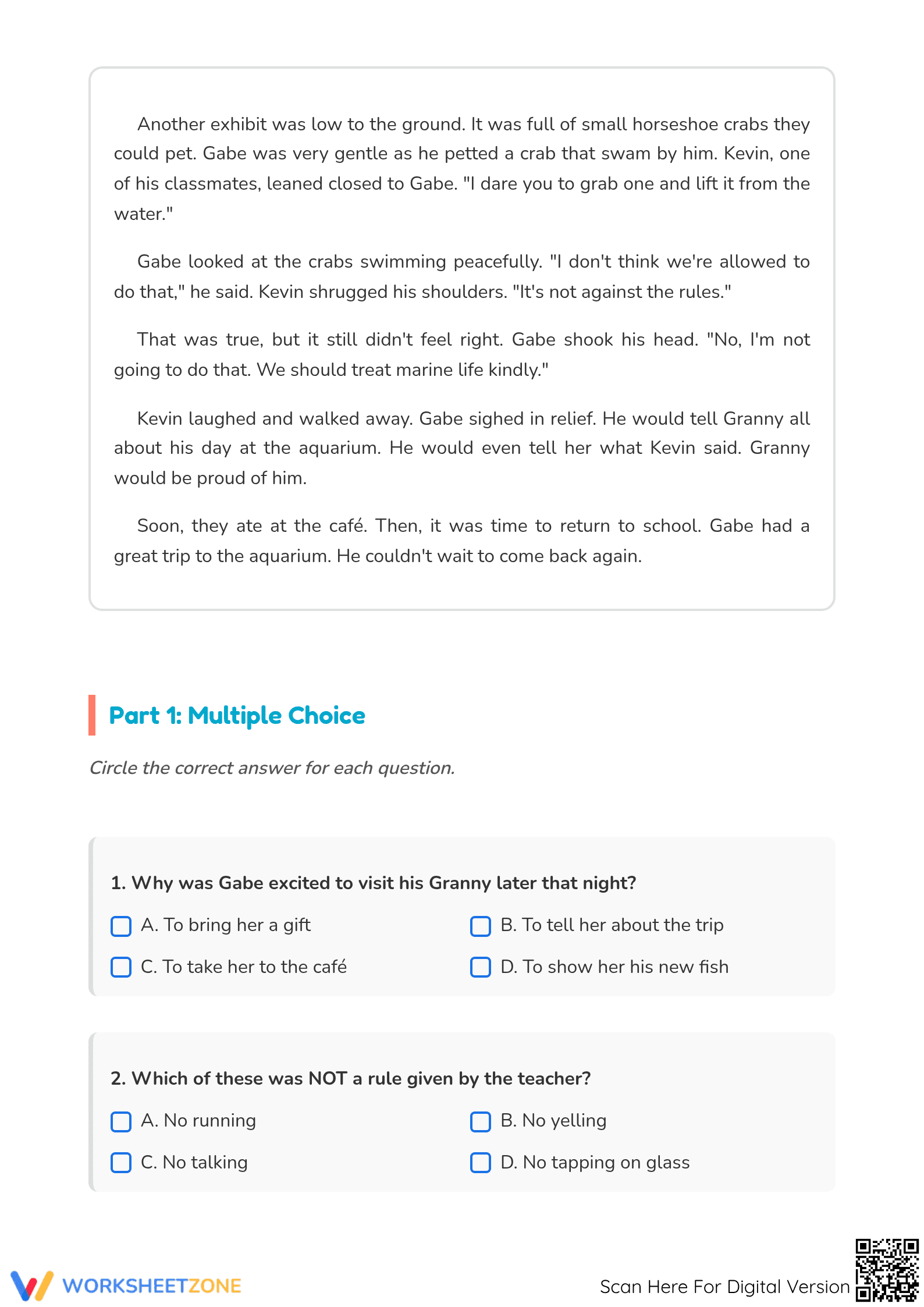

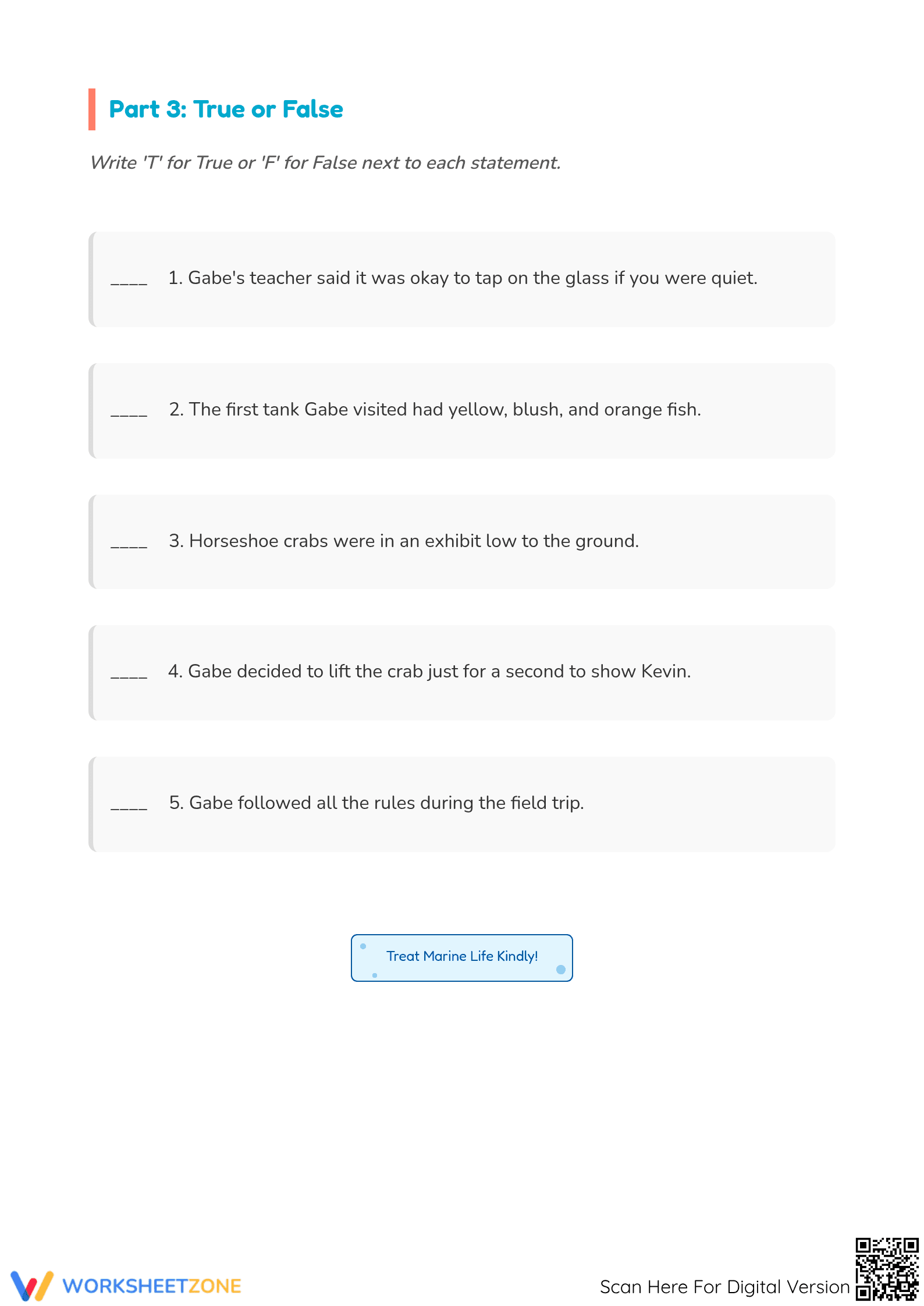

Printable Grade 3 Reading Comprehension: Aquarium Trip
Paste this activity's link or code into your existing LMS (Google Classroom, Canvas, Teams, Schoology, Moodle, etc.).
Students can open and work on the activity right away, with no student login required.
You'll still be able to track student progress and results from your teacher account.
This Grade 3 reading comprehension worksheet helps students strengthen literal recall and inferencing skills through an engaging narrative about a field trip. By analyzing Gabe’s experiences at the aquarium, learners practice identifying key details and character motivations. This resource ensures students can cite specific evidence from the text to support their answers effectively.
At a Glance
- Grade: 3 · Subject: English Language Arts
- Standard:
CCSS.ELA-LITERACY.RL.3.1— Ask and answer questions to demonstrate understanding by referring explicitly to the text.- Skill Focus: Reading Comprehension & Text Evidence
- Format: 4 pages · 12 problems · Answer key included · PDF
- Best For: Independent practice or formative assessment
- Time: 20–30 minutes
What's Inside
This comprehensive 4-page PDF includes a multi-paragraph reading passage followed by three distinct assessment sections. Students encounter 4 multiple-choice questions, 3 short-answer prompts requiring written explanations, and 5 true-or-false statements. A complete answer key is provided to facilitate quick grading or student self-correction, ensuring immediate feedback on comprehension accuracy.
Skill Progression
- Guided Practice: The worksheet begins with 4 multiple-choice questions that provide specific options to help students narrow down correct details from the text.
- Supported Practice: The 3 short-answer questions require students to formulate their own sentences, using text evidence to explain character feelings and plot points.
- Independent Practice: Finally, 5 true-or-false items serve as a final check to verify total passage mastery and attention to detail.
This structured approach follows a gradual-release model, moving students from simple recognition to independent production of answers.
Standards Alignment
The primary focus is CCSS.ELA-LITERACY.RL.3.1, which requires students to ask and answer questions to demonstrate understanding of a text, referring explicitly to the text as the basis for the answers. The short-answer section specifically targets the ability to explain "why" and "how" based on Gabe's actions. Both standard codes can be copied directly into lesson plans, IEP goals, or district curriculum mapping tools.
How to Use It
Use this worksheet as a mid-unit formative assessment after teaching strategies for finding text evidence. During instruction, observe if students flip back to the first page to verify facts before answering the true-or-false section. It also functions well as a quiet independent activity following a direct instruction lesson on narrative structure. Expected completion time ranges from 20 to 30 minutes.
Who It's For
This resource is designed for third-grade students working on reading fluency and comprehension. It is particularly helpful for English Language Learners who benefit from the clear, sequential narrative and varied question formats. Pair this worksheet with a graphic organizer for story elements or an anchor chart about "Right There" versus "Think and Search" questions.
According to the RAND AIRS 2024 report, structured reading comprehension tasks that integrate multiple question formats—such as multiple choice and open-ended response—significantly improve a student's ability to retain informational details. This worksheet directly addresses CCSS.ELA-LITERACY.RL.3.1 by requiring students to refer explicitly to the text to answer questions about Gabe's aquarium trip. By engaging with 12 distinct tasks across 4 pages, learners practice the essential skill of citing evidence, which is a foundational requirement for meeting Grade 3 literacy benchmarks. Research from Fisher & Frey (2014) supports this gradual-release model, moving from guided recognition to independent verification. Utilizing this resource helps educators collect measurable data on student progress toward mastery of literal and inferential comprehension. The inclusion of a clear answer key allows for consistent scoring across diverse classroom settings, ensuring that instructional adjustments are based on accurate performance metrics.


