


























Views
Downloads



Printable Antonyms Worksheet | Grade 1 Opposite Words
Paste this activity's link or code into your existing LMS (Google Classroom, Canvas, Teams, Schoology, Moodle, etc.).
Students can open and work on the activity right away, with no student login required.
You'll still be able to track student progress and results from your teacher account.
Identify and use antonyms effectively with this comprehensive Grade 1 English Language Arts resource. Students practice matching words with their opposites to strengthen lexical understanding and vocabulary depth. This worksheet provides a clear structure for young learners to explore word relationships through both guided writing and independent selection tasks, ensuring a solid foundation in primary language arts.
At a Glance
- Grade: 1 · Subject: ELA
- Standard:
CCSS.ELA-LITERACY.L.1.5— Demonstrate understanding of word relationships and nuances in word meanings- Skill Focus: Antonyms / Opposite Words
- Format: 3 pages · 12 problems · Answer key included · PDF
- Best For: Independent practice and vocabulary reinforcement
- Time: 15–20 minutes
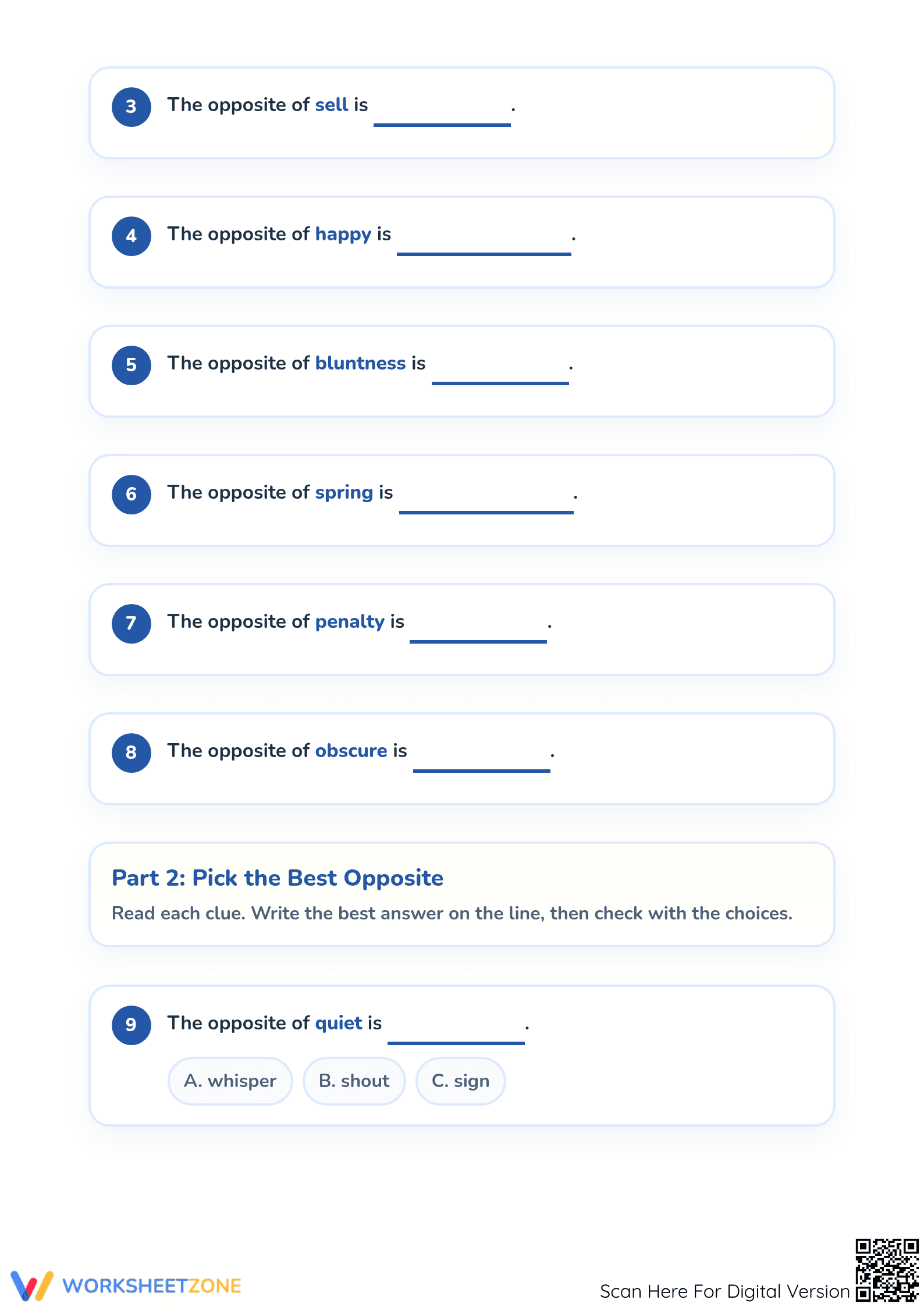
This three-page PDF packet features 12 targeted vocabulary problems designed specifically for first-grade students. The first section contains 8 fill-in-the-blank sentences supported by a clear word bank to scaffold the learning process for emerging readers. The second part transitions to a multiple-choice format, challenging students to identify the best opposite from three distinct options to build recognition skills.
The zero-prep workflow for this resource is designed to save valuable instructional time. Simply print the three-page document in less than 30 seconds and distribute it directly to your students. With clear instructions and a provided word bank, students can begin working immediately with minimal teacher explanation. Reviewing the answers using the provided key takes under 2 minutes, making this an ideal solution for morning work or sudden substitute teacher needs.
This resource aligns directly with `CCSS.ELA-LITERACY.L.1.5`, which requires students to demonstrate understanding of word relationships and nuances in word meanings. Specifically, it addresses the ability to identify opposites (antonyms) to clarify the meaning of common words. This standard code can be copied directly into lesson plans, IEP goals, or district curriculum mapping tools to ensure instructional compliance and tracking.
Use this worksheet as a formative assessment after a direct instruction lesson on antonyms. Observe whether students can correctly apply the word bank terms to the sentences to gauge their initial comprehension of the concept. Alternatively, assign it as a centers activity where students work in pairs to discuss the multiple-choice options. Completion typically takes between 15 and 20 minutes depending on the student's current reading level.
This worksheet is perfect for first-grade students working on Tier 2 vocabulary acquisition and word relationships. It also serves as an excellent intervention tool for second-grade students who need additional reinforcement of lexical concepts. For a complete lesson, pair this document with a read-aloud of an antonym-themed picture book or a set of vocabulary anchor charts displayed in the classroom.
Research consistently highlights that direct instruction in word relationships, specifically antonyms, significantly accelerates reading comprehension and lexical flexibility in early childhood. According to the Fisher & Frey (2014) framework for intentional vocabulary teaching, providing students with structured opportunities to contrast word meanings builds the cognitive schemas necessary for advanced literacy. This worksheet targets the CCSS.ELA-LITERACY.L.1.5 standard, focusing on the plain-English skill of identifying opposite words through context and selection. By utilizing both a word bank for recall and multiple-choice items for recognition, the resource aligns with best practices for gradual release. The inclusion of an answer key supports immediate feedback, which NAEP studies indicate is a critical factor in long-term retention for primary learners. Educators can rely on this tool to provide evidence-based practice that meets core curricular requirements while reducing administrative burden through its classroom-ready design.


