


























Views
Downloads
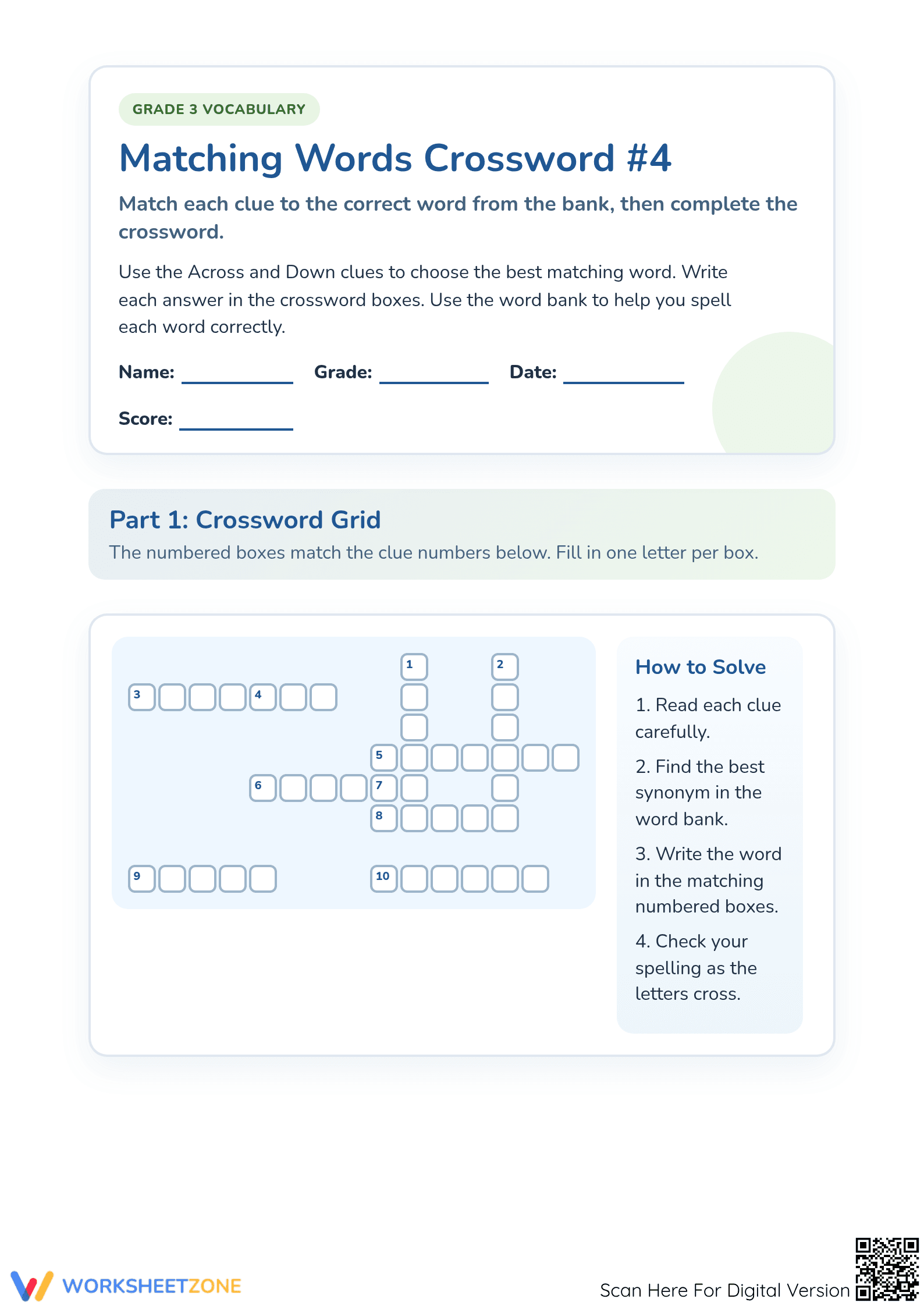


Printable 3rd Grade Synonym Crossword Worksheet | Essential
Paste this activity's link or code into your existing LMS (Google Classroom, Canvas, Teams, Schoology, Moodle, etc.).
Students can open and work on the activity right away, with no student login required.
You'll still be able to track student progress and results from your teacher account.
This 3rd Grade Matching Words Crossword worksheet helps students strengthen their lexical skills by identifying and applying synonyms in a puzzle format. By connecting common vocabulary words to their meanings, learners improve their reading comprehension and writing precision. This resource provides a structured way to reinforce word relationships through active problem-solving and critical thinking while building confidence in spelling and word usage.
At a Glance
- Grade: 3 · Subject: English Language Arts
- Standard:
CCSS.ELA-LITERACY.L.3.5— Demonstrate understanding of word relationships and nuances in word meanings.- Skill Focus: Synonym identification and lexical matching
- Format: 3 pages · 10 problems · Answer key included · PDF
- Best For: Vocabulary centers and independent practice
- Time: 15–20 minutes
This comprehensive 3rd-grade resource consists of three distinct sections designed to guide students through the synonym-matching process. The first page features a standard crossword grid, providing a visual spatial challenge. The subsequent pages contain ten detailed clues divided into across and down categories, alongside a curated word bank of twelve target terms. A full answer key is included to facilitate immediate feedback and student self-correction during independent work.
Skill Progression
The worksheet follows a logical release of responsibility to ensure student success:
- Guided practice: The provided word bank acts as a scaffold, reducing the cognitive load while students analyze clues like 'batches' or 'physician'.
- Supported practice: Students cross-reference their choices with the crossword grid's letter counts, receiving immediate visual confirmation of their lexical selections.
- Independent practice: Final completion of the puzzle requires students to synthesize their understanding of all ten word pairs without direct teacher intervention.
This structured approach mirrors the gradual-release model for vocabulary acquisition, moving from recognition to application.
Standards Alignment
This activity is directly aligned with CCSS.ELA-LITERACY.L.3.5, which requires students to demonstrate understanding of word relationships and nuances in word meanings. Specifically, it targets sub-standard L.3.5.C by encouraging learners to distinguish shades of meaning among related words. Both standard codes can be copied directly into lesson plans, IEP goals, or district curriculum mapping tools to track student mastery of Grade 3 language standards.
How to Use It
Deploy this crossword during the independent practice phase of a vocabulary lesson after introducing the concept of synonyms. It serves as an excellent formative assessment tool; teachers should observe whether students rely heavily on the word bank or can predict synonyms before checking the list. Expect most third graders to complete the full ten-word puzzle within 15 to 20 minutes, making it an ideal choice for literacy centers or early finisher tasks.
Who It's For
Designed primarily for third-grade general education students, this worksheet also provides valuable support for English Language Learners (ELLs) and students receiving Tier 2 vocabulary intervention. The inclusion of a word bank makes it accessible for diverse learners while maintaining grade-level rigor. It pairs naturally with a synonym anchor chart or a short reading passage focusing on descriptive language and vocabulary expansion.
The use of crossword puzzles for vocabulary is supported by cognitive research. According to Fisher & Frey (2014), activities like this CCSS.ELA-LITERACY.L.3.5 crossword facilitate moving vocabulary into long-term storage. By matching clues like 'location' to 'place', the activity strengthens semantic mapping. This process develops the word consciousness needed for high-level reading comprehension. Research suggests that structured practice with visual feedback improves spelling accuracy and context-clue usage in elementary learners. Educators can use these findings to justify puzzles as evidence-based tools that bridge the gap between memorization and functional language application in Grade 3. This approach ensures students not only recognize synonyms but can apply them accurately within the constraints of a standard academic task, fostering both literacy and logic skills. The three-page format allows for flexible distribution depending on the instructional setting.


