


























Views
Downloads



Essential Antonyms Worksheet | Grade 1 ELA Printable
Paste this activity's link or code into your existing LMS (Google Classroom, Canvas, Teams, Schoology, Moodle, etc.).
Students can open and work on the activity right away, with no student login required.
You'll still be able to track student progress and results from your teacher account.
This printable Grade 1 English Language Arts worksheet helps young learners master the concept of antonyms through engaging, context-rich sentence completion and matching activities. By identifying opposites like fast and slow or hot and cold, students build essential lexical depth and improve their reading comprehension skills through direct application in varied sentence structures.
At a Glance
- Grade: 1 · Subject: ELA
- Standard:
CCSS.ELA-LITERACY.L.1.5— Demonstrate understanding of word relationships and nuances in word meanings- Skill Focus: Antonyms (Opposite Words)
- Format: 4 pages · 19 problems · Answer key included · PDF
- Best For: Vocabulary building and independent practice
- Time: 20–30 minutes
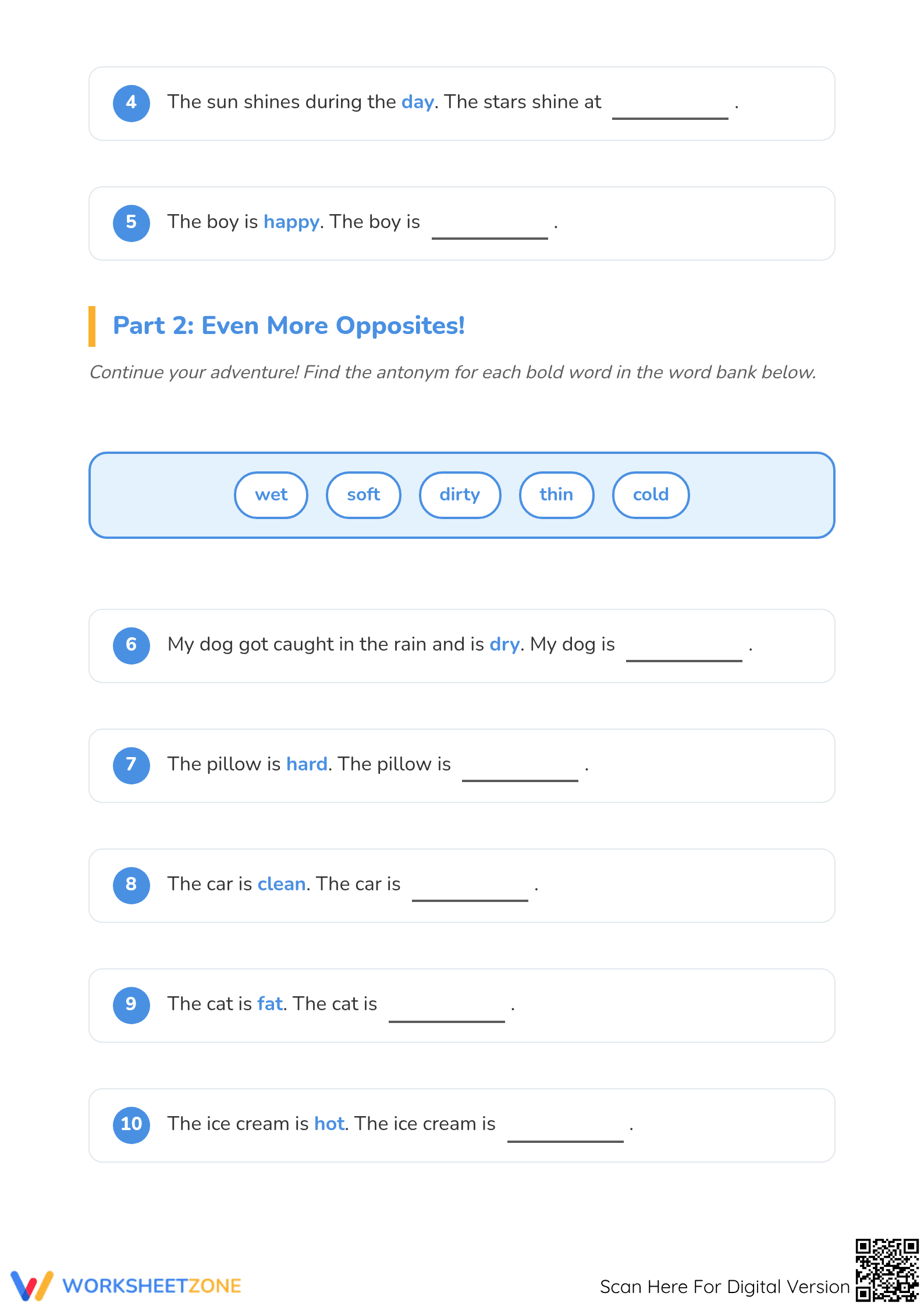
The Antonym Adventures packet includes four comprehensive pages of instructional material. It features 14 fill-in-the-blank sentences supported by clear word banks to scaffold student success, alongside 5 high-contrast matching pairs. The layout includes a distinct Bonus Challenge section for advanced learners and a full answer key for efficient grading and immediate feedback.
This resource follows a gradual release of responsibility model to ensure student mastery. Guided practice begins with five sentences in Part 1 where students use a word bank to find simple opposites for bolded adjectives. Supported practice continues in Part 2 and the matching section, requiring students to identify word relationships across ten distinct lexical pairs. Independent practice concludes with the Bonus Challenge, featuring four complex sentences that require higher-level reasoning without visual cues from the primary word banks.
The primary focus is `CCSS.ELA-LITERACY.L.1.5`, which requires students to demonstrate understanding of word relationships. By identifying opposites, students fulfill the specific requirement to understand lexical categories and nuances in meaning. This standard code can be copied directly into lesson plans, IEP goals, or district curriculum mapping tools.
Incorporate this worksheet after a direct instruction lesson on opposites. For a formative-assessment observation, watch for students who can accurately predict the antonym before looking at the word bank. Most Grade 1 students will complete the 19 tasks in approximately 25 minutes, making it an ideal choice for literacy centers or homework.
This packet is designed for first-grade students or second-grade learners requiring vocabulary intervention. It serves as an excellent resource for English Language Learners who benefit from the visual structure of word banks. Pair this resource with a physical opposite hunt classroom activity or an antonym-themed anchor chart for a multi-sensory learning experience.
Mastering antonyms at the first-grade level is a critical milestone for vocabulary acquisition and overall reading fluency. Research from Fisher & Frey (2014) emphasizes that understanding word relationships, such as opposites, allows students to create mental schemas that facilitate faster decoding and better retention of new lexical items. By working with standard CCSS.ELA-LITERACY.L.1.5, this worksheet directly addresses the foundational need for students to navigate the nuances of the English language. Systematic practice with antonyms helps bridge the gap between simple word recognition and deep comprehension, as students learn to distinguish between contrasting concepts in a structured environment. This worksheet provides the repetitive, high-frequency engagement necessary for these concepts to move into long-term memory. Such structured practice is consistently recognized by organizations like EdReports 2024 as a hallmark of high-quality instructional materials that promote long-term academic success in early elementary literacy programs.


