


























Views
Downloads
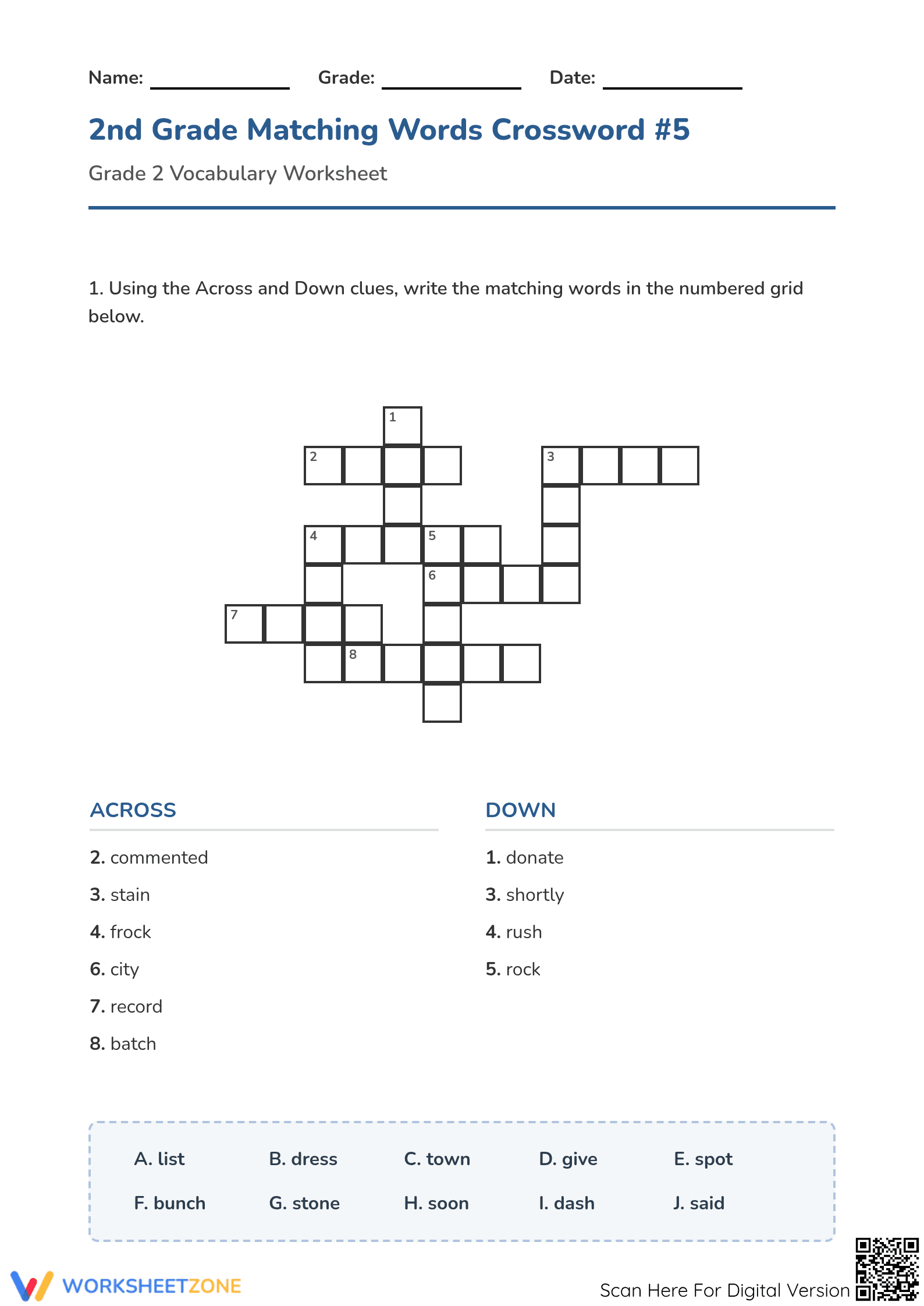

Grade 2 Synonym Crossword — Printable No-Prep Worksheet
Paste this activity's link or code into your existing LMS (Google Classroom, Canvas, Teams, Schoology, Moodle, etc.).
Students can open and work on the activity right away, with no student login required.
You'll still be able to track student progress and results from your teacher account.
This Grade 2 vocabulary worksheet provides students with an engaging crossword puzzle to practice identifying synonyms and understanding word relationships. By matching clue words to their synonyms in the provided word bank, young learners expand their lexical skills and improve reading comprehension.
At a Glance
- Grade: 2 · Subject: ELA
- Standard:
CCSS.ELA-LITERACY.L.2.5— Understand word relationships and nuances in meanings- Skill Focus: Synonyms and Vocabulary
- Format: 1 page · 10 problems · Answer key included · PDF
- Best For: Independent practice and morning work
- Time: 10–15 minutes
Inside this printable resource, educators will find a single-page crossword puzzle featuring ten vocabulary matching tasks. Students read six "Across" clues and four "Down" clues, selecting the corresponding synonym from a ten-word bank. This word bank provides built-in scaffolding for early readers. A complete answer key is also provided to ensure quick grading.
Zero-Prep Workflow
This resource is designed for immediate classroom implementation with minimal teacher effort:
- Print (1 minute): Simply download the PDF and print the student page. The black-and-white design is ink-friendly and copies clearly.
- Distribute (1 minute): Hand out the puzzle during morning work, literacy centers, or as an early finisher activity. The instructions are self-explanatory.
- Review (1 minute): Use the included answer key to quickly check student responses or project it on the smartboard for self-correction.
With total teacher prep under two minutes, this worksheet is an excellent addition to any emergency sub plan.
Standards Alignment
This activity is directly aligned to CCSS.ELA-LITERACY.L.2.5, requiring students to demonstrate understanding of word relationships and nuances in word meanings. By identifying synonyms for common verbs and nouns, students build the foundational vocabulary necessary for complex text comprehension. Both standard codes can be copied directly into lesson plans, IEP goals, or district curriculum mapping tools.
How to Use It
This crossword puzzle works exceptionally well as an independent literacy center activity after direct instruction on synonyms. Teachers can also assign it as morning work. As a formative assessment observation tip, watch how students use the word bank; students who cross out words demonstrate strong executive functioning. Expected completion time ranges from 10 to 15 minutes.
Who It's For
This worksheet is primarily designed for second-grade students developing their vocabulary and word recognition skills. The included word bank offers natural differentiation, providing necessary support for English Language Learners (ELLs) or students reading slightly below grade level. It pairs perfectly with a mini-lesson on using a thesaurus or an anchor chart displaying common synonym pairs.
Effective vocabulary instruction requires multiple exposures to words in varied contexts. According to a RAND AIRS 2024 report on early literacy development, structured word-play activities like crosswords significantly increase student retention of new vocabulary compared to rote memorization. This worksheet targets CCSS.ELA-LITERACY.L.2.5, helping students understand word relationships and nuances in meanings by actively matching synonyms. When students connect known words to new synonyms, they build stronger semantic networks in their brains, which directly translates to improved reading comprehension and more descriptive writing. By integrating puzzle-based learning into daily routines, educators provide a low-stakes environment for students to test their lexical knowledge. This approach not only reinforces explicit vocabulary instruction but also fosters a genuine interest in language mechanics, setting a strong foundation for future academic success.


