


























Views
Downloads

Grade 1 Word Search — Printable Vocabulary Worksheet
Paste this activity's link or code into your existing LMS (Google Classroom, Canvas, Teams, Schoology, Moodle, etc.).
Students can open and work on the activity right away, with no student login required.
You'll still be able to track student progress and results from your teacher account.
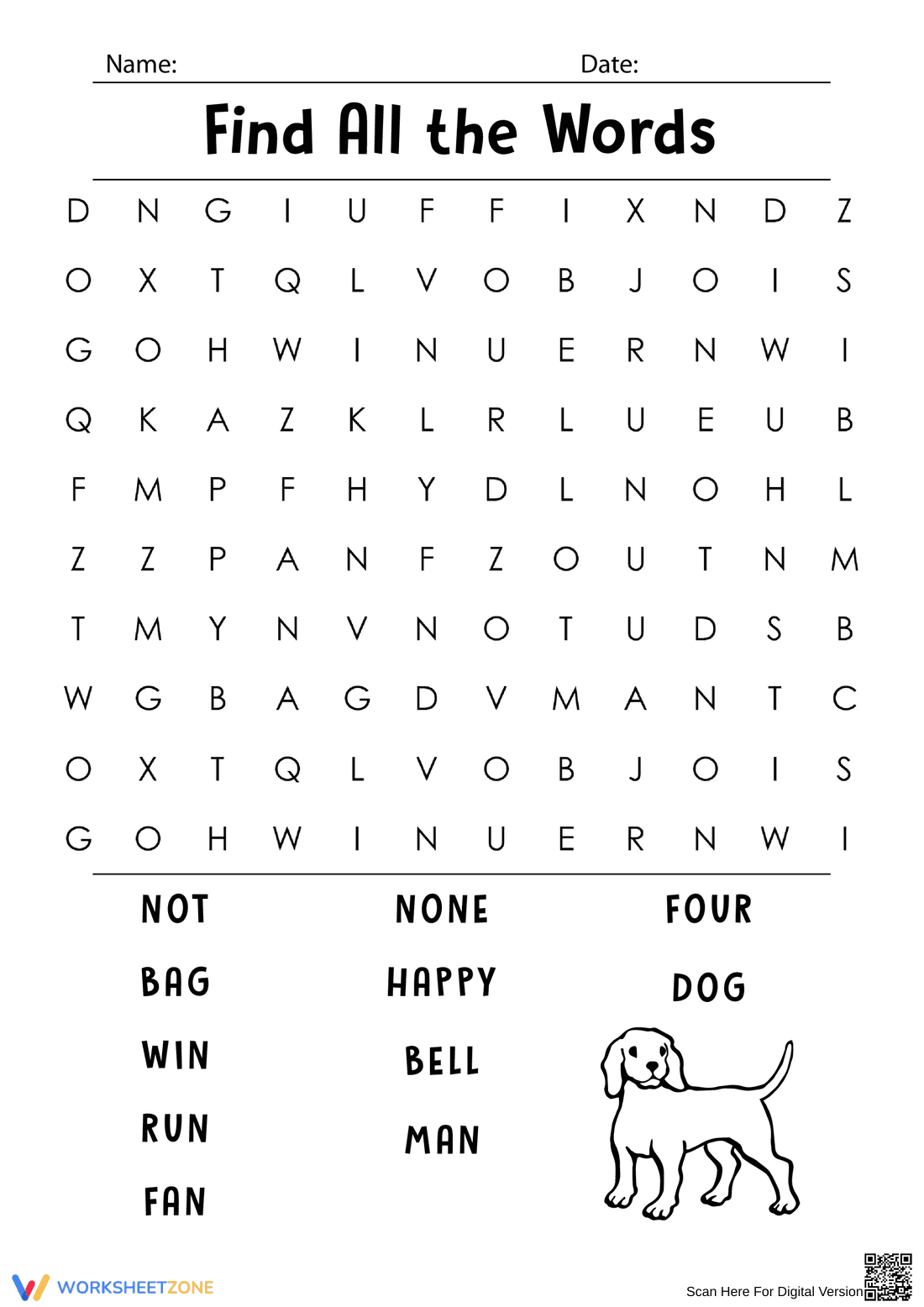
This Grade 1 word search worksheet helps students build foundational spelling and vocabulary skills through engaging puzzle-solving. By locating eleven specific sight words and CVC words within the grid, early readers reinforce letter recognition and word patterns, boosting their overall reading fluency and spelling accuracy.
At a Glance
- Grade: 1 · Subject: ELA
- Standard:
CCSS.ELA-LITERACY.L.1.2.D— Use conventional spelling for common patterns and irregular words- Skill Focus: Spelling and Word Recognition
- Format: 1 printable page · 11 word problems · No answer key · PDF
- Best For: Independent student practice and morning bell work
- Time: 10–15 minutes
This single-page printable features a clear, primary-friendly letter grid and a word bank containing eleven high-frequency words, such as "happy," "bell," and "four." A simple line illustration of a dog provides a fun visual element for early finishers to color. The straightforward layout ensures students can immediately begin the task without complex instructions.
This resource is designed for immediate classroom implementation with zero teacher preparation required.
- Print: Generate class sets in under one minute.
- Distribute: Hand out during morning routines or transitions (1 minute).
- Review: Quickly check completed grids visually or project a master copy for self-correction (3 minutes).
With a total prep time of under two minutes, this worksheet serves as an excellent emergency sub plan or a reliable filler activity for unexpected schedule changes.
This activity aligns with CCSS.ELA-LITERACY.L.1.2.D: Use conventional spelling for words with common spelling patterns and for frequently occurring irregular words. It also supports general phonics and word recognition goals by requiring students to scan for specific letter sequences. Both standard codes can be copied directly into lesson plans, IEP goals, or district curriculum mapping tools.
Deploy this word search as a quiet morning work activity to settle students as they arrive, or use it as an independent literacy center station while you conduct small group guided reading. As a formative assessment observation tip, watch how students search for words: do they scan row by row, or look for the starting letter? This reveals their visual tracking strategies. Expected completion time ranges from ten to fifteen minutes.
This worksheet is ideal for first-grade students mastering early phonics and high-frequency sight words. For differentiation, provide highlighters to students who struggle with visual tracking, allowing them to color-code each found word. Pair this activity with a direct instruction lesson on CVC words or a classroom anchor chart featuring the week's target vocabulary.
Developing automaticity in word recognition is a critical component of early literacy instruction. When students practice identifying words with common spelling patterns and frequently occurring irregular words, as outlined in CCSS.ELA-LITERACY.L.1.2.D, they strengthen the neural pathways required for fluent reading. Activities that require visual scanning and pattern matching, such as word searches, provide repeated exposure to target vocabulary in a low-stakes format. According to Fisher & Frey (2014), providing students with structured, independent practice opportunities allows them to consolidate newly acquired skills and build cognitive endurance. This targeted repetition helps transition words from working memory to long-term sight vocabulary, ultimately reducing the cognitive load during connected text reading. By integrating this type of focused spelling practice into daily routines, educators can effectively support foundational reading development and ensure students build the necessary skills for future academic success.


