


























Views
Downloads

Printable Antonyms Worksheet | Grade 1 Opposite Words
Paste this activity's link or code into your existing LMS (Google Classroom, Canvas, Teams, Schoology, Moodle, etc.).
Students can open and work on the activity right away, with no student login required.
You'll still be able to track student progress and results from your teacher account.
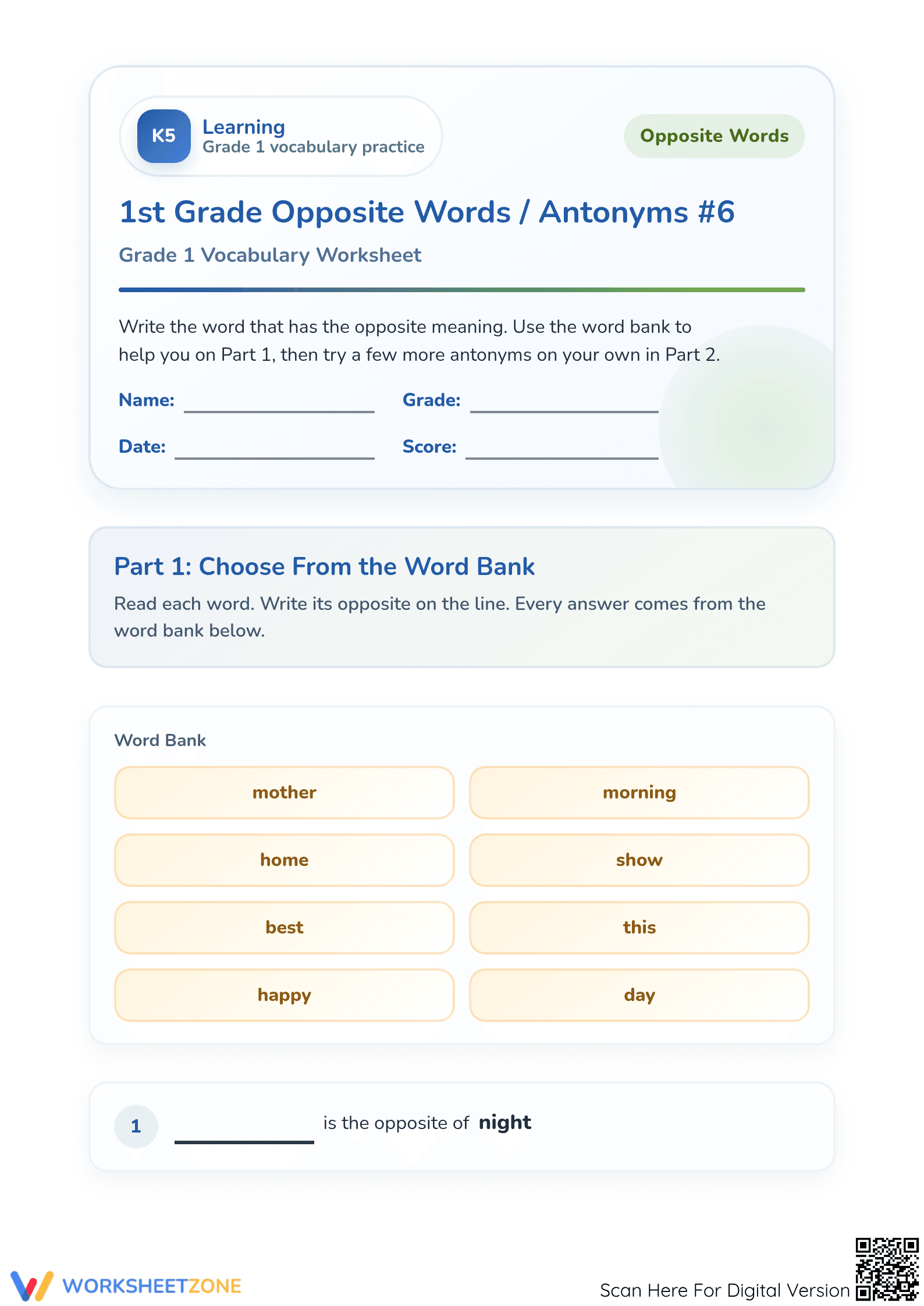
This Grade 1 Opposite Words worksheet helps young learners master antonyms through a clear, scaffolded approach. By identifying word relationships, students strengthen their lexical development and reading comprehension. This printable resource ensures students can accurately define words by identifying their key attributes and opposites, leading to a robust foundational vocabulary and improved language fluency.
At a Glance
- Grade: 1 · Subject: English Language Arts (ELA)
- Standard:
CCSS.ELA-LITERACY.L.1.5— Demonstrate understanding of word relationships and nuances in word meanings- Skill Focus: Antonyms / Opposite Words
- Format: 3 pages · 14 problems · Answer key included · PDF
- Best For: Independent practice and vocabulary reinforcement
- Time: 15–20 minutes
What's Inside
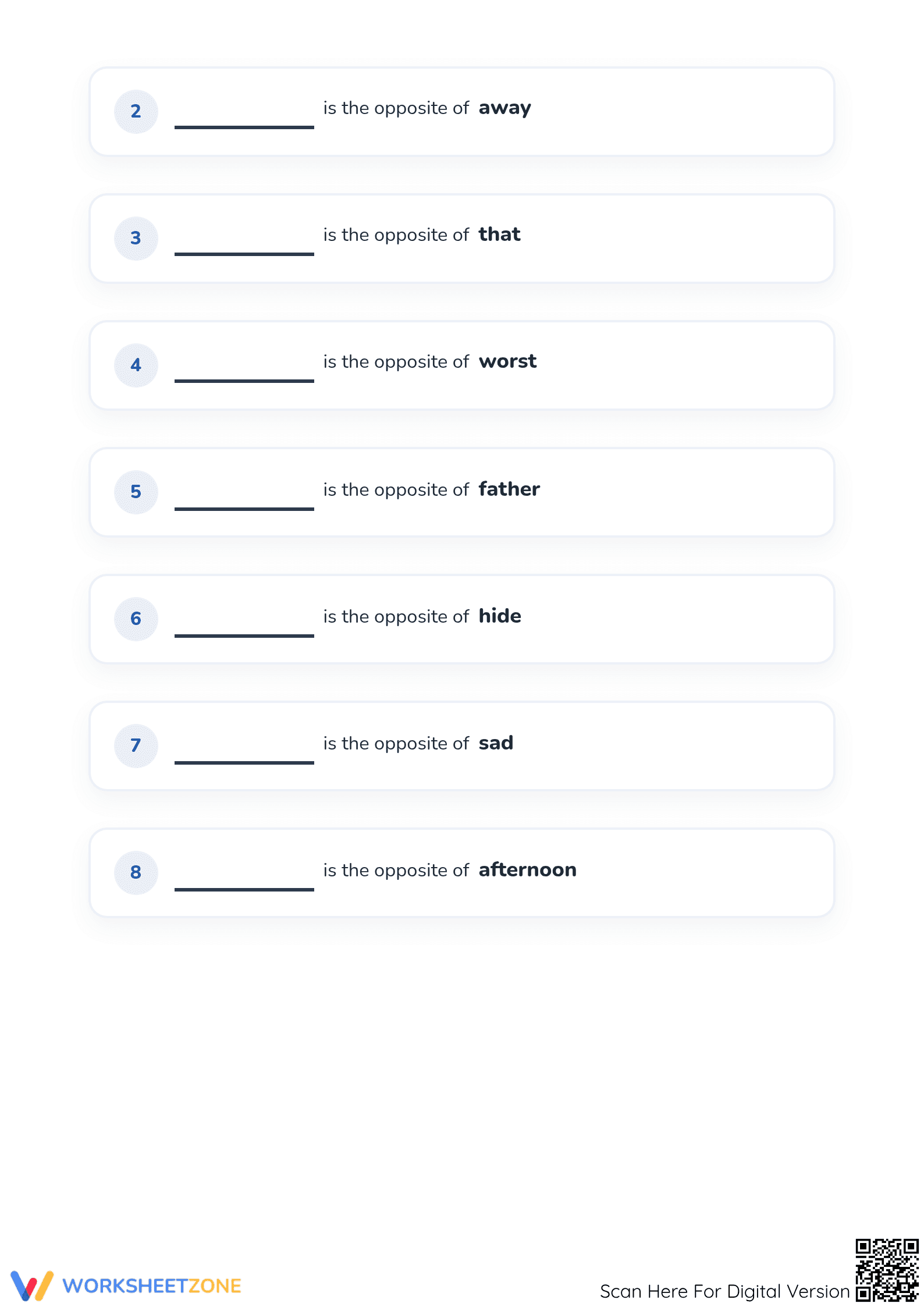
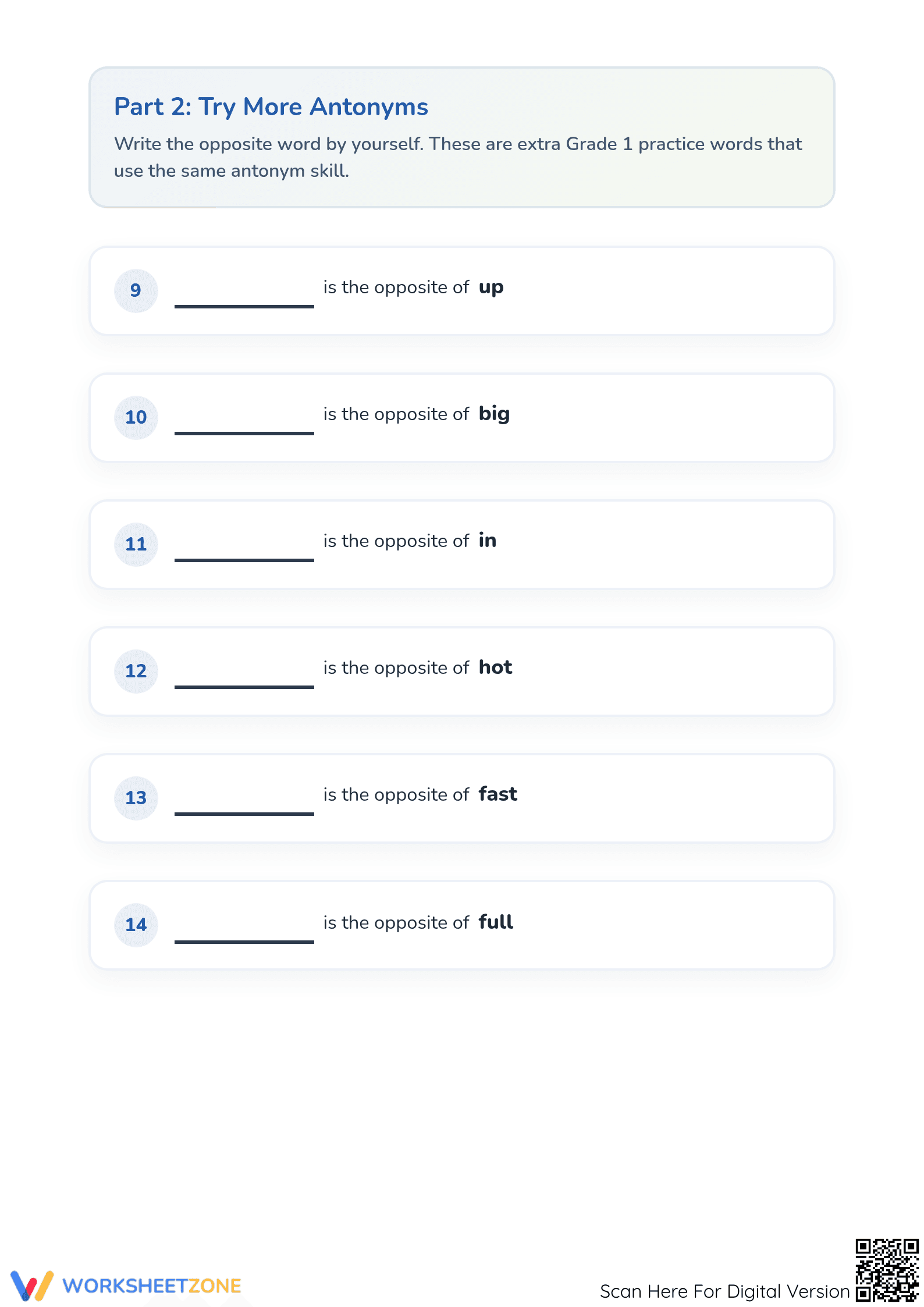
Inside this 3-page PDF, you will find 14 carefully selected antonym pairs designed for first-grade learners. The worksheet is divided into two parts: a guided section featuring a word bank for early support and an independent section that challenges students to recall opposites from memory. The layout is clean and spacious, making it ideal for young writers to practice their handwriting while building essential language skills.
Skill Progression
- Guided Practice: Part 1 provides a word bank with 8 high-frequency terms like "mother," "happy," and "morning," allowing for guided recognition with immediate visual support.
- Supported Practice: Students apply their knowledge to match 8 pairs, bridging the gap between seeing the word and identifying its relationship.
- Independent Practice: Part 2 shifts to independent recall, requiring students to provide the antonym for 6 common words without a word bank.
This deliberate progression ensures students move from recognition to recall, reinforcing the gradual-release instructional strategy.
Standards Alignment
This resource is primary aligned to CCSS.ELA-LITERACY.L.1.5, which focuses on demonstrating an understanding of word relationships and nuances. By working with antonyms, students practice identifying opposites, a key sub-skill for achieving mastery in this language standard. This standard code can be copied directly into lesson plans, IEP goals, or district curriculum mapping tools to ensure instructional alignment.
How to Use It
Use this worksheet during your daily literacy block as a follow-up to a direct instruction lesson on antonyms. It works exceptionally well in a literacy center where students can work at their own pace. During the activity, observe if students can transition from the word bank to the independent section without frustration, as this serves as a valuable formative assessment of their vocabulary retention and recall speed. Expected completion time is 15–20 minutes.
Who It's For
This activity is perfect for first-grade students, but it also serves as an excellent resource for second-grade review or English Language Learners (ELL) building their foundational vocabulary. Pair this worksheet with a picture book about opposites or a classroom anchor chart for a comprehensive learning experience that supports varied learning needs through visual and written cues.
Vocabulary acquisition in early elementary education is a critical predictor of long-term reading success. According to Fisher & Frey (2014), the use of scaffolded practice—moving from recognition tasks with word banks to independent recall—is essential for internalizing word meanings and their relationships. This antonyms worksheet addresses CCSS.ELA-LITERACY.L.1.5 by requiring students to demonstrate an understanding of lexical nuances through 14 targeted problems. By engaging in both recognition and production of opposite words, students build a stronger semantic network, which facilitates faster word retrieval during reading and writing tasks. Research indicates that explicit instruction in word relationships helps students bridge the gap between simple decoding and deep comprehension. This resource provides the structured environment necessary for students to practice these skills, ensuring they meet grade-level expectations for language development while building the confidence needed for more complex linguistic tasks in later grades.


