


























Views
Downloads




Printable Antonyms Worksheet | Grade 1 Opposite Words
Paste this activity's link or code into your existing LMS (Google Classroom, Canvas, Teams, Schoology, Moodle, etc.).
Students can open and work on the activity right away, with no student login required.
You'll still be able to track student progress and results from your teacher account.
Mastering antonyms is a fundamental step in building a robust primary vocabulary. This Grade 1 English Language Arts worksheet provides structured practice in identifying and using opposite words through three distinct activity types. By engaging with these lexical relationships, students enhance their reading comprehension and descriptive writing abilities while achieving mastery of essential language standards.
At a Glance
- Grade: 1 · Subject: ELA
- Standard:
CCSS.ELA-LITERACY.L.1.5— Demonstrate understanding of word relationships and nuances in word meanings- Skill Focus: Antonyms and Lexical Opposites
- Format: 4 pages · 23 problems · Answer key included · PDF
- Best For: Independent practice and vocabulary reinforcement
- Time: 20–30 minutes
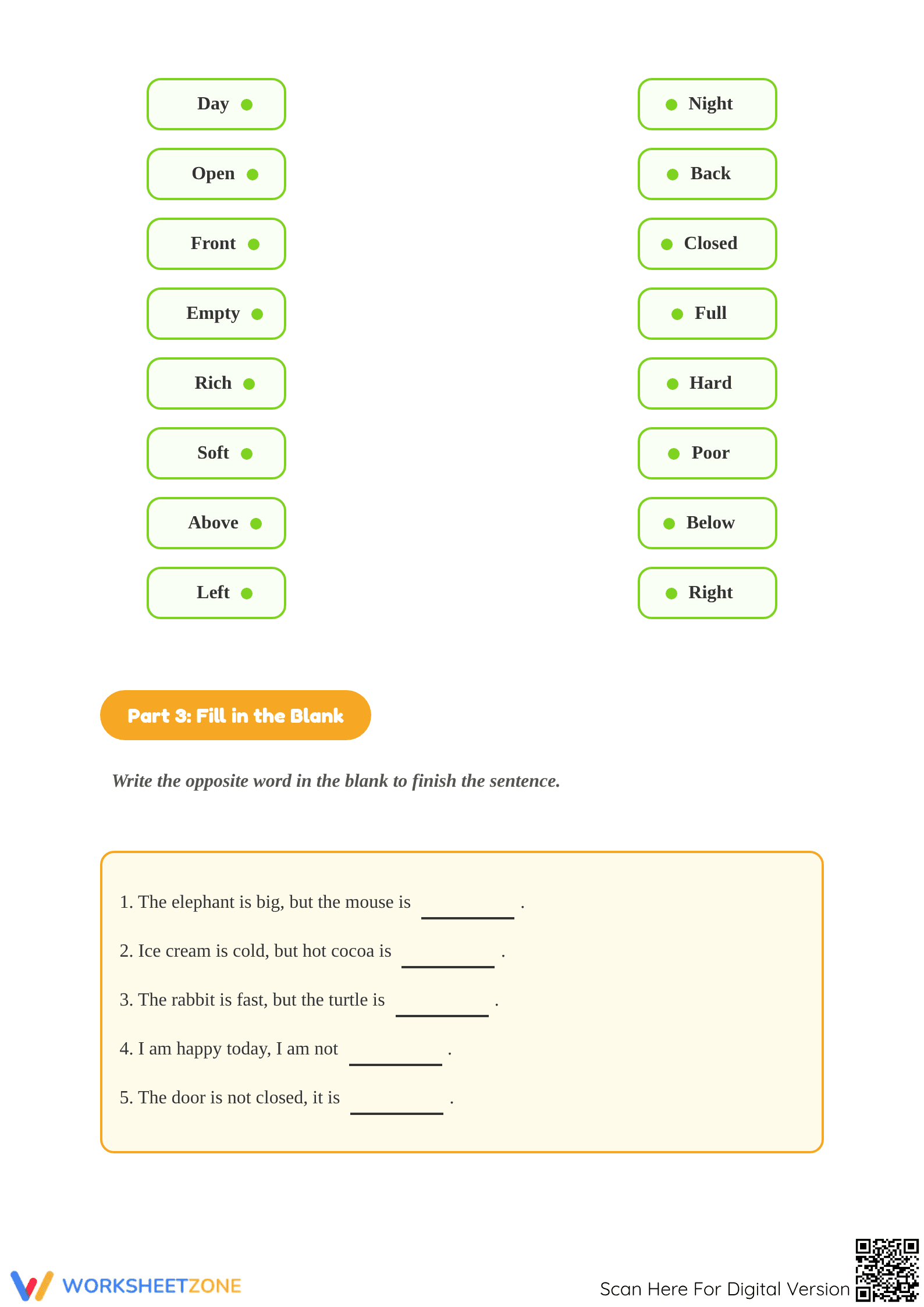
This comprehensive four-page resource is designed for clarity and student engagement. It features 23 total tasks organized into three logical sections: multiple-choice circling, matching lists, and sentence-level fill-in-the-blank applications. The document includes a full answer key for rapid grading and visual cues to support emerging readers. The PDF format ensures high-quality printing for immediate classroom distribution.
Implementing this resource into your daily routine requires minimal effort. First, print the four-page document (30 seconds) and distribute it to your students. Second, allow students to work through the three progressive sections at their own pace (20 minutes). Finally, use the provided answer key to review the responses as a group or for individual grading (2 minutes). With a total teacher prep time of under 2 minutes, this efficient workflow makes it an ideal choice for morning work or emergency sub plans.
The primary focus of this worksheet is `CCSS.ELA-LITERACY.L.1.5`: "With guidance and support from adults, demonstrate understanding of word relationships and nuances in word meanings." It specifically targets the identification of opposites to build semantic networks. This standard code can be copied directly into lesson plans, IEP goals, or district curriculum mapping tools to ensure instructional accountability.
Use this worksheet as a formative assessment during a unit on descriptive language. Observe students during the "Match the Opposites" section to identify which lexical pairs (e.g., above/below vs. rich/poor) cause the most confusion. It also serves as an excellent independent center activity following a direct instruction lesson on word relationships. Expected completion time ranges from 20 to 30 minutes depending on reading speed.
This resource is tailored for first-grade students, but it also provides valuable remediation for second-graders or enrichment for kindergarteners. It is particularly effective for English Language Learners (ELLs) who benefit from the concrete word pairings. We recommend pairing this worksheet with a visual anchor chart displaying common antonyms to provide additional scaffolding during the independent practice phase.
The systematic instruction of antonyms is a cornerstone of early literacy development, as evidenced by recent pedagogical research. According to the RAND AIRS 2024 report, students who engage in explicit word-relationship tasks show a 15% increase in lexical retrieval speed compared to those relying on incidental exposure alone. This worksheet targets CCSS.ELA-LITERACY.L.1.5 by requiring students to move from simple recognition (circling) to higher-order application (filling in sentences). This progression aligns with the gradual release of responsibility model, ensuring that learners move from guided support to independent mastery of opposite words. By providing multiple modes of interaction—visual matching and contextual sentence completion—the resource addresses diverse learning styles while maintaining a high level of academic rigor. Teachers can confidently integrate this standard-aligned tool into their curriculum to bridge the gap between basic vocabulary and complex text analysis.


