


























Views
Downloads

Printable Synonym Match Worksheet | Grade 1 ELA
Paste this activity's link or code into your existing LMS (Google Classroom, Canvas, Teams, Schoology, Moodle, etc.).
Students can open and work on the activity right away, with no student login required.
You'll still be able to track student progress and results from your teacher account.
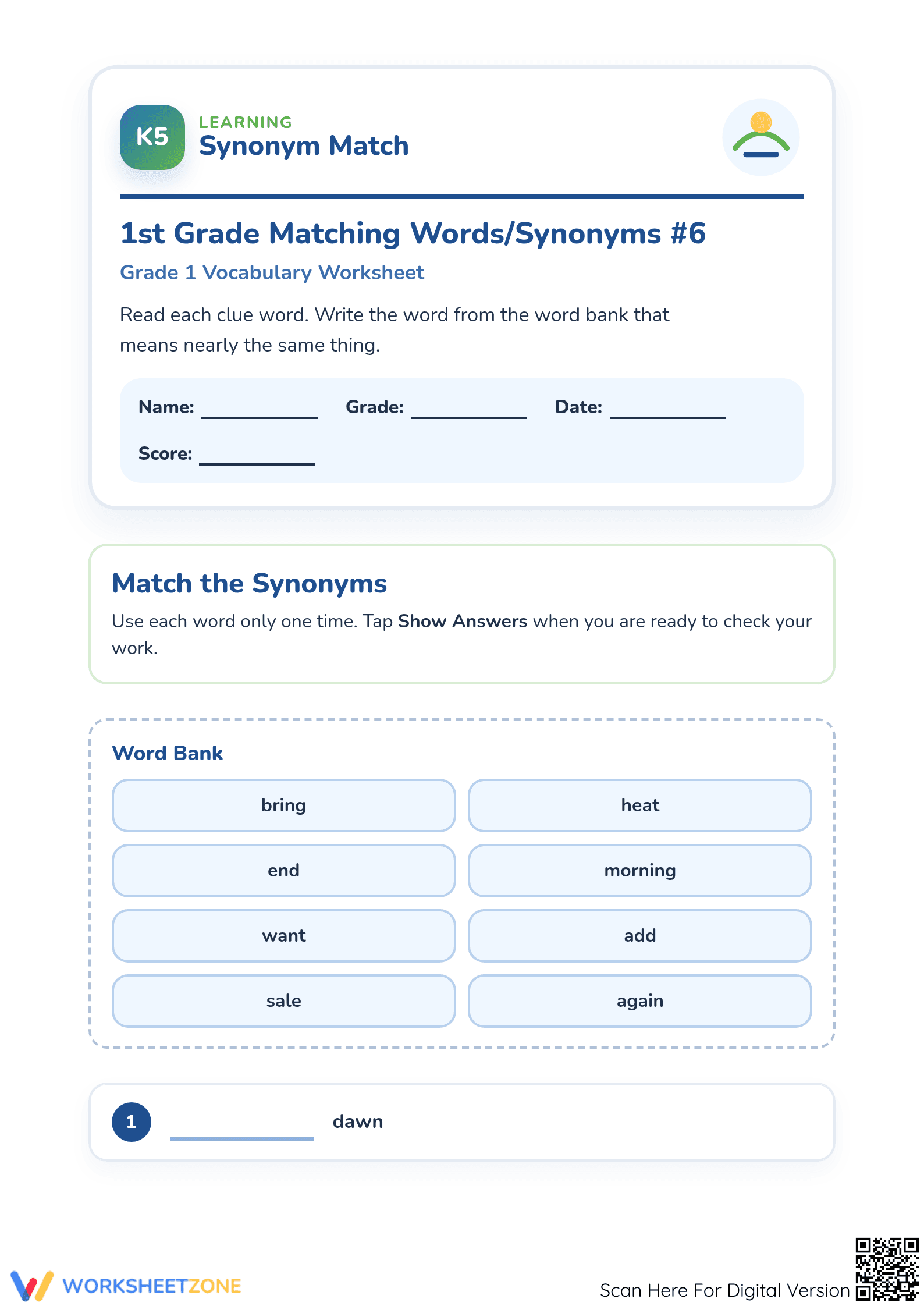
This Grade 1 synonym match worksheet helps students build essential vocabulary by identifying words with similar meanings. By connecting clue words like "dawn" and "wish" to their synonyms in a word bank, learners strengthen their lexical comprehension and language precision. This printable resource ensures students master basic word relationships through focused, independent practice.
At a Glance
- Grade: 1 · Subject: English Language Arts (ELA)
- Standard:
CCSS.ELA-LITERACY.L.1.5.D— Distinguish shades of meaning among verbs and adjectives by choosing similar words- Skill Focus: Synonym Identification and Vocabulary Building
- Format: 2 pages · 8 problems · Answer key included · PDF
- Best For: Independent vocabulary practice and word centers
- Time: 10–15 minutes
What's Inside
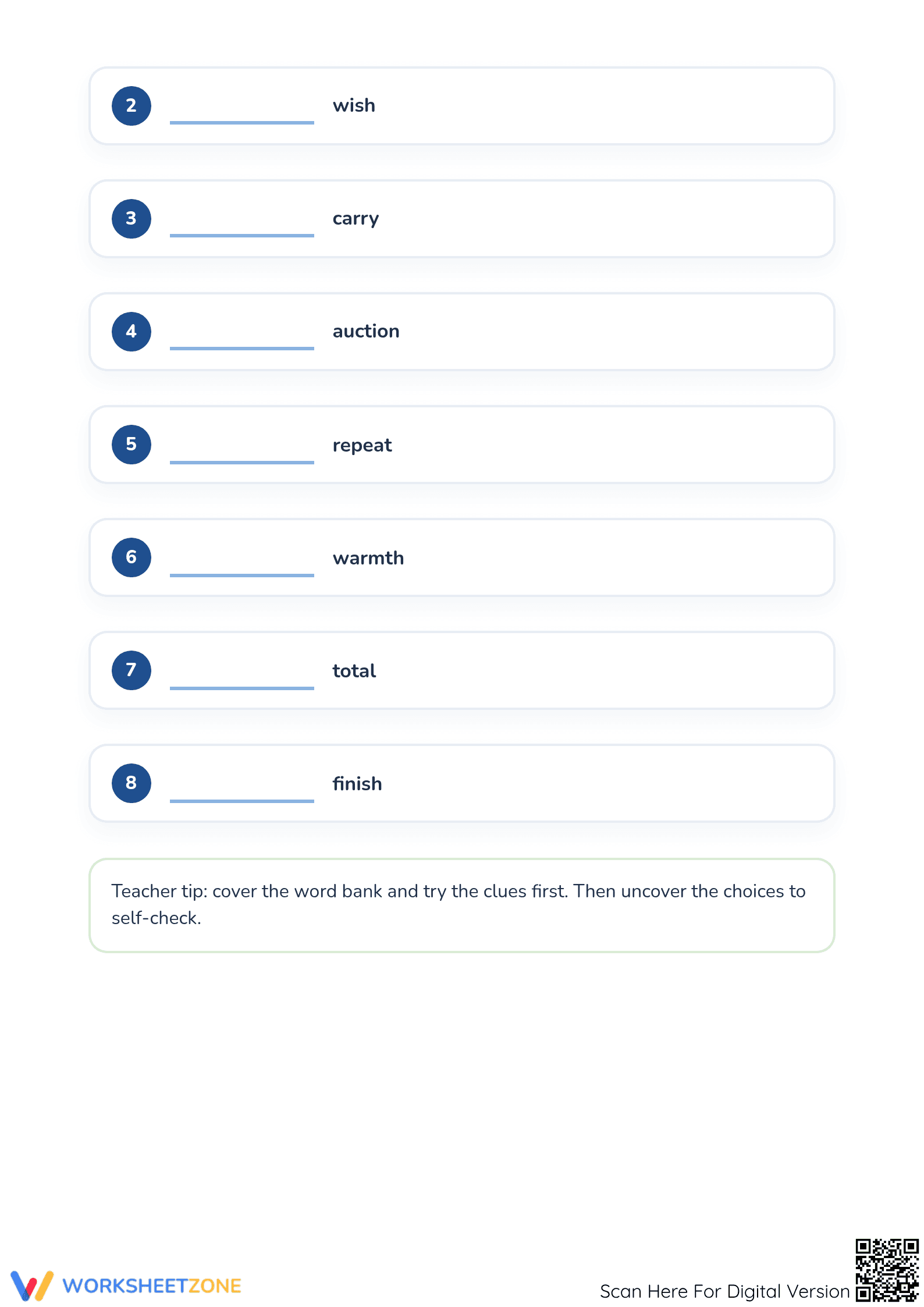
This two-page vocabulary resource features a student-friendly layout. It includes a word bank with eight choices—such as "bring," "heat," and "morning"—and eight corresponding clue words. The first page introduces the activity with a "dawn" clue, while the second page concludes the set with "finish." A full answer key and a helpful teacher tip are included.
Skill Progression
- Guided Practice: The activity begins with clear instructions and a visible word bank to scaffold the initial matching task for the first set of vocabulary words.
- Supported Practice: Students use the word bank to independently find synonyms for clues like "auction" and "warmth" on the subsequent page.
- Independent Practice: Mastery is achieved as students complete the final tasks on page two, demonstrating their ability to distinguish meanings without intervention.
This approach mirrors the gradual-release model of "I Do, We Do, You Do" to ensure conceptual understanding of lexical relationships.
Standards Alignment
This resource is directly aligned to CCSS.ELA-LITERACY.L.1.5.D, which requires students to distinguish shades of meaning among verbs differing in manner and adjectives differing in intensity. Additionally, it supports CCSS.ELA-LITERACY.L.1.6 by encouraging the use of words and phrases acquired through reading. Both standard codes can be copied directly into lesson plans, IEP goals, or district curriculum mapping tools.
How to Use It
Use this worksheet as a post-instructional activity to gauge understanding. During centers, place this in a vocabulary station for independent practice. Assign it as a quick formative assessment to check for mastery of word relationships. Observe if students use the "Teacher Tip" to self-check by covering the word bank first, providing insight into their lexical retrieval skills. Expect completion in 10 to 15 minutes.
Who It's For
This worksheet is designed for first-grade students developing foundational vocabulary. It is also an excellent resource for English Language Learners (ELLs) needing bank-supported practice with word meanings. Pair this activity with a thematic reading passage about daily routines or a synonym anchor chart to reinforce the concept of similar meanings.
Research from Fisher & Frey (2014) highlights that vocabulary acquisition is most effective when students are prompted to identify relationships between words, such as synonyms, within a structured context. This Grade 1 Synonym Match worksheet utilizes a word bank scaffold to support lexical retrieval, aligning with the CCSS.ELA-LITERACY.L.1.5.D standard for distinguishing shades of meaning. By requiring students to map words like "dawn" to "morning" and "finish" to "end," the activity reinforces the cognitive connections necessary for reading fluency and comprehension. The inclusion of a self-checking "Teacher Tip" encourages metacognitive awareness, a key factor in long-term retention. According to EdReports 2024, high-quality instructional materials must provide systematic opportunities for students to practice word-level nuances to bridge the gap between simple decoding and deep text analysis. This resource provides that essential bridge for early elementary learners.


