


























Views
Plays


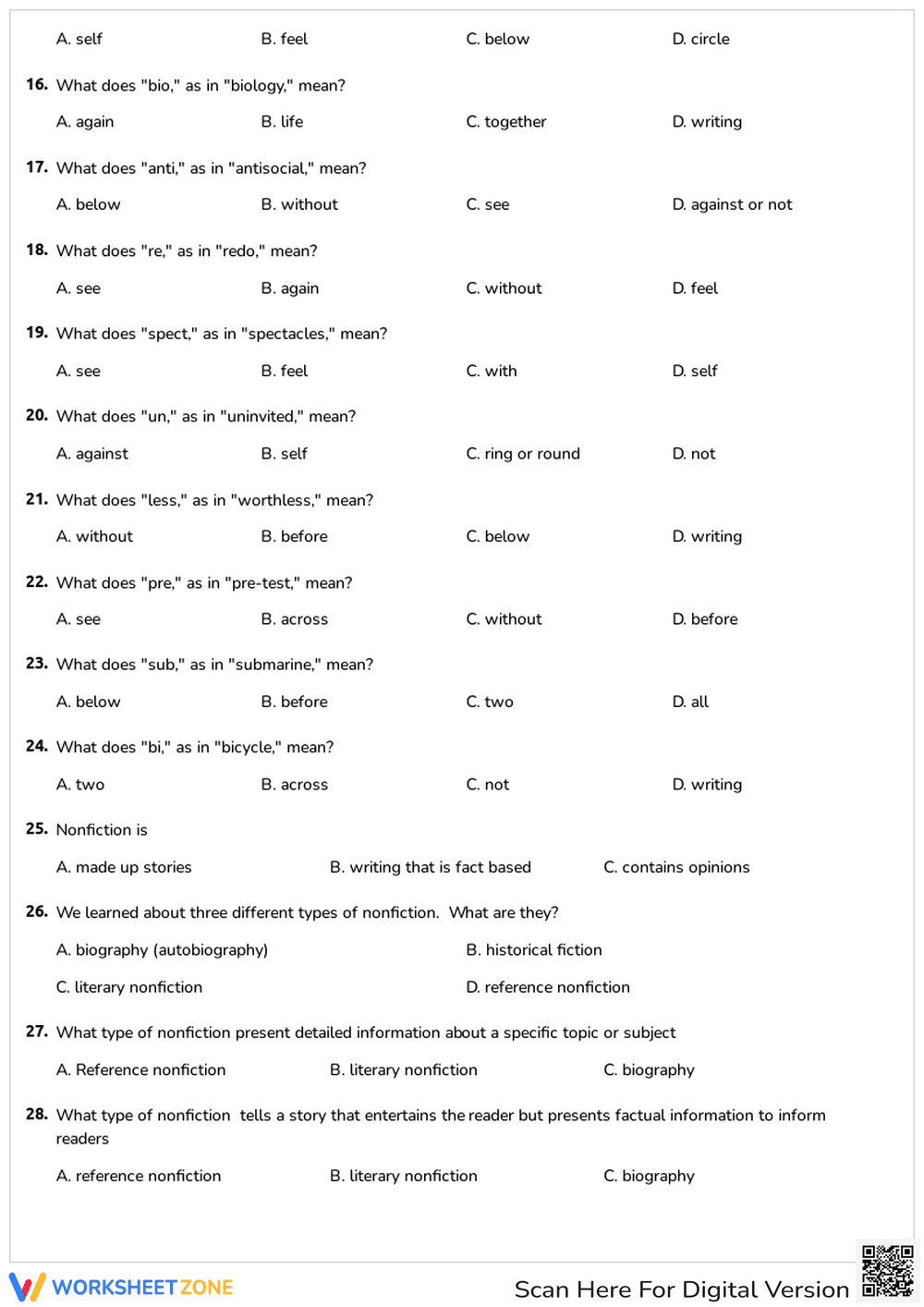
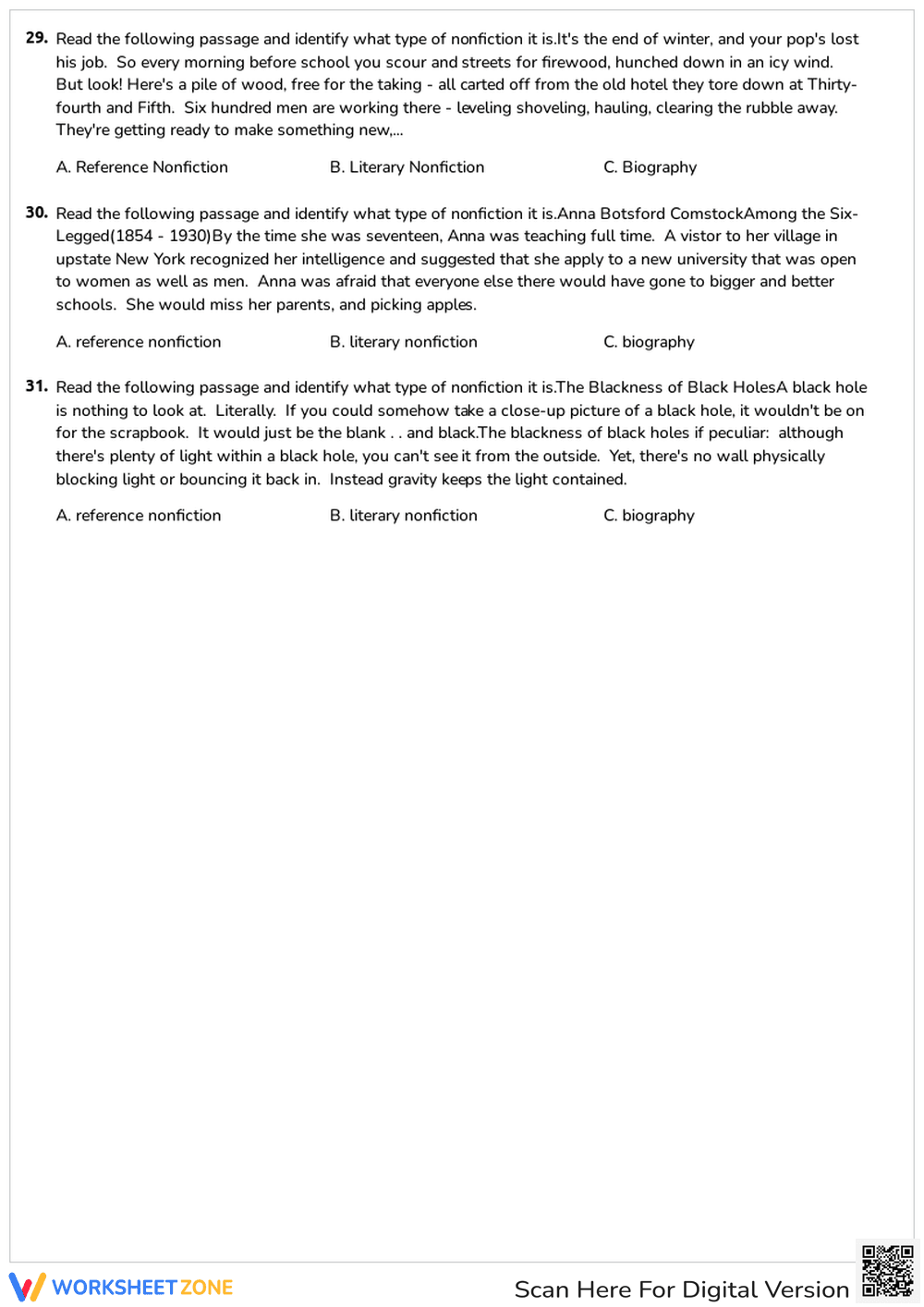

Grade 6 Nonfiction Reading — Printable No-Prep Worksheet
Paste this activity's link or code into your existing LMS (Google Classroom, Canvas, Teams, Schoology, Moodle, etc.).
Students can open and work on the activity right away, with no student login required.
You'll still be able to track student progress and results from your teacher account.
This Grade 6 ELA worksheet gives students comprehensive practice with nonfiction reading skills, helping them identify central ideas, analyze text features, and decode vocabulary using prefixes and suffixes. Designed as a robust review, it assesses foundational comprehension and morphology to ensure students can confidently navigate informational texts.
At a Glance
- Grade: 6 · Subject: ELA
- Standard:
CCSS.ELA-LITERACY.RI.6.2— Determine a central idea and how it is conveyed- Skill Focus: Nonfiction Reading & Morphology
- Format: 4 pages · 31 problems · Answer key included · PDF
- Best For: End-of-unit review or assessment
- Time: 30–45 minutes
This comprehensive resource features 31 multiple-choice questions spread across four pages. The task types include reading short passages to determine the main idea, identifying the correct usage of text features like captions and indexes, and defining words based on common prefixes and suffixes (such as bio-, anti-, and sub-). A complete answer key is included for fast and accurate grading.
- Print (1 minute): Simply print the four-page PDF assessment and the accompanying answer key.
- Distribute (1 minute): Hand out the packets to students for independent work or assessment.
- Review (5 minutes): Use the provided key to quickly score the 31 multiple-choice questions.
Total teacher prep time is under two minutes, making this an ideal resource for a quick formative assessment, a comprehensive unit review, or a reliable emergency sub plan.
Aligned to CCSS.ELA-LITERACY.RI.6.2: Determine a central idea of a text and how it is conveyed through particular details; provide a summary of the text distinct from personal opinions or judgments. It also supports vocabulary development through morphology. Both standard codes can be copied directly into lesson plans, IEP goals, or district curriculum mapping tools.
This worksheet is highly effective as an end-of-grading-period assessment to measure retention of nonfiction reading concepts. Alternatively, use it during direct instruction as a guided review packet, pausing after each section to discuss the rationale behind the correct answers. For formative assessment, observe which specific question types (e.g., text features vs. central idea) cause the most difficulty to guide future mini-lessons. Expected completion time is 30 to 45 minutes.
This resource is designed for 6th-grade general education students, but it also serves as an excellent review for 7th graders needing foundational reinforcement. To support differentiation, teachers can reduce the number of answer choices or allow students to use an anchor chart for the prefix and suffix section. It pairs perfectly with any introductory unit on informational texts or literary nonfiction.
Integrating explicit instruction and assessment on text features and central ideas is critical for middle school reading comprehension. According to Fisher & Frey (2014), students who can accurately identify and utilize informational text structures demonstrate significantly higher retention of complex content. This assessment directly targets CCSS.ELA-LITERACY.RI.6.2, requiring students to determine a central idea and how it is conveyed. By combining main idea analysis with morphology and text feature identification, this resource provides a holistic measure of a student's ability to navigate informational texts, ensuring they are prepared for more rigorous academic reading demands.


