


























Views
Downloads

12x Tables Bingo Printable | Grade 3 Math
Paste this activity's link or code into your existing LMS (Google Classroom, Canvas, Teams, Schoology, Moodle, etc.).
Students can open and work on the activity right away, with no student login required.
You'll still be able to track student progress and results from your teacher account.
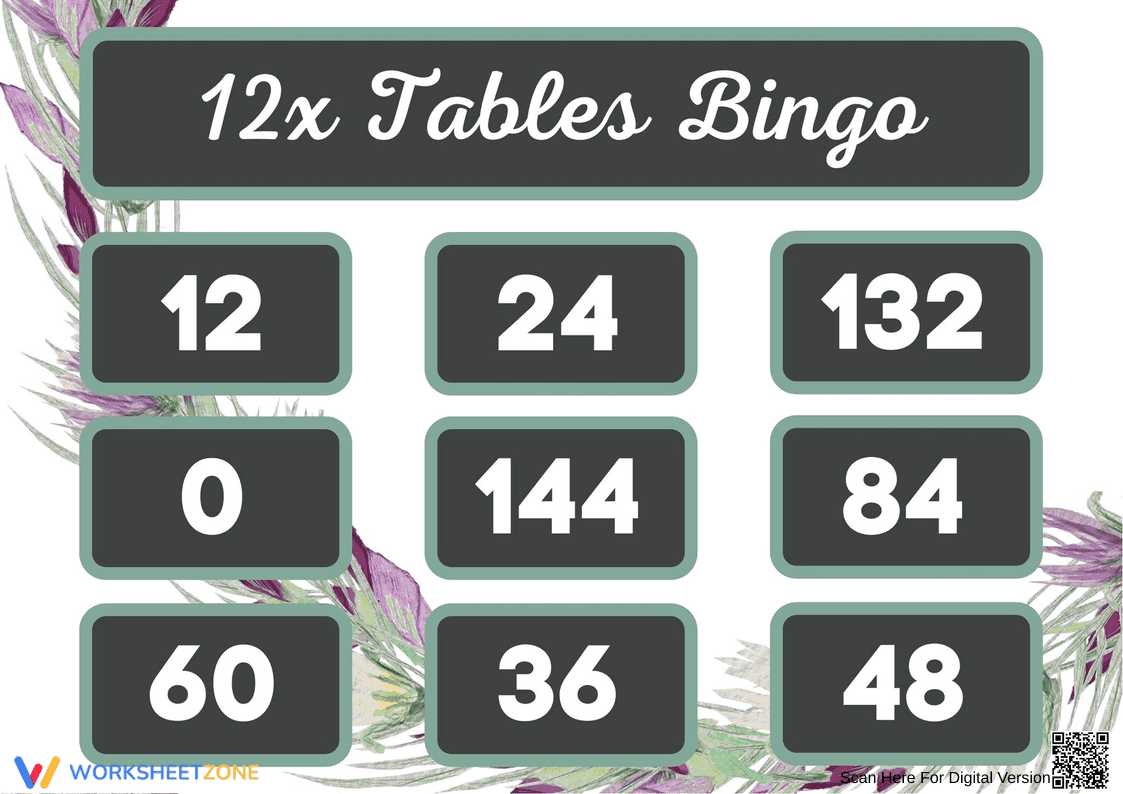
This Grade 3 multiplication worksheet gives students an engaging way to practice their 12 times tables through a fun bingo format. By matching products to multiplication equations, learners build essential math fluency and automaticity. The Australiana theme adds a unique visual element to keep students focused and motivated during practice.
At a Glance
- Grade: 3 · Subject: Math
- Standard:
CCSS.MATH.CONTENT.3.OA.C.7— Fluently multiply and divide within 100- Skill Focus: 12x Multiplication Tables
- Format: 1 page · 9 problems · No answer key · PDF
- Best For: Math centers and group review
- Time: 15–20 minutes
This resource features a beautifully designed 3x3 bingo card focused exclusively on the 12 times tables. The single-page layout includes nine distinct products ranging from 0 to 144, set against a calming botanical Australiana background. Students will find a clear grid that eliminates visual clutter while reinforcing their multiplication facts. The straightforward format requires no complex instructions, making it an immediate addition to any math rotation.
This zero-prep activity is designed for immediate classroom implementation:
- Print (1 min): Download the PDF and print the bingo cards.
- Distribute (1 min): Hand out cards and counters.
- Review (15 mins): Call out 12x expressions while students cover the products.
With total teacher preparation under two minutes, this is perfect for sub plans.
This activity aligns with CCSS.MATH.CONTENT.3.OA.C.7: Fluently multiply and divide within 100, using strategies such as the relationship between multiplication and division or properties of operations. While the standard explicitly mentions fluency within 100, mastering the 12s up to 144 provides a critical extension for advanced third graders and standard fourth-grade curriculum preparation. Both standard codes can be copied directly into lesson plans, IEP goals, or district curriculum mapping tools.
Teachers can utilize this bingo card during small group math centers to reinforce direct instruction on multiplication strategies. As a formative assessment tool, observe which students quickly identify the product of 12x12 versus those who still rely on repeated addition or skip counting. Alternatively, use it as a whole-class Friday review game to build excitement around math fact fluency. The expected completion time ranges from 15 to 20 minutes, depending on the pace of the caller and the students' current mastery levels.
This resource is primarily designed for third and fourth-grade students working on multiplication fact automaticity. The visual simplicity supports learners who might be overwhelmed by text-heavy worksheets, while the specific focus on the 12s provides appropriate rigor for students ready to move beyond the base-ten facts. It pairs perfectly with a direct instruction lesson on the distributive property or a visual anchor chart breaking down the 12 times tables into 10s and 2s.
Developing automaticity with multiplication facts, including the challenging twelve times tables, is a foundational component of elementary mathematics education. This resource directly targets CCSS.MATH.CONTENT.3.OA.C.7, requiring students to fluently multiply and divide within 100. According to a comprehensive EdReports 2024 analysis of effective math instructional materials, incorporating game-based practice formats like bingo significantly increases student engagement and repeated exposure to core facts without the fatigue associated with traditional drill worksheets. When students can rapidly recall products up to 144, they free up essential cognitive working memory required for more complex multi-digit algorithms and fraction operations introduced in upper elementary grades. By utilizing targeted, low-stakes practice environments, educators can foster both mathematical confidence and procedural fluency, ensuring learners are adequately prepared for advanced algebraic reasoning tasks in their future academic careers.


