


























Views
Downloads

Essential -ly, -re, or -est? Adverb vs Adjective Worksheet
Paste this activity's link or code into your existing LMS (Google Classroom, Canvas, Teams, Schoology, Moodle, etc.).
Students can open and work on the activity right away, with no student login required.
You'll still be able to track student progress and results from your teacher account.
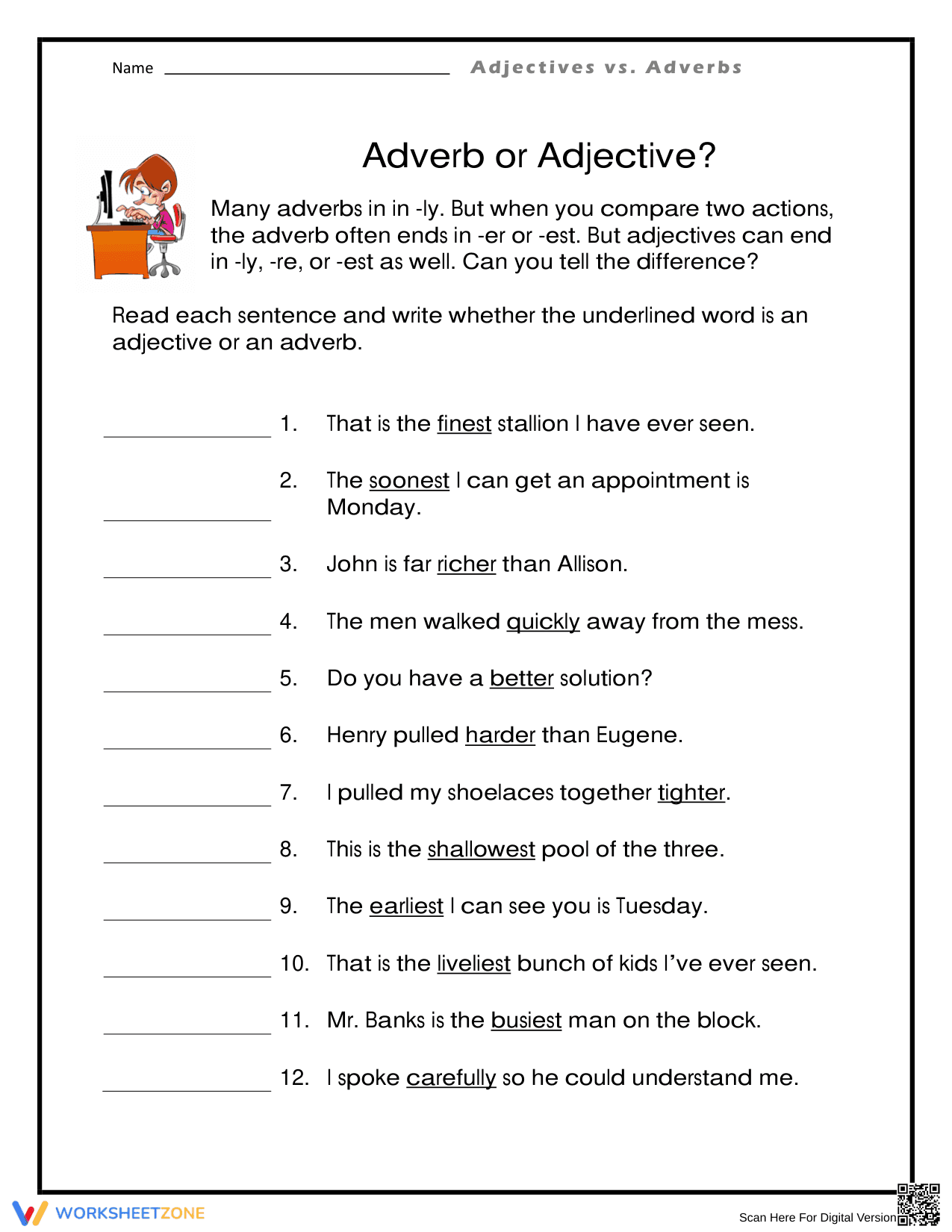
This Grade 4 grammar worksheet helps students distinguish between adjectives and adverbs by analyzing word endings like -ly, -re, and -est. Students strengthen linguistic precision by identifying how modifiers function within different sentence contexts. By the end of this activity, learners will confidently categorize descriptive words based on their role in modifying nouns or verbs.
At a Glance
- Grade: 4 · Subject: ELA Grammar
- Standard:
CCSS.ELA-LITERACY.L.3.1.G— Use comparative and superlative adjectives and adverbs to modify words correctly- Skill Focus: Modifier Identification
- Format: 1 page · 12 problems · Answer key included · PDF
- Best For: Independent grammar practice or review
- Time: 10–15 minutes
This PDF contains a brief instructional header clarifying how adverbs and adjectives can share similar suffixes. Below the instructions are 12 carefully crafted sentences, each featuring one underlined word. Students must evaluate the sentence context and write the correct part of speech on the provided line, ensuring they understand the functional difference between modifiers like "better" and "carefully."
Implementing this resource takes under two minutes of teacher preparation. Simply print the single-page worksheet and distribute it to your students. Because the instructions are self-contained and include a helpful reminder of suffix rules, students can begin working immediately with minimal guidance. The included answer key allows for a rapid review session, making it ideal for busy classroom schedules or sub plans.
This activity is aligned with the Common Core State Standard CCSS.ELA-LITERACY.L.3.1.G, which requires students to form and use comparative and superlative adjectives and adverbs correctly. It also supports general Grade 4 language conventions regarding modifier usage. Both standard codes can be copied directly into lesson plans, IEP goals, or district curriculum mapping tools.
Use this worksheet as a formative assessment after direct instruction on modifiers. Teachers should observe students at task 12 to see if they can distinguish between the -ly adverb "carefully" and the -est adjective "busiest." Completion typically takes 12 minutes, making it a perfect exit ticket or a quick check-in to gauge student mastery of descriptive language components.
This resource is designed for Grade 4 students but works effectively for Grade 3 enrichment or Grade 5 review. It provides essential support for English Language Learners who struggle with the nuances of English suffixes. Pair this worksheet with a short reading passage or an anchor chart on parts of speech to provide students with a comprehensive modifier study unit.
Academic research emphasizes that explicit instruction in morphology and word endings is critical for developing reading comprehension. According to Fisher & Frey (2014), scaffolded practice like this modifier identification task improves a student's ability to apply grammar rules in novel contexts. This worksheet targets CCSS.ELA-LITERACY.L.3.1.G by requiring students to distinguish between adjectives and adverbs that share common suffixes like -ly, -re, and -est. By analyzing 12 distinct sentence structures, students build the cognitive pathways necessary for choosing the correct modifier in their own descriptive writing. Such targeted practice is a hallmark of high-quality ELA instruction, ensuring students apply rules to authentic linguistic scenarios rather than simply memorizing definitions. This resource provides a structured environment for mastering the nuances of comparative and superlative forms across various sentence types.


