


























Views
Downloads

Printable Letter K Tracing Worksheet | Grade K ELA
Paste this activity's link or code into your existing LMS (Google Classroom, Canvas, Teams, Schoology, Moodle, etc.).
Students can open and work on the activity right away, with no student login required.
You'll still be able to track student progress and results from your teacher account.
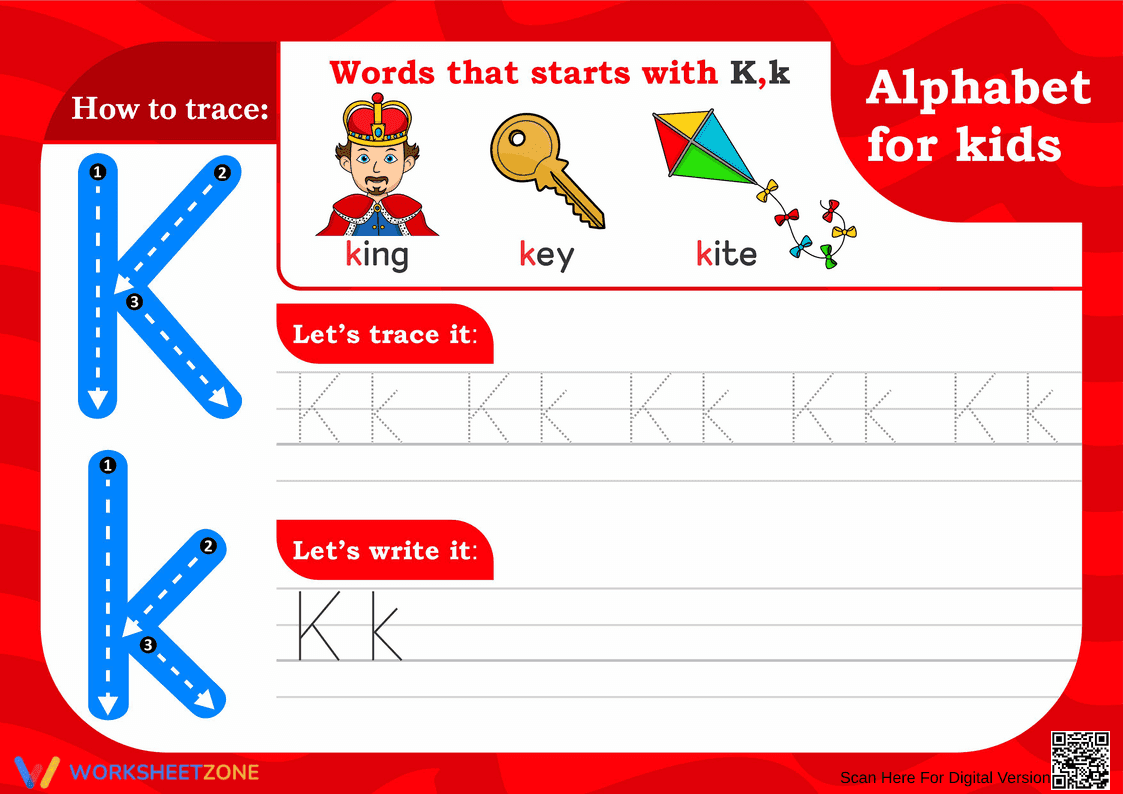
This printable Letter K tracing worksheet helps early learners master handwriting and letter recognition. Students practice forming uppercase and lowercase K through guided strokes and independent writing tasks. By connecting the letter to familiar vocabulary like king, key, and kite, young readers build foundational phonics skills.
At a Glance
- Grade: K · Subject: English
- Standard:
CCSS.ELA-LITERACY.L.K.1.A— Print many upper- and lowercase letters- Skill Focus: Letter K Tracing and Writing
- Format: 1 page · 6 problems · No answer key needed · PDF
- Best For: Independent practice and centers
- Time: 10–15 minutes
This single-page resource features a structured layout for early writers. The top section provides numbered directional arrows demonstrating exactly how to form both the uppercase and lowercase letter K. Next, a vocabulary row displays colorful illustrations of a king, key, and kite to reinforce letter-sound correspondence. The bottom half includes five pairs of dotted letters on primary handwriting lines for guided tracing, followed by an open space for independent writing practice.
This worksheet offers immediate classroom implementation.
- Print (1 minute): Simply download the PDF and print the required copies. The high-contrast design ensures clear lines.
- Distribute (1 minute): Hand out the sheets during morning work, literacy centers, or as a quick transition activity.
- Review (0 minutes): Because the directional arrows and tracing guides are self-explanatory, students can begin working immediately.
Total teacher prep time is under two minutes, making this an excellent option for emergency sub plans or spontaneous skill reinforcement.
This resource is directly aligned to CCSS.ELA-LITERACY.L.K.1.A, requiring students to print many upper- and lowercase letters. The structured progression from tracing to independent writing ensures students develop the fine motor control necessary to meet this foundational literacy expectation. Both standard codes can be copied directly into lesson plans, IEP goals, or district curriculum mapping tools.
Use this worksheet during morning work to establish a focused start. It also serves perfectly as an independent literacy center activity while the teacher conducts small group reading instruction. As a formative assessment tip, observe students while they trace the initial letters to ensure they are following the numbered directional arrows rather than drawing the lines out of sequence. Expected completion time ranges from 10 to 15 minutes depending on the student's fine motor development.
This resource is primarily designed for Kindergarten students and first graders who need targeted handwriting intervention. For students requiring additional differentiation, teachers can provide a textured surface underneath the paper or highlight the bottom writing line to guide spatial awareness. This worksheet pairs naturally with a whole-class phonics lesson introducing the /k/ sound or an anchor chart displaying K-vocabulary words.
Developing handwriting automaticity is a critical component of early literacy that directly impacts future reading and writing proficiency. When students practice to print many upper- and lowercase letters, as outlined in CCSS.ELA-LITERACY.L.K.1.A, they reduce the cognitive load required for letter formation, freeing up mental resources for spelling and composition. According to a RAND AIRS 2024 report on early childhood literacy interventions, explicit handwriting instruction combined with phonics reinforcement significantly improves overall reading fluency in primary grades. This targeted letter K worksheet provides the exact repetition and visual scaffolding necessary to build that foundational motor memory. By integrating directional cues with vocabulary anchors, the resource supports comprehensive letter acquisition. Consistent practice with these structured tracing activities ensures young learners develop the physical stamina and accuracy required for long-term academic success.


