


























Views
Downloads
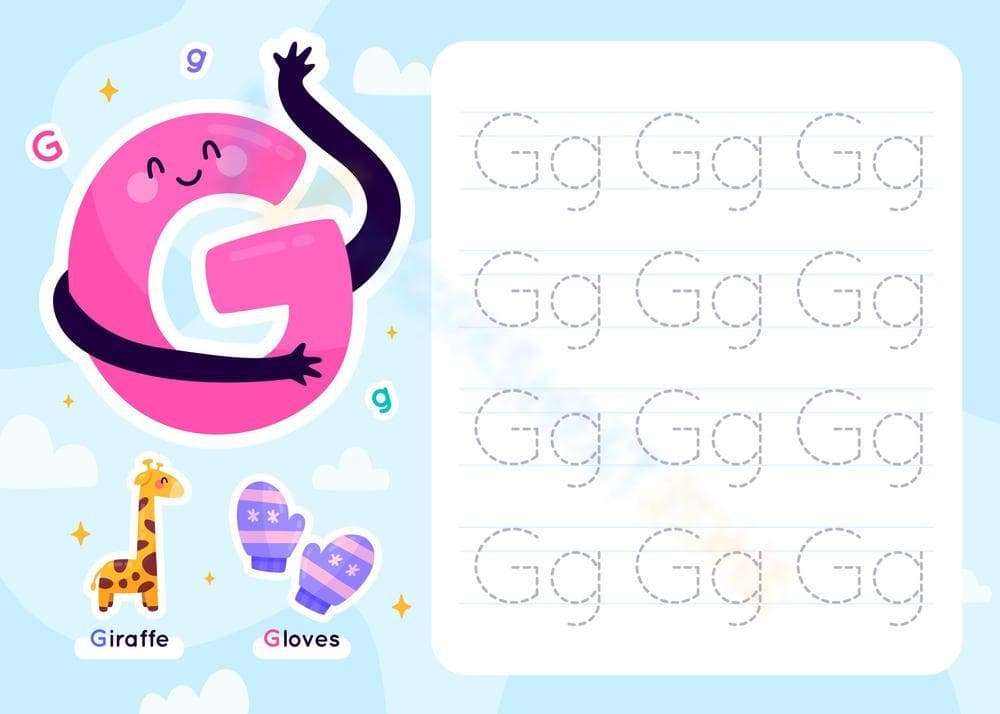

Letter G Writing Practice | Essential Kindergarten Worksheet
Paste this activity's link or code into your existing LMS (Google Classroom, Canvas, Teams, Schoology, Moodle, etc.).
Students can open and work on the activity right away, with no student login required.
You'll still be able to track student progress and results from your teacher account.
This Letter G writing practice worksheet provides early learners with a structured environment to develop fine motor skills and letter recognition. Students trace uppercase and lowercase pairs to build muscle memory and foundational literacy. By focusing on a single character, children gain the confidence needed for fluent handwriting and phonetic awareness.
At a Glance
- Grade: Kindergarten · Subject: Handwriting
- Standard:
CCSS.ELA-LITERACY.L.K.1.A— Print many upper- and lowercase letters correctly- Skill Focus: Letter G formation
- Format: 1 page · 12 tasks · No-prep · PDF
- Best For: Morning work or literacy centers
- Time: 10–15 minutes
Inside this resource, you will find a single-page layout designed for clarity and engagement. The left side features vibrant illustrations of a giraffe and gloves to reinforce the "g" sound, while the right side contains 12 dotted-line pairs of "Gg" for tracing. The large font size is specifically tailored for small hands still developing grip strength and spatial awareness on the page.
The zero-prep workflow for this worksheet is designed for maximum efficiency in a busy classroom. First, print the single-page PDF (30 seconds). Second, distribute the sheets to students during your literacy block or as they arrive in the morning (1 minute). Finally, review the letter formation by walking the room to provide immediate feedback on stroke order (ongoing). Total teacher preparation time is under 2 minutes, making it an ideal choice for sub plans or last-minute activities.
This resource aligns with `CCSS.ELA-LITERACY.L.K.1.A`, which requires students to print many upper- and lowercase letters. It also supports phonemic awareness by connecting the letter shape to visual representations of the /g/ sound. Both standard codes can be copied directly into lesson plans, IEP goals, or district curriculum mapping tools to ensure compliance with state and national benchmarks.
Use this worksheet during the "You Do" phase of a gradual release model. After demonstrating the proper stroke order for the letter G on the board, assign this sheet for independent practice. It also serves as an excellent formative assessment tool; observe if students start their uppercase G at the top or bottom to identify who needs additional one-on-one intervention. Completion typically takes 10 to 15 minutes depending on the student's fine motor development.
This worksheet is ideal for preschool and kindergarten students who are beginning their handwriting journey. It is particularly helpful for English Language Learners (ELLs) who benefit from the visual cues of the giraffe and gloves. Pair this resource with a tactile sand tray or a letter G anchor chart to create a multi-sensory learning experience that caters to diverse learning styles in a general education or special education setting.
Handwriting instruction remains a cornerstone of early literacy, as the physical act of letter formation is linked to better letter recognition and reading fluency. According to Fisher & Frey (2014), the gradual release of responsibility—moving from teacher modeling to independent tracing—is essential for mastery of foundational skills like those found in `CCSS.ELA-LITERACY.L.K.1.A`. This worksheet provides the necessary "independent practice" phase where students internalize the specific curves and lines of the letter G. Research indicates that repetitive tracing helps solidify the neural pathways required for automaticity in writing. By providing 12 distinct opportunities to trace both uppercase and lowercase forms, this resource ensures that students move beyond simple recognition toward functional production. This structured approach is a reliable method for improving neatness and consistency in early childhood education settings, allowing teachers to focus on individual student needs while the rest of the class engages in meaningful, standards-aligned work.


