


























Views
Downloads
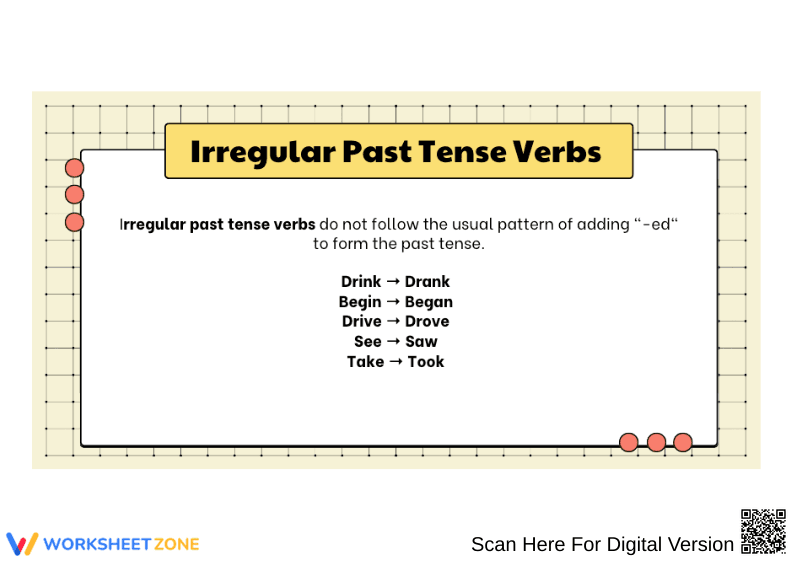

Irregular Past Tense Verbs: Printable Grade 3-4 Guide
Paste this activity's link or code into your existing LMS (Google Classroom, Canvas, Teams, Schoology, Moodle, etc.).
Students can open and work on the activity right away, with no student login required.
You'll still be able to track student progress and results from your teacher account.
This Grade 3 and 4 English Language Arts reference sheet helps students master irregular past tense verbs by showing how they change from their base forms. Students learn to identify and use non-standard verb mutations instead of adding the typical suffix. Use this tool to build foundational grammar skills.
At a Glance
- Grade: Grade 3 and Grade 4 · Subject: English Language Arts
- Standard:
CCSS.ELA-LITERACY.L.3.1.D— Form and use irregular verbs correctly in writing- Skill Focus: Irregular past tense verb conjugation and spelling patterns
- Format: 1 printable page · 5 core examples · Reference chart · PDF
- Best For: Independent writing support and grammar notebooks
- Time: 5–10 minutes of daily review
This instructional resource features a clear, student-friendly definition of irregular past tense verbs, explaining that they do not follow the standard rule of adding "-ed" to form the past tense. It provides 5 high-frequency example pairs: drink to drank, begin to began, drive to drove, see to saw, and take to took.
Zero-Prep Classroom Workflow
Implement this resource in under 2 minutes with three simple steps. First, print the single-page PDF document. Second, distribute the sheet to students to place in their writing folders. Third, review the five featured verb transformations together. This straightforward layout requires zero teacher preparation, making it an ideal choice for emergency sub plans or quick morning work routines.
Standards Alignment
This resource aligns directly with the Common Core State Standard CCSS.ELA-LITERACY.L.3.1.D, which requires students to form and use regular and irregular verbs. By explicitly showing how these verbs change form, it supports students in developing correct grammar habits. Both standard codes can be copied directly into lesson plans, IEP goals, or district curriculum mapping tools.
How to Use It
Use this sheet during direct instruction as a visual anchor chart when introducing irregular verbs. Alternatively, print it as a desk reference card for students to use during independent writing workshops. For a quick formative assessment, ask students to write sentences using three of the verbs, observing if they apply the correct past tense forms. Students typically complete the review in 5 to 10 minutes.
Who It's For
This reference sheet is designed for third and fourth-grade students learning English grammar rules, as well as English language learners who need visual support. It pairs naturally with a narrative writing prompt or a reading passage. Teachers can easily differentiate by having struggling writers keep this guide visible on their desks during writing tasks.
This grammar reference sheet targets the standard CCSS.ELA-LITERACY.L.3.1.D, helping third and fourth-grade students master the plain-English skill of forming and using irregular past tense verbs. According to research by Fisher & Frey (2014) on scaffolded instruction, visual anchor charts and reference tools provide essential cognitive support during the independent practice phase of learning. By presenting clear, high-frequency examples like drink to drank and drive to drove, this resource reduces cognitive load and helps students internalize non-standard spelling patterns. Teachers can integrate this tool into daily writing workshops to reinforce correct verb usage and improve overall writing accuracy. The structured format ensures that students have immediate access to correct spelling models, which supports long-term retention of irregular verb forms.


