




























Views
Downloads

Handwriting Practice Worksheet | Grade K-1 Essential

Paste this activity's link or code into your existing LMS (Google Classroom, Canvas, Teams, Schoology, Moodle, etc.).
Students can open and work on the activity right away, with no student login required.
You'll still be able to track student progress and results from your teacher account.
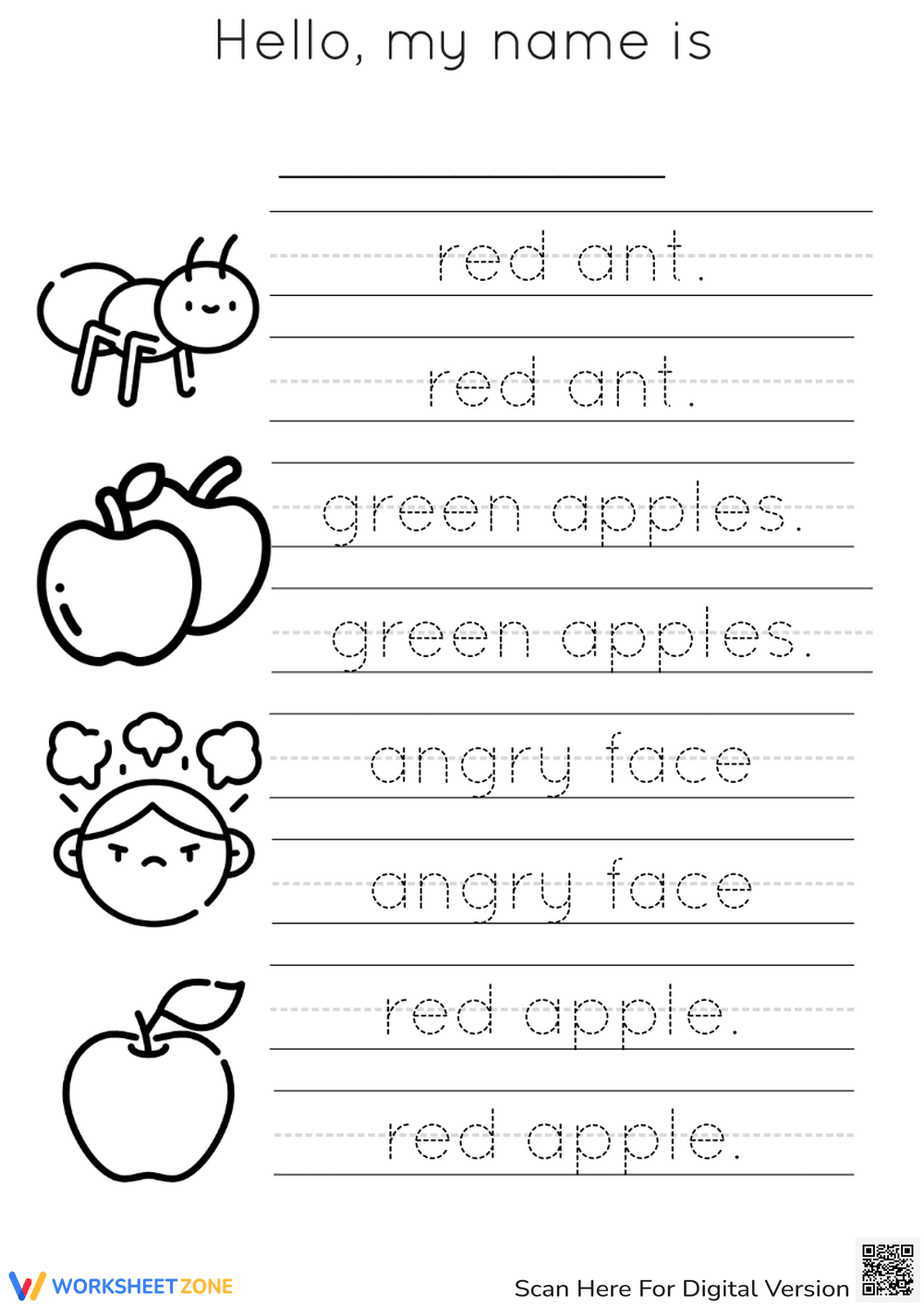
This Kindergarten and Grade 1 handwriting worksheet provides immediate practice for early learners developing fine motor control. By tracing familiar phrases like "red ant" and "green apples," students build the muscle memory required for fluent writing. It transforms abstract letter shapes into meaningful words through repetitive, guided tracing tasks that ensure student success.
At a Glance
- Grade: K-1 · Subject: Handwriting
- Standard:
CCSS.ELA-LITERACY.L.K.1.A— Print many upper- and lowercase letters correctly- Skill Focus: Letter formation and word tracing
- Format: 1 page · 8 tasks · No-prep · PDF
- Best For: Morning work or fine motor centers
- Time: 10–15 minutes
The worksheet features a clean, distraction-free layout with four distinct vocabulary phrases. Each phrase is presented twice in a dashed font on primary-ruled lines to ensure proper letter height and placement. Simple line-art illustrations accompany each word set, providing visual cues that support early reading and engagement during the writing process.
This resource is designed for a zero-prep workflow. First, print the single-page PDF in about 30 seconds. Second, distribute to students with a pencil or crayon in under 1 minute. Third, review student letter formation as they work or during a quick desk-side check. Total teacher preparation time is less than 2 minutes, making it an ideal sub-plan addition.
This activity aligns with `CCSS.ELA-LITERACY.L.K.1.A`, which focuses on the correct production of upper- and lowercase letters. It also supports `CCSS.ELA-LITERACY.RF.K.1.B` by reinforcing that spoken words are represented in written language by specific sequences of letters. Both standard codes can be copied directly into lesson plans, IEP goals, or district curriculum mapping tools.
Use this worksheet during the "You Do" phase of a handwriting lesson after demonstrating proper stroke order on a whiteboard. It also serves as an excellent formative assessment tool; observe if students start their letters from the top or bottom to identify who needs additional intervention. Completion typically takes 10 to 15 minutes for most early learners.
This resource is perfect for Kindergarten students beginning their writing journey and Grade 1 students needing remedial fine motor support. It pairs naturally with alphabet anchor charts or phonics lessons focusing on the letters A and G. The simple vocabulary makes it accessible for English Language Learners (ELLs) as well as general education students.
Research by Fisher & Frey (2014) emphasizes the importance of the gradual release of responsibility, where guided practice like tracing serves as a bridge to independent writing. This worksheet provides that necessary scaffold by offering 8 specific tracing opportunities that reinforce letter-to-sound correspondence and spatial awareness on the page. According to the NAEP, early mastery of handwriting is a significant predictor of later compositional quality, as it reduces the cognitive load required for mechanical production. By utilizing this structured tracing format, educators ensure that students meet the foundational requirements of CCSS.ELA-LITERACY.L.K.1.A while building the confidence needed for creative expression. The inclusion of visual icons alongside text further supports dual-coding theory, helping young learners associate the physical act of writing with concrete objects and colors, ultimately leading to higher retention of letter forms and vocabulary.


