


























Views
Downloads

Essential Grade 11-12 Reading & Vocab Worksheet
Paste this activity's link or code into your existing LMS (Google Classroom, Canvas, Teams, Schoology, Moodle, etc.).
Students can open and work on the activity right away, with no student login required.
You'll still be able to track student progress and results from your teacher account.
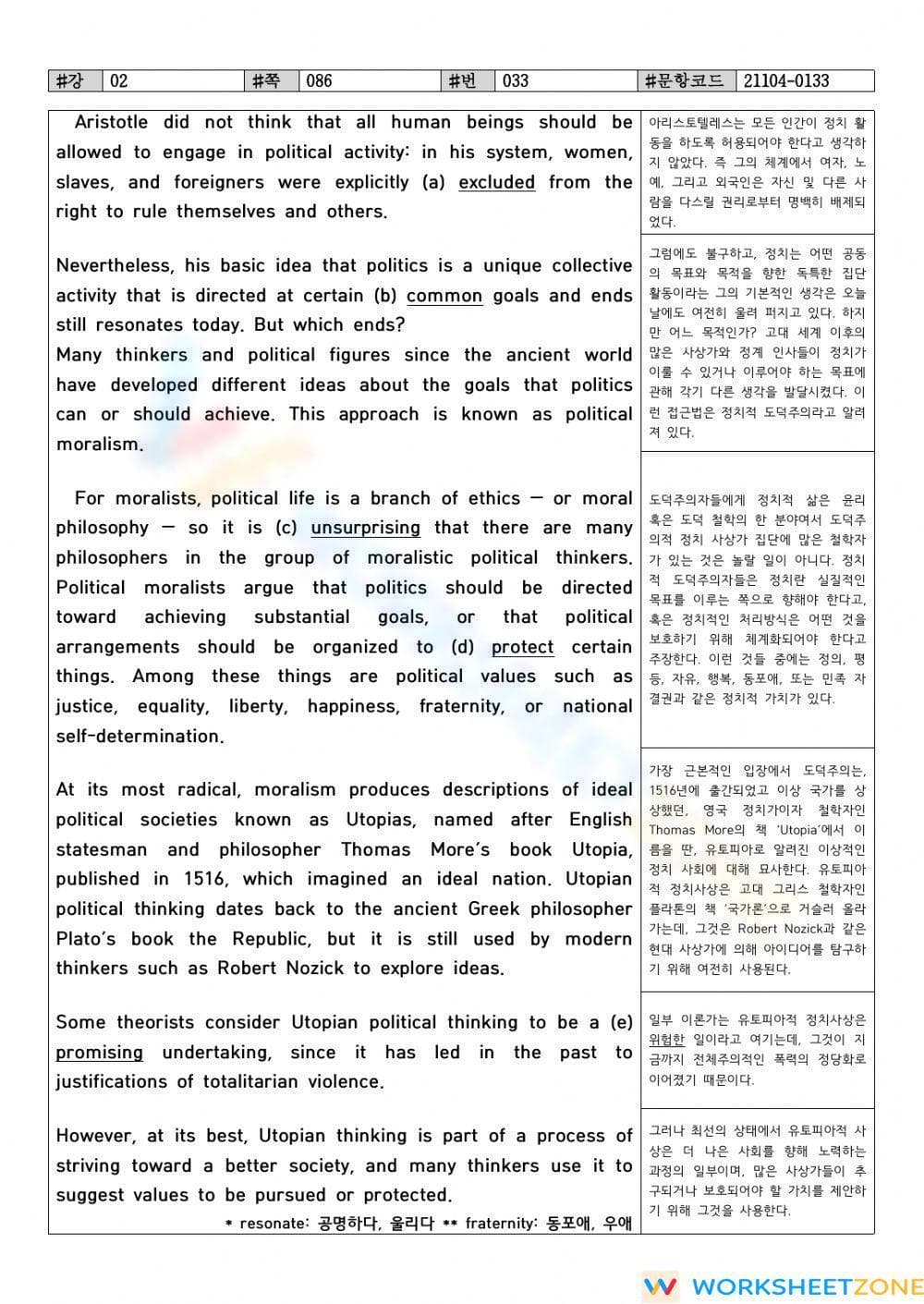
This Grade 11-12 ELA worksheet provides a rigorous bridge between linguistic proficiency and conceptual mastery. By analyzing dense passages on political moralism and social polling, students build the stamina required for college-level reading. The dual-language support makes it an excellent resource for advanced ELL learners or students tackling high-level academic vocabulary.
At a Glance
- Grade: 11-12 · Subject: ELA Literature
- Standard:
CCSS.ELA-LITERACY.RI.11-12.4— Determine the meaning of words and phrases as they are used in a text- Skill Focus: Academic Vocabulary in Context
- Format: 2 pages · 10 problems · Answer key included · PDF
- Best For: High school test prep and academic vocabulary
- Time: 25–35 minutes
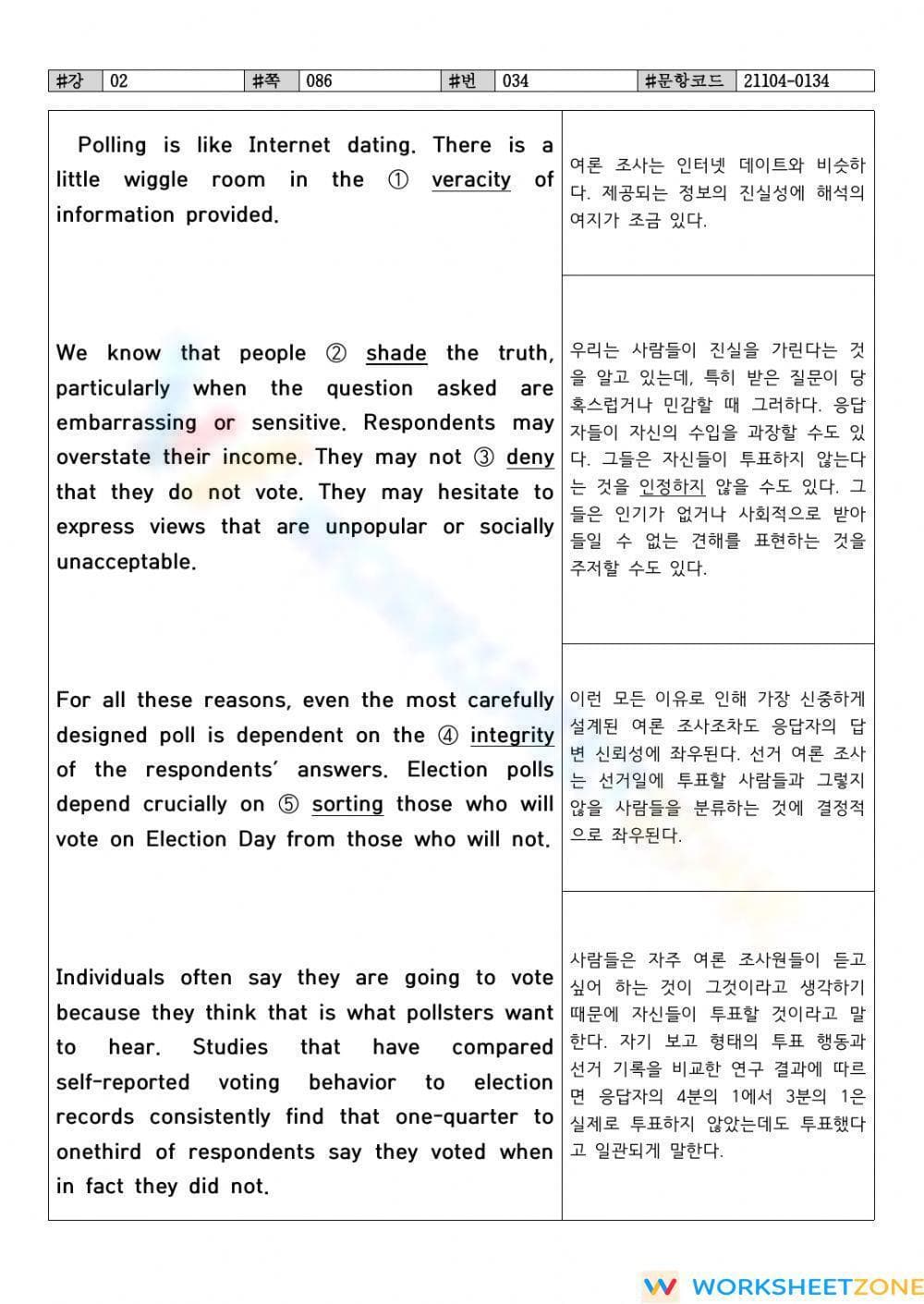
The worksheet consists of two pages, each featuring a dense reading passage followed by five vocabulary tasks. Page one explores political moralism and Thomas More’s Utopia, while page two examines polling data veracity. The bilingual layout provides translation support, allowing students to verify conceptual understanding while focusing on English lexical choices and technical definitions.
Skill Progression
- Guided Practice: Students begin by identifying philosophical terms in the first passage using provided context clues.
- Supported Practice: The second section requires differentiating between complex sociological terms like veracity and integrity.
- Independent Practice: Students synthesize high-level vocabulary to summarize ethical implications across both academic texts.
The instructional design follows a structured pathway toward linguistic independence. The primary focus is CCSS.ELA-LITERACY.RI.11-12.4, determining the meaning of words and phrases in complex texts. The resource also supports RI.11-12.10 by engaging students with literary non-fiction at the college-readiness level. Both standard codes can be copied directly into lesson plans, IEP goals, or district curriculum mapping tools.
This resource is best utilized during the "You Do" phase of a gradual release model. Use it as a warm-up for a seminar or as a formative assessment for academic vocabulary. One observation tip: watch for students who struggle with technical terms like moralism or veracity. Expected completion time is 30 minutes.
This worksheet is designed for Grade 11-12 and college students. It is effective for advanced ELL learners who benefit from translation. It pairs naturally with primary source excerpts from Thomas More or modern data sets on election polling, providing a rigorous bridge to university-level literature.
Academic success in higher education is fundamentally tied to a student's ability to navigate complex, non-fiction texts and master Tier 3 vocabulary. This Grade 11-12 worksheet directly addresses this need by aligning with CCSS.ELA-LITERACY.RI.11-12.4, focusing on the precision of word choice in philosophical and sociological contexts. Research from Fisher & Frey (2014) emphasizes that complex text analysis is most effective when students are prompted to use context to define technical terminology, a process that builds cognitive endurance. By providing 10 targeted vocabulary-in-context tasks across two dense pages, this resource ensures students move beyond surface-level reading toward a deeper, analytical understanding of academic discourse. The inclusion of bilingual support further scaffolds this process, ensuring that the conceptual load does not overshadow linguistic development. This methodology is essential for preparing students for the rigors of college-level research and standardized assessments like the SAT or ACT.


