


























Views
Downloads
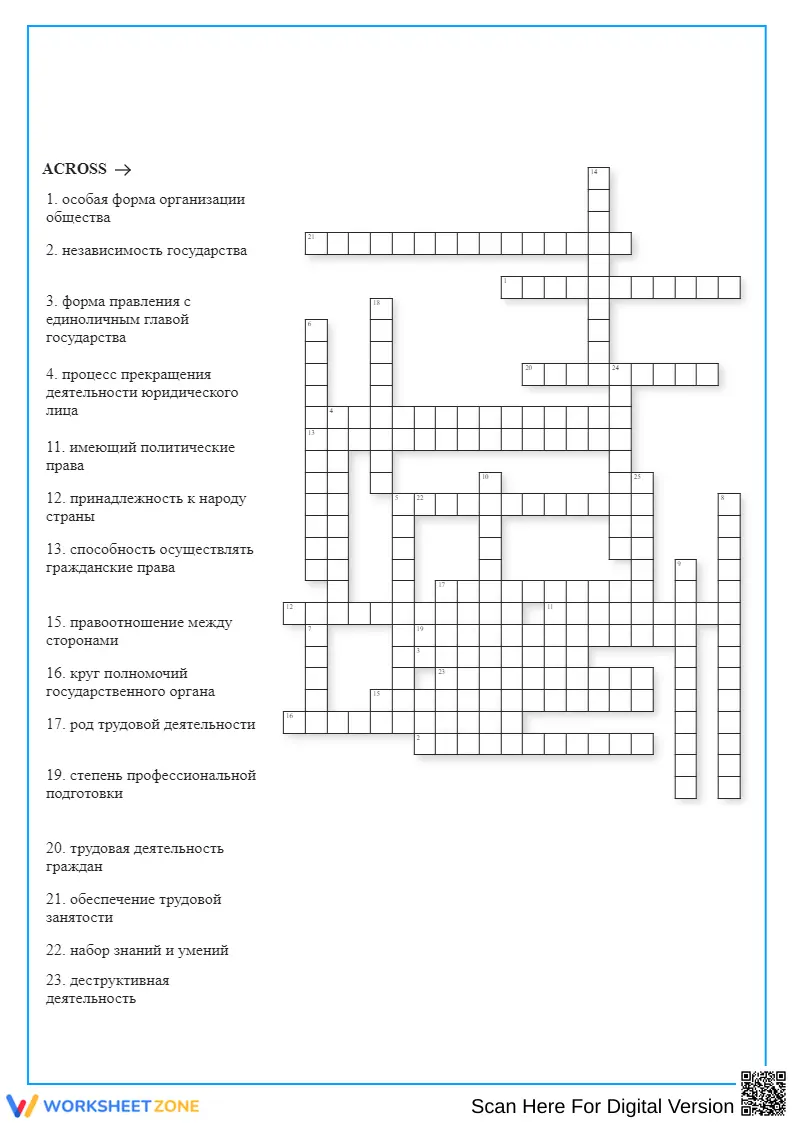


Russian Civics Vocabulary Crossword | Grade 4 Ready
Paste this activity's link or code into your existing LMS (Google Classroom, Canvas, Teams, Schoology, Moodle, etc.).
Students can open and work on the activity right away, with no student login required.
You'll still be able to track student progress and results from your teacher account.
Overview
This Grade 4 Russian civics vocabulary worksheet helps students master complex terminology related to government structures, legal rights, and citizenship responsibilities. By engaging with a crossword format, learners reinforce their understanding of domain-specific language through context clues and definitions. This resource ensures students can accurately identify and apply social studies concepts in academic discussions.
At a Glance
- Grade: 4 · Subject: Social Studies (Russian)
- Standard:
CCSS.ELA-LITERACY.RI.4.4— Determine the meaning of domain-specific words or phrases in a text- Skill Focus: Civics and Government Vocabulary
- Format: 2 pages · 26 problems · Answer key included · PDF
- Best For: Independent practice or sub plans
- Time: 20–30 minutes
What's Inside
The resource consists of a two-page PDF document designed for clarity and ease of use. The first page features a large, interconnected crossword grid alongside 15 "Across" clues. The second page provides 11 "Down" clues to complete the set. The definitions cover essential topics such as forms of government, legal norms, and professional qualifications. A comprehensive answer key is provided for quick grading or student self-correction.
Zero-Prep Workflow
Teachers can implement this activity in under two minutes with three simple steps. First, print the two-page document for each student (1 minute). Second, distribute the sheets and explain the crossword format to the class (30 seconds). Finally, review the completed grids using the provided answer key to identify common misconceptions (30 seconds). This streamlined process makes it an ideal choice for emergency sub plans or transition periods.
Standards Alignment
The primary focus is `CCSS.ELA-LITERACY.RI.4.4`, which requires students to determine the meaning of general academic and domain-specific words or phrases in a text relevant to a grade 4 topic or subject area. By decoding definitions to find specific terms like "sovereignty" or "jurisdiction," students demonstrate mastery of technical vocabulary. Both standard codes can be copied directly into lesson plans, IEP goals, or district curriculum mapping tools.
How to Use It
Use this worksheet as a summative review at the end of a unit on government and law. It serves as an excellent formative assessment tool; observe which students struggle with the "Down" clues to identify who may need additional support with abstract concepts like legal norms. The expected completion time is approximately 25 minutes, making it suitable for a mid-lesson activity or a quiet morning work task.
Who It's For
This resource is designed for fourth-grade students studying civics in a Russian-language context, but it is also highly effective for dual-language immersion programs. It pairs naturally with an anchor chart displaying government branches or a primary source text regarding citizen rights. The crossword format provides a low-stakes environment for students to test their knowledge of complex political and legal systems.
The use of crossword puzzles in social studies instruction aligns with the research of Fisher & Frey (2014), who emphasize the importance of word-consciousness and active engagement with domain-specific terminology. By requiring students to retrieve definitions and fit them into a constrained spatial grid, the activity promotes deeper cognitive processing than simple rote memorization. This worksheet specifically targets `CCSS.ELA-LITERACY.RI.4.4` by providing 26 distinct opportunities for students to interact with the language of governance and law. According to recent pedagogical analyses, such structured vocabulary tasks significantly improve reading comprehension in informational texts by reducing the cognitive load associated with unfamiliar terms. Educators can confidently integrate this tool into a comprehensive literacy framework, ensuring that students build the necessary linguistic foundation for middle school social studies and beyond while maintaining high standards for academic vocabulary acquisition.


