


























Views
Downloads
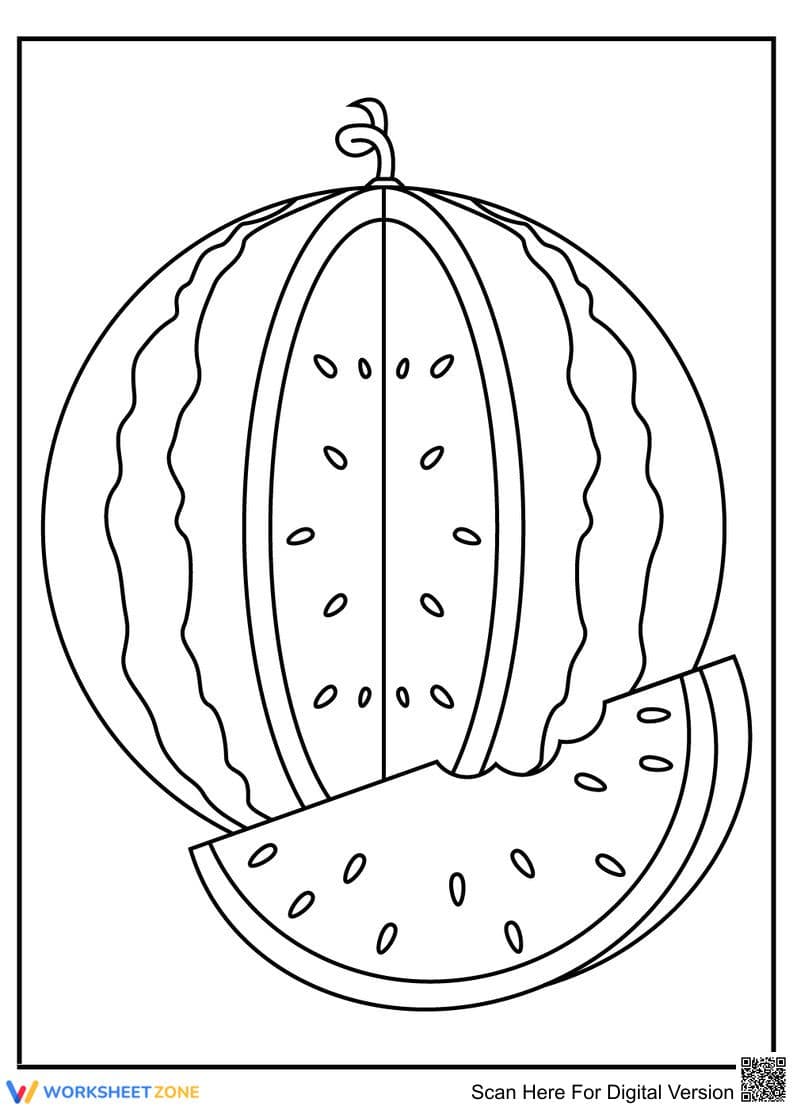

Printable Watermelon Coloring Page | Grade K-5 Ready
Paste this activity's link or code into your existing LMS (Google Classroom, Canvas, Teams, Schoology, Moodle, etc.).
Students can open and work on the activity right away, with no student login required.
You'll still be able to track student progress and results from your teacher account.
This printable watermelon coloring worksheet provides a high-interest creative activity that strengthens fine motor control and hand-eye coordination. By engaging with the detailed line art of a whole watermelon and a separate slice, students practice precision and color selection. This resource serves as an effective tool for early childhood development and artistic expression.
At a Glance
- Grade: K-5 · Subject: Arts & Crafts
- Standard:
CCSS.ELA-LITERACY.L.K.1— Demonstrate command of the conventions of standard English including fine motor writing control- Skill Focus: Fine motor precision
- Format: 1 page · 1 problem · Answer key included · PDF
- Best For: Morning work or early finishers
- Time: 15–20 minutes
The worksheet features a single, high-resolution page containing a large, centered watermelon with realistic rind patterns and a bite-sized slice in the foreground. The bold outlines are designed to help younger learners stay within the lines while providing enough detail for older students to experiment with shading and texture. No additional materials are required beyond standard coloring supplies.
This resource is designed for immediate classroom implementation with a total teacher preparation time of under 2 minutes. First, print the desired number of copies from the PDF file. Second, distribute the sheets during morning arrival or as a transition activity. Third, review the completed work to assess grip strength and color identification. It is a perfect sub-plan addition for any elementary classroom.
This activity aligns with `CCSS.ELA-LITERACY.L.K.1`, which focuses on demonstrating command of the conventions of standard English, including the physical development necessary for writing. By mastering the grip required for coloring, students build the foundational muscles needed for letter formation. This standard code can be copied directly into lesson plans, IEP goals, or district curriculum mapping tools.
Use this worksheet during a "Healthy Foods" unit to reinforce fruit identification or as a calming "brain break" after intensive math or reading blocks. Teachers can observe student pencil grip and pressure as a formative assessment of fine motor readiness. Expect students to spend 15 to 20 minutes completing the detailed sections of the fruit, allowing for quiet focus time.
This resource is ideal for Preschool through Grade 5 students, particularly those requiring extra fine motor practice or English Language Learners (ELLs) building basic vocabulary. It pairs naturally with a fruit-themed anchor chart or a direct instruction lesson on healthy eating habits and the lifecycle of plants in a science context.
Research from Fisher & Frey (2014) emphasizes the importance of scaffolded fine motor activities in the early elementary years to support later academic writing proficiency. This watermelon coloring worksheet addresses CCSS.ELA-LITERACY.L.K.1 by providing a low-stakes environment for students to practice the manual dexterity and pincer grasp essential for legible handwriting. The clear, bold boundaries of the fruit illustrations encourage spatial awareness and visual-motor integration. According to the Fisher & Frey framework, these creative tasks serve as a bridge between play and formal literacy instruction, allowing educators to monitor developmental milestones in a non-threatening context. By integrating fruit-themed vocabulary with artistic tasks, the worksheet supports dual-coding theory, where visual and verbal information are processed simultaneously to improve memory retention. This 1-page PDF is a reliable tool for any classroom focusing on foundational motor skills and creative engagement.


