


























Views
Downloads




Essential Expository Writing Prompt: Favorite Animal
Paste this activity's link or code into your existing LMS (Google Classroom, Canvas, Teams, Schoology, Moodle, etc.).
Students can open and work on the activity right away, with no student login required.
You'll still be able to track student progress and results from your teacher account.
This high school expository writing worksheet guides students through a structured research process to produce a formal essay about their favorite animal. By breaking down the complex task of informative writing into manageable steps, students develop critical skills in source documentation and information organization before drafting their final response.
At a Glance
- Grade: 10-12 · Subject: English Language Arts
- Standard:
CCSS.ELA-LITERACY.W.9-10.2— Write informative/explanatory texts to examine and convey complex ideas and information- Skill Focus: Expository Research & Drafting
- Format: 4 pages · 4 tasks · No answer key · PDF
- Best For: Independent research projects or sub plans
- Time: 45–60 minutes
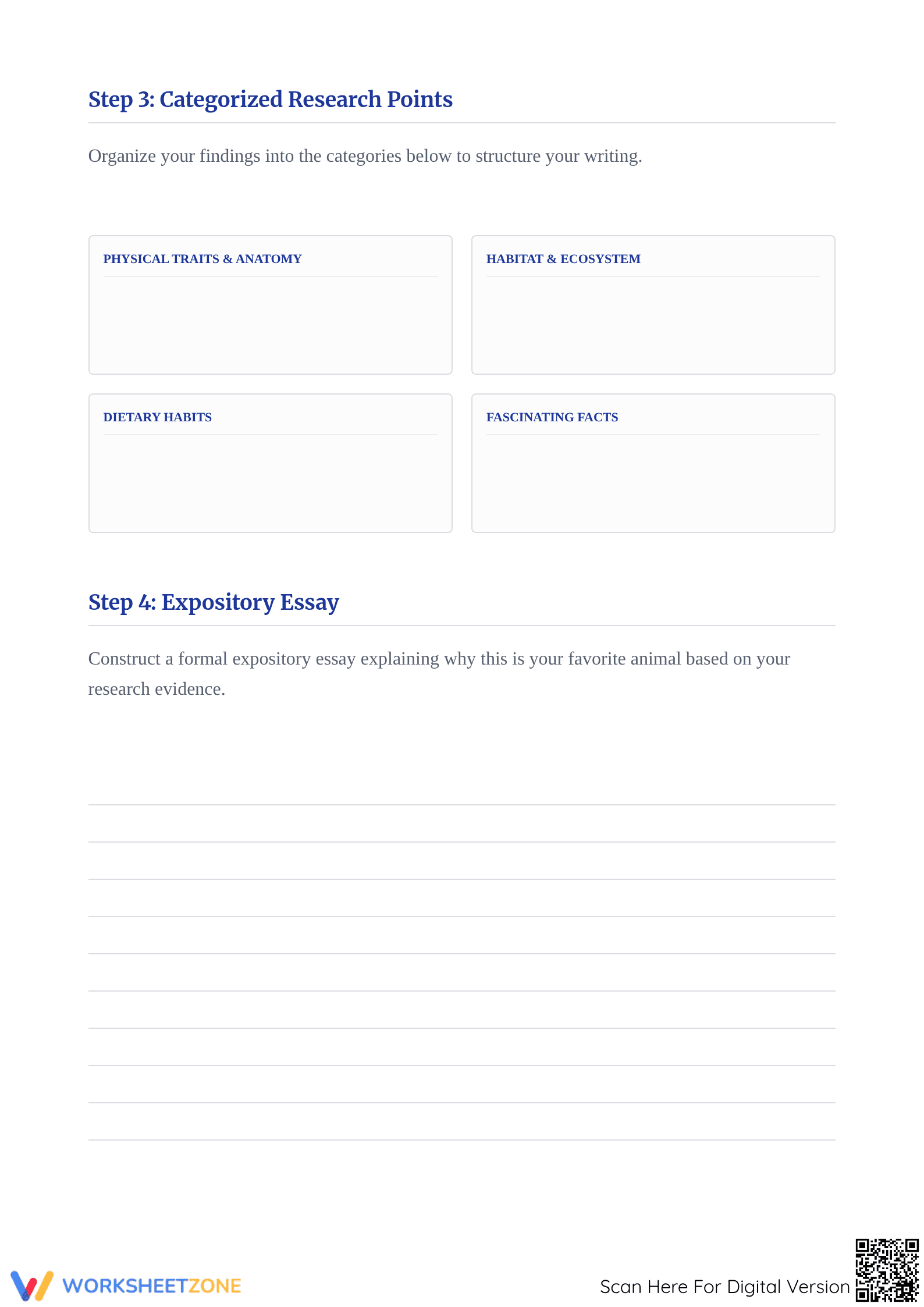
This 4-page PDF includes a formal research definition, a prompt featuring 5 specific inquiry questions, and a dedicated space for documenting 3 primary sources. The packet provides a graphic organizer for categorizing data into physical traits, habitat, diet, and facts, followed by 2 full pages of lined paper for the final expository essay.
Zero-Prep Workflow:
- Print: Select the 4-page PDF and print enough copies for your class (30 seconds).
- Distribute: Hand out the packets and provide access to digital or library research tools (1 minute).
- Review: Monitor student progress through the 4 steps, checking the categorization phase before they begin the final draft (0 minutes prep).
Standards Alignment
The primary focus is `CCSS.ELA-LITERACY.W.9-10.2`, which requires students to write informative texts that convey complex information clearly and accurately through the effective selection and organization of content. It also supports `CCSS.ELA-LITERACY.W.9-10.7` by requiring short research projects to answer a question. Both standard codes can be copied directly into lesson plans, IEP goals, or district curriculum mapping tools.
How to Use It
Assign this during the independent practice phase of a writing unit to assess student ability to synthesize research. It serves as an excellent formative assessment for checking if students can distinguish between physical traits and habitat descriptions. Expect completion within one standard class period or as a multi-day homework assignment.
Who It's For
Designed for Grade 10 through College-level learners, this prompt is particularly effective for students who need a structured scaffold for research. It pairs naturally with a lesson on credible source selection or a library orientation session to help students find the required 3 sources.
According to the RAND AIRS 2024 analysis of secondary writing instruction, providing students with explicit organizational scaffolds—such as the categorization blocks found in this worksheet—significantly improves the structural coherence of expository essays. This resource targets `CCSS.ELA-LITERACY.W.9-10.2` by requiring students to move beyond simple description into a systematic investigation of facts. By documenting three distinct sources and answering five targeted research questions, learners practice the essential skill of evidence-based writing. Research from Fisher & Frey (2014) suggests that the gradual release of responsibility, moving from guided inquiry to independent drafting, is critical for mastery in high school ELA. This 4-page packet facilitates that transition by ensuring students have a solid data foundation before they begin the cognitively demanding task of formal essay construction. It is a reliable tool for measuring student proficiency in informative writing and research synthesis across secondary grade levels.


