


























Views
Downloads

Animal Offspring Vocabulary Worksheet | Grade 4-6 Essential
Paste this activity's link or code into your existing LMS (Google Classroom, Canvas, Teams, Schoology, Moodle, etc.).
Students can open and work on the activity right away, with no student login required.
You'll still be able to track student progress and results from your teacher account.
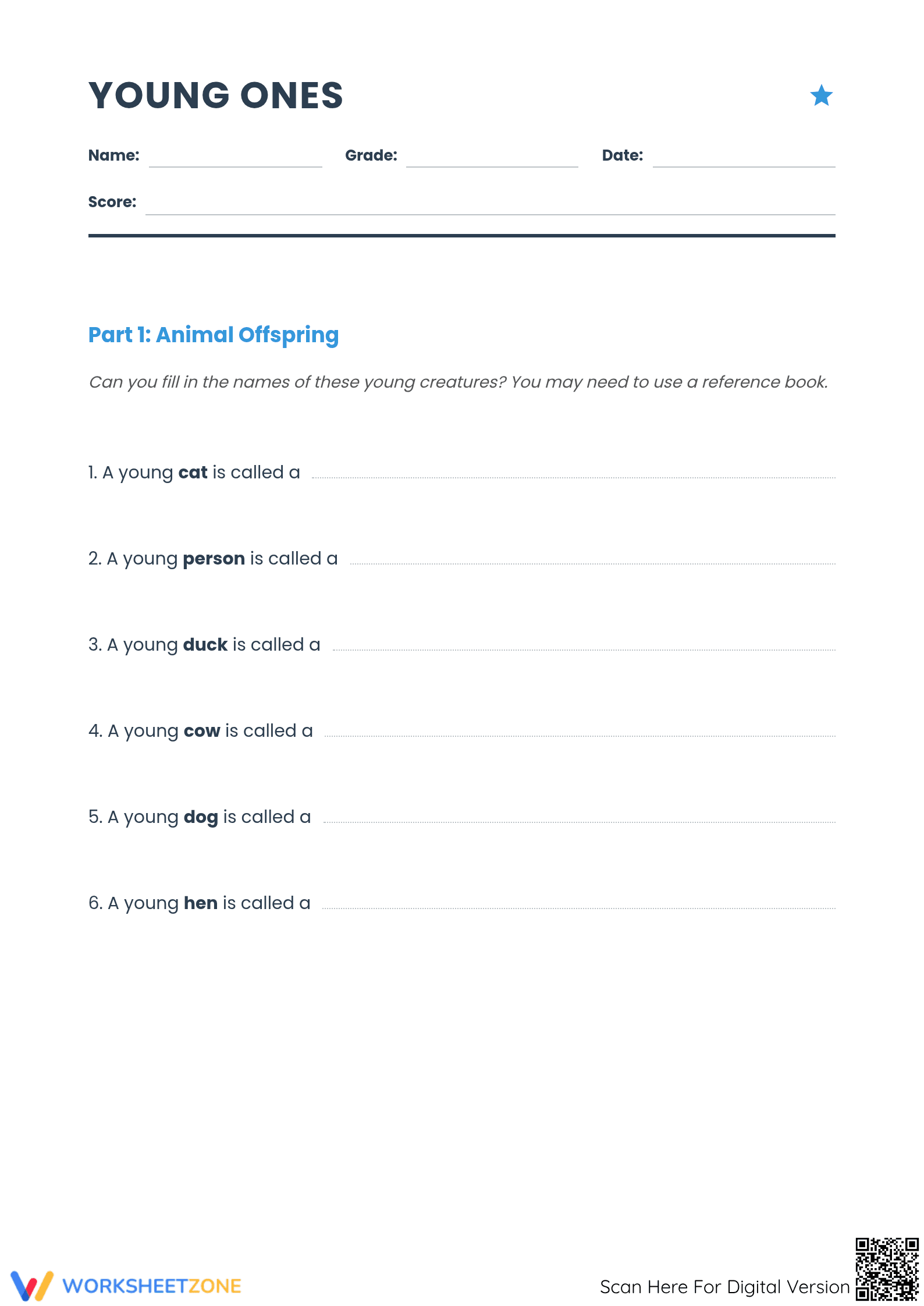
This Grade 4-6 English Language Arts worksheet focuses on expanding student vocabulary through the study of animal offspring and descriptive adjectives. Students identify specific terms for young animals before transitioning into creative sentence construction and synonym exploration. This resource ensures learners can accurately use domain-specific language in their writing and daily communication.
At a Glance
- Grade: 4-6 · Subject: English Language Arts
- Standard:
CCSS.ELA-LITERACY.L.4.6— Acquire and use accurately grade-appropriate general academic and domain-specific words- Skill Focus: Animal Offspring Vocabulary & Adjectives
- Format: 2 pages · 19 problems · Answer key included · PDF
- Best For: Independent vocabulary practice and creative writing
- Time: 20–30 minutes
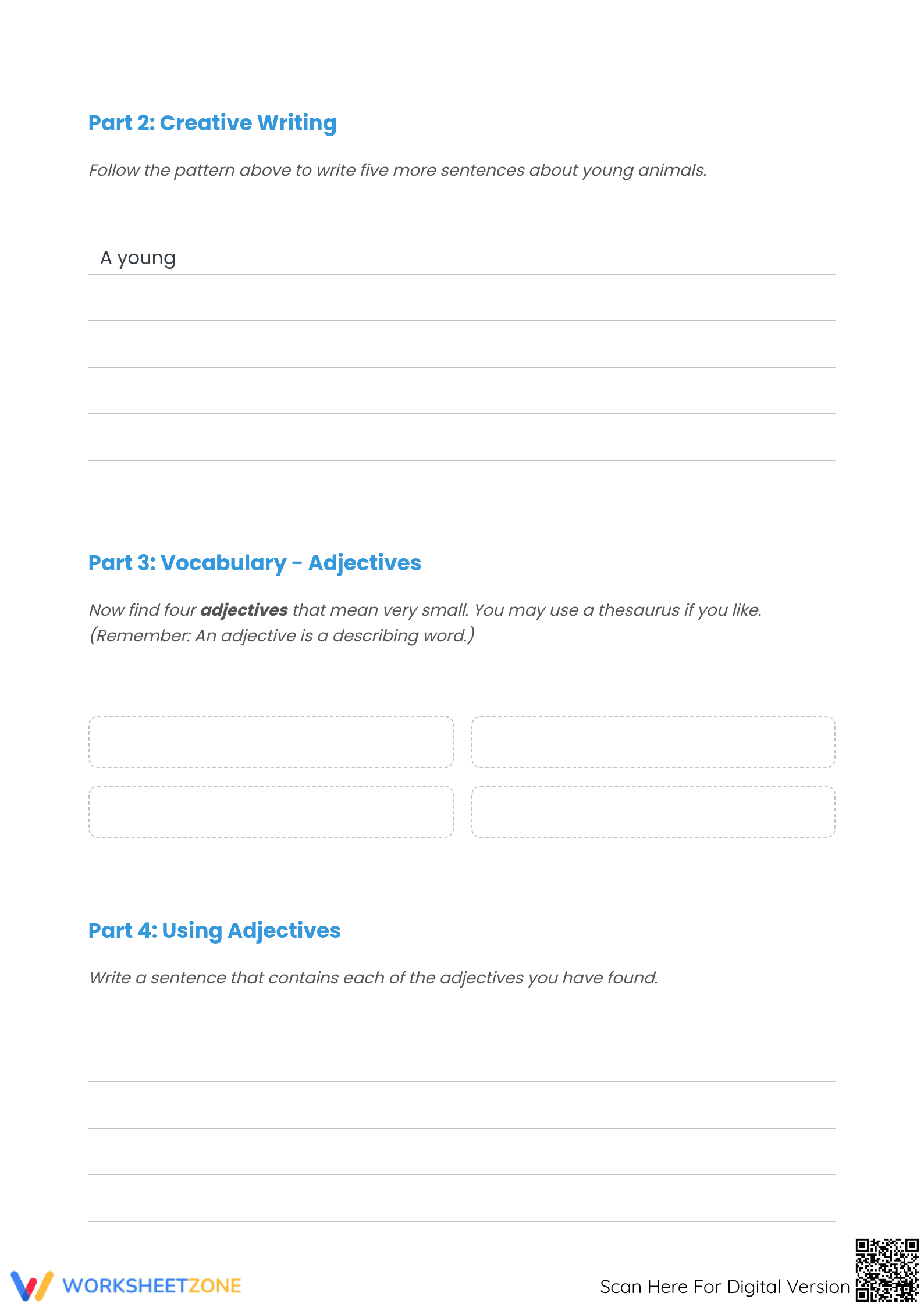
Four distinct sections build linguistic precision. Part one features six fill-in-the-blank questions identifying animal offspring. Part two requires students to generate five original sentences following a specific syntactic pattern. Part three challenges learners to identify four synonyms for "small" using a thesaurus, while part four requires the application of those adjectives in context. A full answer key is provided for rapid grading.
This resource is designed for immediate classroom implementation with a total teacher preparation time of under 2 minutes. First, print the two-page document for your roster (1 minute). Second, distribute the sheets as a bell-ringer or independent center activity (30 seconds). Finally, review the answers using the provided key or have students peer-grade to encourage collaborative learning and immediate feedback. It serves as an excellent emergency sub plan.
CCSS.ELA-LITERACY.L.4.6 requires students to acquire and use accurately grade-appropriate general academic and domain-specific words and phrases. By identifying specific nouns like "kitten" or "calf" and finding nuanced adjectives, students meet the rigorous demands of middle-grade language standards. Both standard codes can be copied directly into lesson plans, IEP goals, or district curriculum mapping tools to track student progress toward mastery.
Use this worksheet during a vocabulary-building unit or as a high-quality assessment. It works effectively as a formative tool after a lesson on using reference materials like dictionaries or thesauruses. Observe student independence with reference tools during Part 3 to gauge research proficiency. Expect students to complete the entire packet in approximately 25 minutes, making it ideal for a single instructional block.
This activity is ideal for general education students in grades 4, 5, and 6, as well as English Language Learners (ELL) who need targeted practice with specific English nouns. It pairs naturally with an anchor chart on animal classifications or a direct instruction lesson on using a thesaurus to enhance descriptive writing and word choice.
Research by Fisher & Frey (2014) emphasizes that vocabulary instruction is most effective when students are required to use new words in multiple contexts, moving from simple identification to generative writing. This worksheet applies this principle by transitioning students from identifying animal offspring to constructing original sentences and exploring descriptive adjectives. By aligning with CCSS.ELA-LITERACY.L.4.6, the resource ensures that students are not merely memorizing definitions but are actively integrating domain-specific language into their functional lexicon. The inclusion of 19 distinct tasks provides the necessary repetition for long-term retention. Educational data suggests that structured worksheets focusing on word relationships significantly improve reading comprehension scores by reducing the cognitive load during complex text analysis. This resource provides a scaffolded approach that supports diverse learners in achieving linguistic mastery within the standard ELA curriculum framework.


