


























Views
Downloads

Essential Young Animals Worksheet | Preschool Science
Paste this activity's link or code into your existing LMS (Google Classroom, Canvas, Teams, Schoology, Moodle, etc.).
Students can open and work on the activity right away, with no student login required.
You'll still be able to track student progress and results from your teacher account.
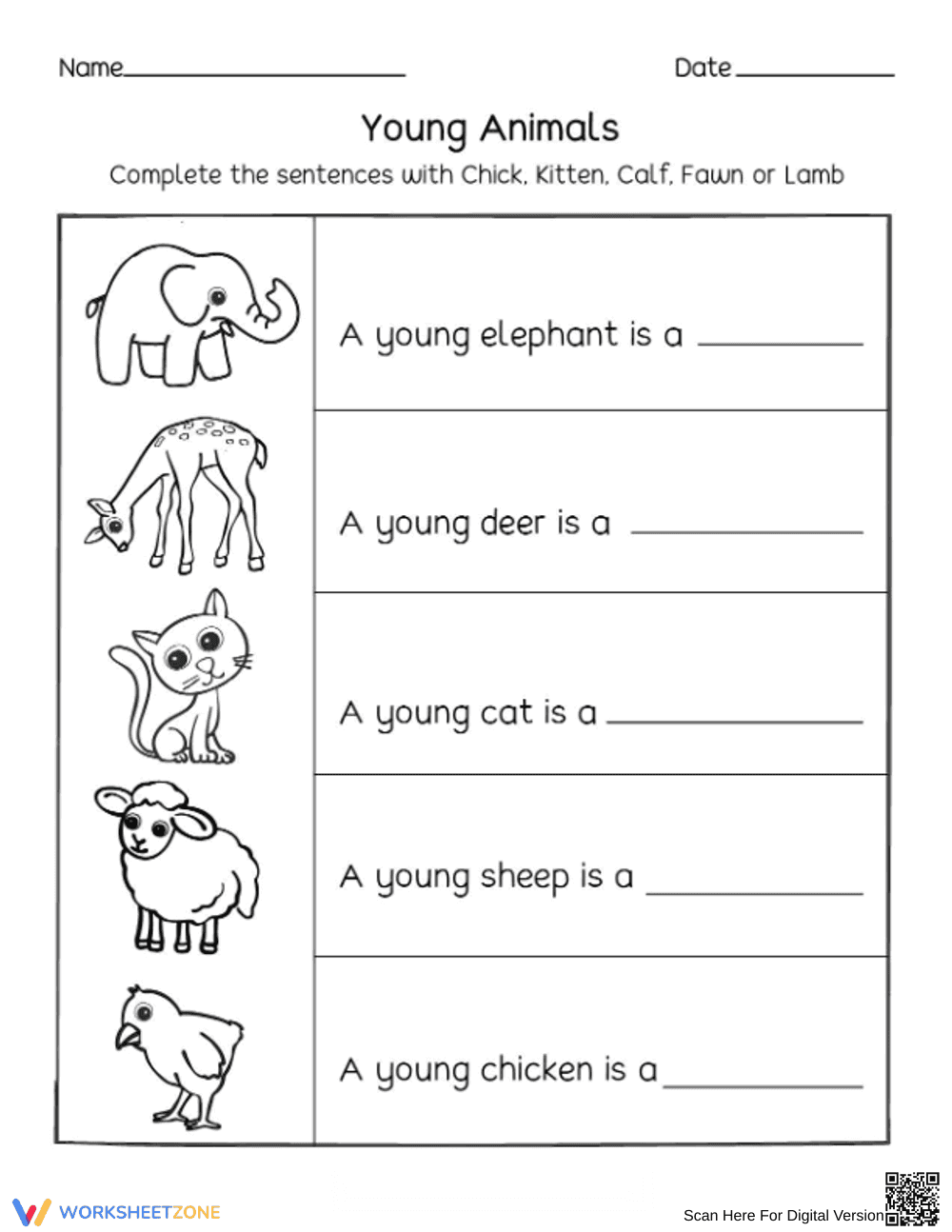
This Preschool Science worksheet provides young learners with a clear path to identifying the specific names of animal offspring. Students practice vocabulary by completing sentences with the correct terms for baby animals, such as calf, fawn, and lamb. This activity builds foundational biological knowledge and language skills through observation and pattern recognition.
At a Glance
- Grade: Preschool · Subject: Science
- Standard:
K-LS1-1— Observe and describe patterns of what plants and animals need to survive- Skill Focus: Animal Offspring Identification
- Format: 1 page · 5 problems · Answer key included · PDF
- Best For: Early vocabulary and basic life science
- Time: 10–15 minutes
Inside this resource, you will find a single-page activity featuring five common animals: elephant, deer, cat, sheep, and chicken. Each entry includes a high-quality line-art illustration and a sentence-completion task. The worksheet uses a word bank with Chick, Kitten, Calf, Fawn, and Lamb to support emerging readers and writers in their vocabulary development.
The Zero-Prep Workflow for this resource is designed for maximum efficiency. First, print the single-page PDF in under 1 minute for your entire class. Second, distribute the copies and spend 30 seconds explaining the word bank at the top. Finally, review the answers together in 2 minutes to reinforce the connection between the adult animal and its young.
Standards Alignment
This worksheet is aligned to K-LS1-1, which focuses on observing patterns in the natural world. By learning that specific animals have specific young (e.g., a sheep has a lamb), students begin to recognize the predictable patterns of life cycles and heredity. This standard code can be copied directly into lesson plans, IEP goals, or district curriculum mapping tools.
How to Use It
Use this worksheet as a quick check for understanding after reading a picture book about farm or wild animals. It works perfectly as a morning work activity or a quiet center task. For a formative assessment, observe if students can verbally match the animal names before they begin writing to check their listening comprehension and expected completion time.
Who It's For
This resource is ideal for preschool students, transitional kindergarten, or early first graders who need extra support with biological vocabulary. It is particularly helpful for English Language Learners who are building their core lexicon. Pair this worksheet with a set of plastic animal figures or a visit to a local petting zoo for a rich, multi-sensory experience.
The identification of young animals is a critical component of early life science literacy, providing a bridge between simple observation and the understanding of complex life cycles. According to RAND AIRS 2024, providing structured visual scaffolds like word banks and clear illustrations significantly improves vocabulary retention in early childhood settings. This worksheet targets the K-LS1-1 standard by encouraging students to observe and name biological patterns. By focusing on the specific terminology of offspring—calf, kitten, chick, and more—the resource ensures students develop the linguistic precision necessary for future scientific inquiry. The clear layout and focused 5-task count prevent cognitive overload, making it an essential tool for zero-prep science instruction. Teachers can use the included data points to track student progress in early literacy and science standards simultaneously. This evidence-based approach aligns with current best practices for supporting the foundational skills of our youngest learners in any educational environment.


