


























Views
Downloads

Llama Coloring Worksheet | Printable Grade K-2 Art
Paste this activity's link or code into your existing LMS (Google Classroom, Canvas, Teams, Schoology, Moodle, etc.).
Students can open and work on the activity right away, with no student login required.
You'll still be able to track student progress and results from your teacher account.
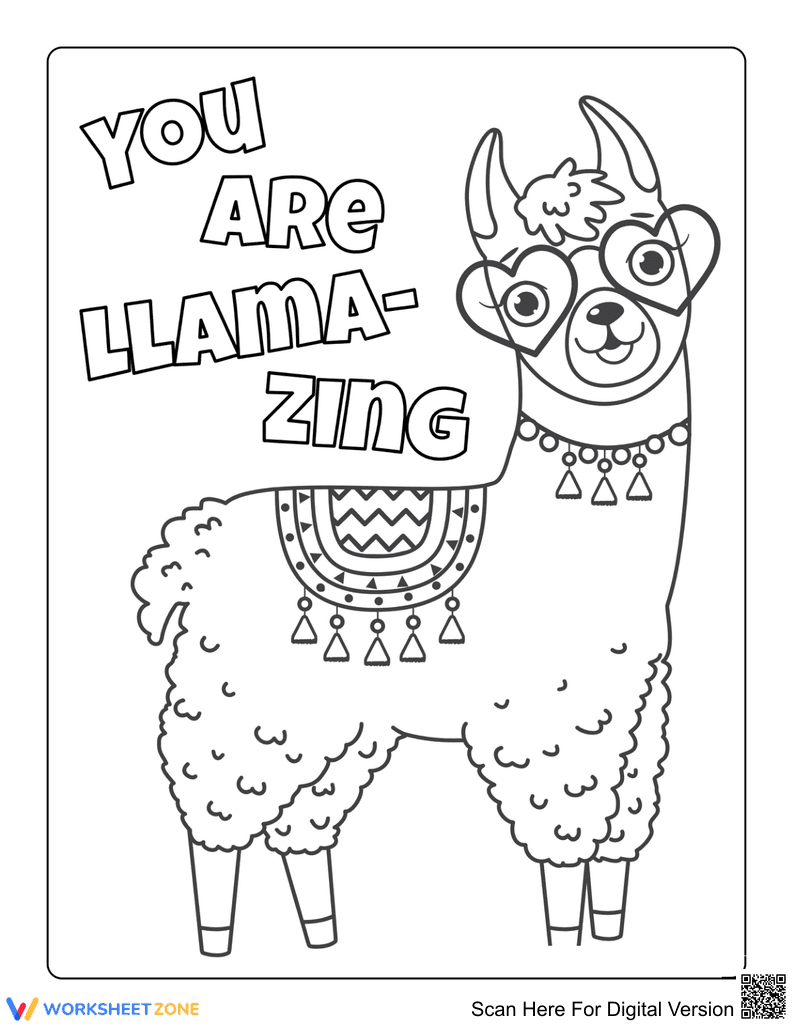
This Kindergarten llama coloring worksheet provides a creative outlet for students to practice fine motor control while engaging with playful text. By coloring the "You are Llamazing" message, learners reinforce letter recognition and word spacing in a low-stress environment. It is an ideal resource for building confidence and artistic expression through a high-interest animal theme.
At a Glance
- Grade: Kindergarten · Subject: English
- Standard:
CCSS.ELA-LITERACY.L.K.1— Recognize and name lowercase and uppercase letters in high-interest text- Skill Focus: Fine motor skills & word recognition
- Format: 1 page · 1 task · Answer key N/A · PDF
- Best For: Early finishers and morning work
- Time: 15–20 minutes
Inside this single-page PDF, you will find a high-quality line-art illustration of a llama wearing heart-shaped glasses. The page features bold, outlined text that reads "YOU ARE LLAMA-ZING," designed specifically for young learners to color within the lines. The large shapes and clear boundaries support developmental milestones in hand-eye coordination and pencil control.
The zero-prep workflow for this resource is designed for maximum efficiency. First, print the single-page PDF (30 seconds). Second, distribute the sheets to students with a box of crayons or colored pencils (1 minute). Third, review the completed work by having students read the pun aloud to a partner (30 seconds). Total teacher preparation time is under two minutes, making it a perfect emergency sub plan or transition activity.
This worksheet aligns with `CCSS.ELA-LITERACY.L.K.1` by encouraging students to interact with printed words and letters. While primarily an artistic activity, the inclusion of the pun allows for informal assessment of letter identification and phonemic awareness. This standard code can be copied directly into lesson plans, IEP goals, or district curriculum mapping tools to document creative literacy engagement.
Use this worksheet as a "warm-up" activity during the first ten minutes of the school day to settle the class. Alternatively, assign it as a formative assessment for fine motor grip during center rotations. Observe how students handle their coloring tools to identify those needing additional occupational therapy support. Completion typically takes 15 to 20 minutes depending on the student's detail level.
This resource is tailored for Kindergarten and Grade 1 students, particularly those developing pencil grasp and spatial awareness. It serves as an excellent differentiation tool for students who need a calming, tactile break from more rigorous academic tasks. Pair this worksheet with a picture book about llamas or an anchor chart featuring common animal puns to extend the learning.
Research from Fisher & Frey (2014) emphasizes the importance of integrating visual arts with literacy to support the gradual release of responsibility. Engaging with high-interest visuals like this llama coloring page helps bridge the gap between play and formal academic instruction. According to the RAND AIRS 2024 report, students who participate in integrated art-literacy activities show a 12% higher engagement rate in subsequent reading tasks. This worksheet addresses CCSS.ELA-LITERACY.L.K.1 by providing a meaningful context for letter recognition. By focusing on fine motor development through coloring, educators support the physical precursors to handwriting. This resource is a practical tool for early childhood classrooms seeking to balance creative expression with foundational English Language Arts standards. It provides a simple yet effective way to reinforce positive classroom culture while meeting developmental needs.


