


























Views
Downloads


Grade 9 YCJA Guided Notes | Printable Civics Worksheet
Paste this activity's link or code into your existing LMS (Google Classroom, Canvas, Teams, Schoology, Moodle, etc.).
Students can open and work on the activity right away, with no student login required.
You'll still be able to track student progress and results from your teacher account.
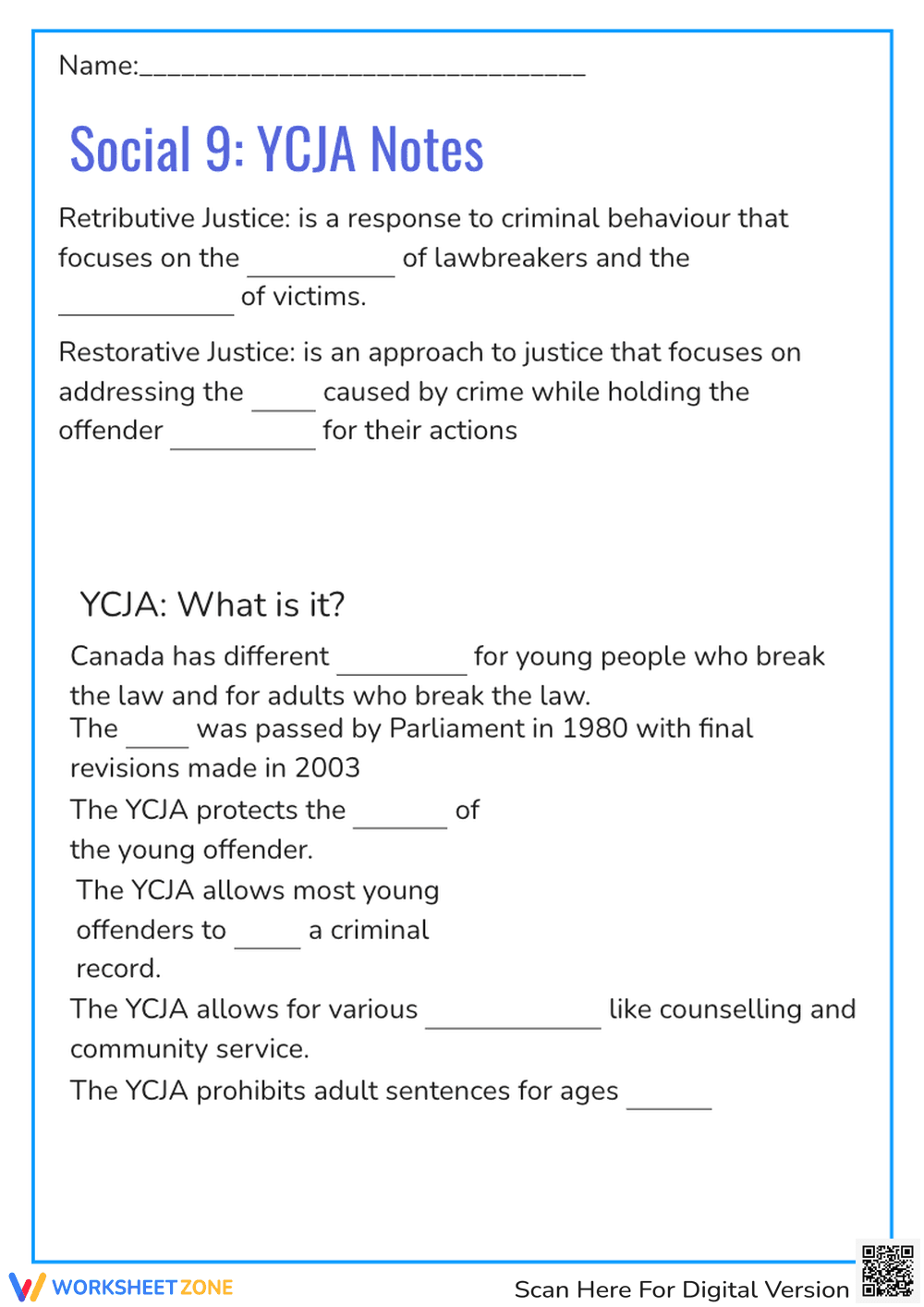
This Grade 9 guided notes worksheet helps students master key concepts of the Youth Criminal Justice Act (YCJA). By completing targeted fill-in-the-blank exercises, learners will differentiate between restorative and retributive justice, understand sentencing factors, and grasp the core objectives of the youth justice system.
At a Glance
- Grade: 9 · Subject: Social Studies
- Standard:
CCSS.ELA-LITERACY.RH.9-10.4— Determine the meaning of domain-specific words- Skill Focus: Civics Vocabulary & YCJA Concepts
- Format: 2 pages · 15 problems · PDF
- Best For: Direct instruction guided notes
- Time: 20–30 minutes
This two-page resource features a structured layout designed to keep students engaged during lectures or reading assignments. It includes 15 fill-in-the-blank tasks organized into clear thematic sections: definitions of justice types, the purpose of the YCJA, sentencing objectives, determining factors for consequences, and extrajudicial measures. The clean formatting and bold headings make it easy for students to follow along and retain critical civics information.
This resource requires minimal teacher preparation:
- Print (1 minute): Simply download the PDF and print a class set. The black-and-white design is optimized for standard copiers.
- Distribute (1 minute): Hand out the two-page packet at the beginning of your YCJA unit or lesson.
- Review (3 minutes): Use the structured headings to guide your lecture, pausing to ensure students capture the missing terms.
With under two minutes of total prep time, this worksheet is an excellent addition to your core curriculum or a reliable emergency sub plan.
This resource is aligned to CCSS.ELA-LITERACY.RH.9-10.4: Determine the meaning of words and phrases as they are used in a text, including vocabulary describing political, social, or economic aspects of history/social science. It also supports general reading comprehension in the content areas by requiring students to use context clues. Both standard codes can be copied directly into lesson plans, IEP goals, or district curriculum mapping tools.
Use these guided notes during direct instruction to ensure active listening; as you present on the YCJA, students fill in the missing keywords. Alternatively, assign the worksheet as an independent reading guide alongside a textbook chapter or article about the justice system. For a quick formative assessment, walk the room while students work to check that they are accurately identifying terms like "restorative justice" and "accountability." Expect this activity to take 20 to 30 minutes depending on the instructional pace.
This worksheet is ideal for Grade 9 social studies or civics students learning about government and law. The fill-in-the-blank format provides built-in scaffolding, making it highly accessible for English Language Learners (ELLs) and students with IEPs who benefit from reduced writing demands. Pair this resource with a primary source document or a classroom debate on youth sentencing to deepen understanding.
Integrating structured note-taking tools like this worksheet is a proven strategy for improving content retention in secondary social studies classrooms. Aligned with CCSS.ELA-LITERACY.RH.9-10.4, this activity requires students to determine the meaning of domain-specific words related to the justice system. According to a ScienceDirect TpT Analysis, providing guided notes significantly reduces cognitive load, allowing students to focus on synthesizing complex concepts rather than simply copying information. By isolating key vocabulary terms such as "retributive" and "extrajudicial," educators can ensure that foundational knowledge is secured before moving on to higher-order analytical tasks. This targeted approach to vocabulary acquisition not only supports immediate lesson objectives but also builds the academic language necessary for long-term success in high school civics and history courses.


