


























Views
Downloads
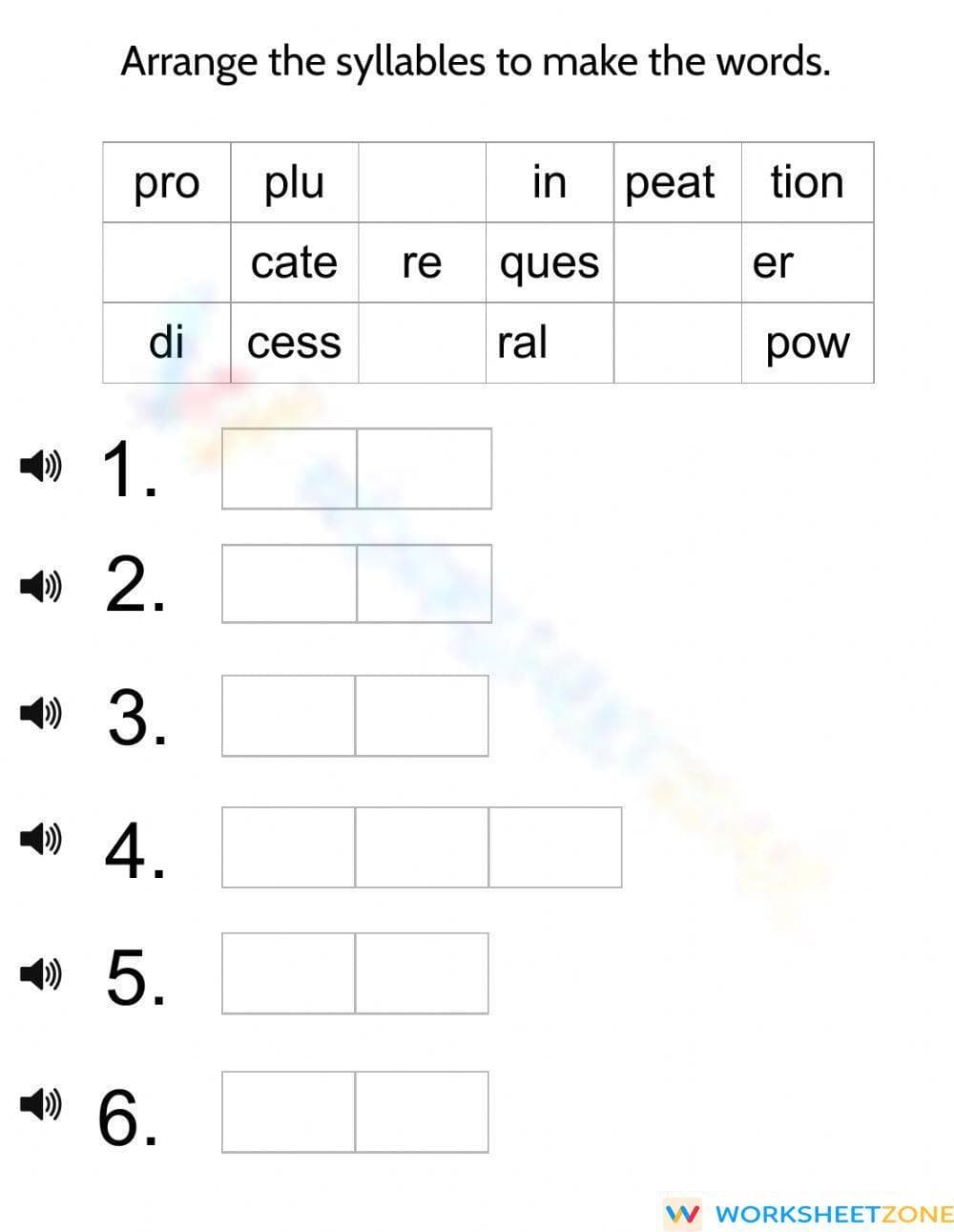

Printable Syllables Worksheet: Words 13-18 | Grade 4 Aligned
Paste this activity's link or code into your existing LMS (Google Classroom, Canvas, Teams, Schoology, Moodle, etc.).
Students can open and work on the activity right away, with no student login required.
You'll still be able to track student progress and results from your teacher account.
This Grade 4 syllable construction worksheet helps students master the art of decoding multisyllabic words by arranging mixed syllables into functional vocabulary. By identifying phonetic patterns and structural cues, learners bridge the gap between isolated sounds and complex word recognition. This targeted practice builds the reading fluency required for success in ELA.
At a Glance
- Grade: 4 · Subject: ELA
- Standard:
RF.4.3.A— Use syllabication patterns and morphology to read unfamiliar multisyllabic words accurately- Skill Focus: Multisyllabic word decoding
- Format: 1 page · 6 problems · Answer key included · PDF
- Best For: Independent literacy centers and phonics reinforcement
- Time: 10–15 minutes
This PDF resource features a syllable bank containing 13 units, including prefixes like "pro-" and "re-" and suffixes like "-tion." Students complete six tasks, using boxes that correspond to the syllables needed for words like "indicate" and "process." The worksheet is designed for quick printing, featuring clear icons and a clean layout that minimizes distraction during independent work.
The implementation for this worksheet is designed for teacher efficiency. First, print the single-page PDF (30 seconds). Second, distribute the sheets and model the first task to show how to select syllables from the top grid (1 minute). Finally, review the completed words as a class to verify pronunciation (5 minutes). Total teacher preparation time remains under two minutes, making it an ideal choice for emergency sub plans or warm-up activities.
Aligned with RF.4.3.A, this worksheet requires students to use letter-sound correspondences, syllabication patterns, and morphology to read unfamiliar multisyllabic words. By requiring students to arrange syllables into words like "repeat" and "power," the activity reinforces structural analysis skills necessary for complex text interaction. This standard code can be copied directly into lesson plans, IEP goals, or district curriculum mapping tools to track student progress throughout the academic year.
Deploy this during the "during instruction" phase of a phonics lesson for immediate application. It serves as a formative assessment tool; teachers should observe students during task 4 (the three-syllable "indicate") to see if they can manage increased complexity beyond two-syllable pairings. Expect completion within 10 to 15 minutes. For best results, have students read the completed words aloud to a partner to reinforce the connection between the written syllable structure and the spoken word.
This resource is intended for Grade 4 students, though it offers value for Grade 3 learners or older students requiring remedial support. It is particularly effective for English Language Learners who benefit from visual syllable boxes. Pair this with a multisyllabic word anchor chart or a short reading passage containing the target words to allow students to see the vocabulary used in a broader, meaningful academic or literary context.
According to the RAND AIRS 2024 report on foundational literacy, decomposing multisyllabic words is a critical indicator of reading comprehension success. This worksheet targets that skill by requiring students to utilize phonics-based decoding to reconstruct six essential vocabulary words. By focusing on syllabication patterns, the activity aligns with research from Fisher & Frey (2014) regarding the gradual release of responsibility in literacy. The inclusion of the RF.4.3.A standard ensures the practice remains rigorous and relevant to modern ELA curricula. This evidence-based approach helps students move beyond simple phonetic decoding toward sophisticated word recognition strategies required for reading complex informational texts. Focusing on morphological units like prefixes and suffixes reinforces the structural foundations of the English language, providing a scalable strategy for decoding thousands of unfamiliar words. This standalone summary reflects best practices in systematic, explicit phonics instruction for the upper elementary grades.


